Sitharaman to move Insolvency and Bankruptcy Code (Second Amendment) Bill, 2019 in Lok Sabha

News Network
March 6, 2020

New Delhi, Mar 6: Union Finance Minister Nirmala Sitharaman on Friday will move the Insolvency and Bankruptcy Code (Second Amendment) Bill, 2019 for consideration and passing in Lok Sabha.

In December last year, the Union Cabinet had approved a proposal to promulgate an ordinance to amend the Insolvency and Bankruptcy Code (IBC) 2016.

The amendments will remove certain ambiguities in the IBC 2016 and ensure smooth implementation of the code, an official statement said.

The move is aimed at easing the insolvency resolution process and promoting the ease of doing business. Aimed at streamlining of the insolvency resolution process, the amendments seek to protect last-mile funding and boost investment in financially-distressed sectors.

Under the amendments, the liability of a corporate debtor for an offence committed before the corporate insolvency resolution process will cease.

The debtor will not be prosecuted for an offence from the date the resolution plan has been approved by the adjudicating authority if a resolution plan results in change in the management or control of the corporate debtor to a person who was not a promoter or in the management or control of the corporate debtor or a related party of such a person.

The amendments are aimed at providing more protection to bidders participating in the recovery proceedings and in turn boosting investor confidence in the country's financial system.

Comments

Add new comment

  • Coastaldigest.com reserves the right to delete or block any comments.
  • Coastaldigset.com is not responsible for its readers’ comments.
  • Comments that are abusive, incendiary or irrelevant are strictly prohibited.
  • Please use a genuine email ID and provide your name to avoid reject.
News Network
July 12,2020

Hubli, Jul 12: Union Parliamentary Affairs Minister Pralhad Joshi on Sunday said that the Monsoon session of Parliament will be held with the government ensuring all health precautions for COVID-19 are followed.

"Monsoon session (of Parliament) will certainly be held. The government will do all the formalities and take all precautions," the Parliamentary Affairs Minister told reporters here.

Earlier in March, the Parliament had passed 12 bills during the curtailed budget session with Lok Sabha passing 15 bills and Rajya Sabha 13.
During the session, 19 bills were introduced in the two Houses (18 in Lok Sabha and 1 in Rajya Sabha). The two Houses were adjourned sine die after completion of the budgetary process including passage of the Finance Bill.

The second part of the session was curtailed in view of the threat of the spread of coronavirus.
On June 1, Rajya Sabha Chairman M Venkaiah Naidu and Lok Sabha Speaker Om Birla had held a detailed discussion on holding the ensuing monsoon session of Parliament in view of the coronavirus-induced norm of social distancing, sources said.

They said the leaders have taken note of reports suggesting that the fight against COVID-19 is likely to be a long haul.

Comments

Add new comment

  • Coastaldigest.com reserves the right to delete or block any comments.
  • Coastaldigset.com is not responsible for its readers’ comments.
  • Comments that are abusive, incendiary or irrelevant are strictly prohibited.
  • Please use a genuine email ID and provide your name to avoid reject.
News Network
January 9,2020

New Delhi, Jan 9: JNU students who tried to march towards the Rashtrapati Bhavan on Thursday protesting the violence on the university campus were stopped by police and later detained.

The police also resorted to baton charge to control the mob who tried to block the traffic at Janpath. Using loudspeakers, the police also appealed to the crowd to maintain peace.

Before the students tried to proceed towards the Rashtrapati Bhavan, a delegation of JNU Students' Union and JNU Teachers' Association also met Human Resource Development (HRD) Ministry officials and demanded the removal of Vice-Chancellor M Jagadesh Kumar from his post.

Comments

Add new comment

  • Coastaldigest.com reserves the right to delete or block any comments.
  • Coastaldigset.com is not responsible for its readers’ comments.
  • Comments that are abusive, incendiary or irrelevant are strictly prohibited.
  • Please use a genuine email ID and provide your name to avoid reject.
Agencies
August 3,2020

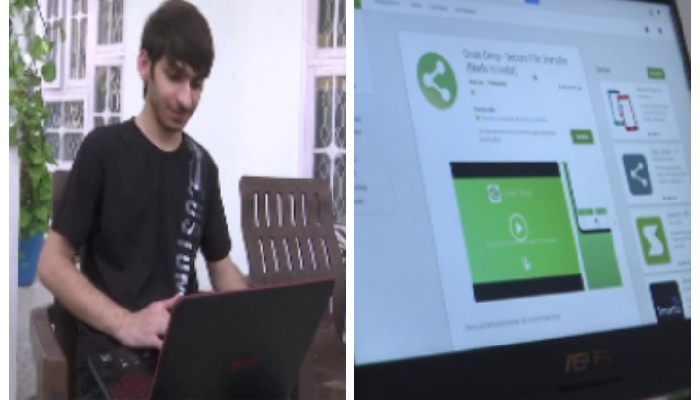
Rajouri, Aug 3: Ashfaq Mehmood Choudhary, a 17-year-old boy from Chattyear of Jammu and Kashmir's Rajouri district, has developed a file-sharing app 'Dodo Drop' which would enable users to share audios, videos, images, and texts between two devices without Internet access.

While speaking to media persons, Ashfaq Mehmood said that the 'Dodo Drop' application is an alternative to the Chinese 'SHAREit' app. "The Indian government has banned several Chinese apps due to data breaching, and among those apps was SHAREit which was used for sharing files.

Users faced a lot of problems due to the ban, and so I decided to make this file-sharing app. With 'Dodo Drop', users can share audios, videos, images, and even texts," he said.

Ashfaq said that it took him four weeks to develop the application, and it was launched on August 1 this year. The 'Dodo Drop' application has a transfer rate of up to 480 mbps, which is faster than the SHAREit app and is "quite easy" to use.

"Users can transfer data comprising photos, videos, audios, apps, texts, etc. between two devices with no Internet access. The transfers are fully encrypted and secure," he added.

"Our Prime Minister has always asserted the need for decreasing the dependency on foreign products and apps and to focus on the development of India-based apps. I tried to be part of the initiative of 'Aatmanirbhar Bharat' by developing an India-based file-sharing app. I want to develop global-standard apps for India," he added.

"We support and cooperate with him. He generates his own income by working on some projects and utilises it. We will continue to support him," said Parvez Ahmed Choudhary, Ashfaq's father.

In July, the Ministry of Electronics and Information Technology (MEITY) banned 47 apps, which were variants and cloned copies of the 59 apps banned earlier in June. These banned clones included SHAREit Lite, Tiktok Lite, Helo Lite, BIGO LIVE Lite, and VFY Lite.

The 59 apps had been banned by the Centre in June in view of the information available that they were engaged in activities which were "prejudicial to sovereignty and integrity and defence" of the country.

Almost all the apps banned had some preferential Chinese interest and the majority had parent Chinese companies.

The ban came amid border tensions with China in the Eastern Ladakh region.

Comments

Add new comment

  • Coastaldigest.com reserves the right to delete or block any comments.
  • Coastaldigset.com is not responsible for its readers’ comments.
  • Comments that are abusive, incendiary or irrelevant are strictly prohibited.
  • Please use a genuine email ID and provide your name to avoid reject.