



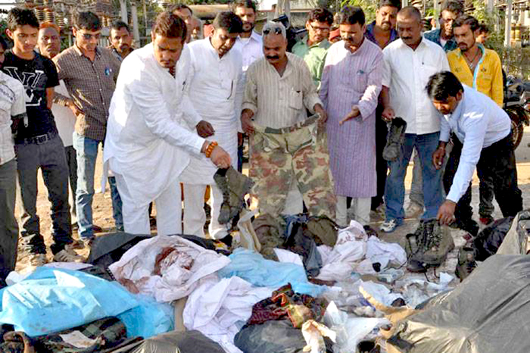
Slain CRPF jawans' blood-stained uniforms found in garbage bin

December 4, 2014

CRPF uniforms 1

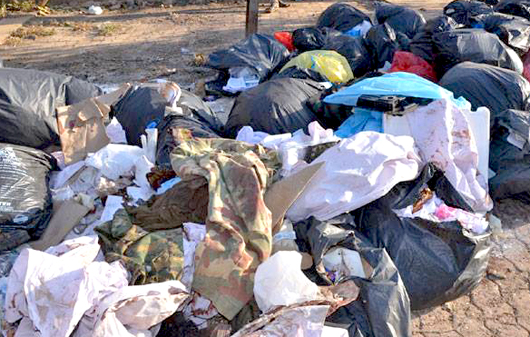
Raipur, Dec 4: Blood-stained uniforms and shoes of some of the CRPF personnel who were killed in the Sukma Naxal attack were today found in a garbage bin on the hospital premises, sparking outrage.

Opposition Congress leaders said it showed "insensitivity and disrespect" of the authorities and demanded an apology from the BJP government in the state.

District Congress chief Vikas Upadhyay and others visited Dr Bhimrao Ambedkar Memorial Hospital and took away the uniforms and other belongings of the jawans to the Congress office.

"We rushed there (to the hospital) after learning that the uniforms of the slain CRPF men were lying in a dustbin filled with garbage near the mortuary where their autopsies took place," Upadhyay said.

"We collected four sets of blood-stained uniforms and 10 pairs of shoes and carried those to Congress Bhawan. Later, CRPF officials came here and we handed over all the belongings to them," he added.

Fourteen CRPF personnel, including two officers, were killed on Monday in a Naxal attack in the Chintagufa region of South Bastar's Sukma district.

Bodies of the slain personnel were airlifted and sent to their families yesterday.

"Chhattisgarh government should apologise to the families of martyred jawans as well as to the country for this disrespect," said state Congress chief Bhupesh Baghel.

Baghel alleged that in 2009, bodies of four state police personnel who were killed in a Maoist attack in Dantewada district had been transported in a garbage truck.

"As per the procedure, police bring back the belongings (of a deceased) following post-mortem. After receiving the information that some uniforms and belongings were found left there, CRPF officials were asked to collect them," Additional Director General of Police (anti-Naxal operations), RK Vij said.

Deputy Inspector General (DIG), CRPF, Pradeep Chandra said a probe would be conducted in this regard.

Meanwhile, the dean of Ambedkar hospital, Vivek Chaudhary, said, "After a post-mortem is performed, the viscera and other remains are preserved and not kept openly. The video that I saw today (of the blood-stained uniforms left lying in the open) is very unfortunate."

CRPF uniforms 2

Comments

Add new comment

  • Coastaldigest.com reserves the right to delete or block any comments.
  • Coastaldigset.com is not responsible for its readers’ comments.
  • Comments that are abusive, incendiary or irrelevant are strictly prohibited.
  • Please use a genuine email ID and provide your name to avoid reject.
News Network
April 23,2020

Washington, Apr 23: Air pollution over northern India has plummeted to a 20-year-low for this time of the year, according to satellite data published by US space agency National Aeronautics and Space Administration (NASA).
The US space agency's satellite sensors observed aerosol levels at a 20-year low post the countrywide lockdown, implemented to slow the spread of the novel coronavirus.

"We knew we would see changes in atmospheric composition in many places during the lockdown," said Pawan Gupta, a Universities Space Research Association (USRA) scientist at NASA''s Marshall Space Flight Center. "But I have never seen aerosol values so low in the Indo-Gangetic Plain at this time of year," added Mr Gupta.

Acting Assistant Secretary of State for South and Central Asia Alice G Wells tweeted, "These images from NASA were taken each spring starting in 2016 and show a 20-year low in airborne particle levels over India. When India and the world are ready to work and travel again, let's not forget that collaborative action can result in cleaner air."

The data published with maps show aerosol optical depth (AOD) in 2020 compared to the average for 2016-2019. Aerosol optical depth is a measure of how light is absorbed or reflected by airborne particles as it travels through the atmosphere.

If aerosols are concentrated near the surface, an optical depth of 1 or above indicates very hazy conditions. An optical depth, or thickness, of less than 0.1 over the entire atmospheric vertical column is considered "clean." The data were retrieved by the Moderate Resolution Imaging Spectroradiometer (MODIS) on NASA's Terra satellite.

In the first few days of the lockdown, it was difficult to observe a change in the pollution signature. "We saw an aerosol decrease in the first week of the shutdown, but that was due to a combination of rain and the lockdown," said Mr Gupta.

Around March 27, heavy rain poured over vast areas of northern India and helped clear the air of aerosols. Aerosol concentrations usually increase again after such heavy precipitation.

"After the rainfall, I was really impressed that aerosol levels did not go up and return to normal. We saw a gradual decrease and things have been staying at the level we might expect without anthropogenic emissions," Mr Gupta said.

On March 25, the Indian government placed its 1.3 billion citizens under a strict lockdown to reduce the spread of COVID-19. The countrywide mandate decreased activity at factories and severely reduced car, bus, truck and airplane traffic. Every year, aerosols from anthropogenic (human-made) sources contribute to unhealthy levels of air pollution in many Indian cities.

Aerosols are tiny solid and liquid particles suspended in the air that reduce visibility and can damage the human lungs and heart.

In southern India though, the story is a little hazier. Satellite data show aerosol levels have not yet decreased to the same extent. In fact, levels seem to be slightly higher than in the past four years. The reasons are unclear but could be related to recent weather patterns, agricultural fires, winds or other factors.

"This a model scientific experiment," Robert Levy, program leader for NASA's MODIS aerosol products, said about the lockdown and its effects on pollution.

"We have a unique opportunity to learn how the atmosphere reacts to sharp and sudden reductions in emissions from certain sectors. This can help us separate how natural and human sources of aerosols affect the atmosphere," Mr Levy added.

Comments

Add new comment

  • Coastaldigest.com reserves the right to delete or block any comments.
  • Coastaldigset.com is not responsible for its readers’ comments.
  • Comments that are abusive, incendiary or irrelevant are strictly prohibited.
  • Please use a genuine email ID and provide your name to avoid reject.
News Network
July 1,2020

Bengaluru, Jul 1: A day after the Government banned several Chinese apps, popular short-form video app Mitron reported that its daily traffic jumped up by more than 11 times.

Just 5 days after crossing the 10 million (1 crore) downloads milestone, Mitron has now announced that the app has been downloaded by 17 million (1.7 crore) users in India. Mitron app has been one of the most downloaded apps in India during the last two months.

"It is incredibly exciting to see the rapid adoption of Mitron by Indian users. 11-fold jump in traffic, immediately after the ban of Chinese apps, was beyond our expectations," said Shivank Agarwal, Founder, and CEO, Mitron.

Anish Khandelwal, Founder and CTO said, " We have built a solid backend infrastructure and our platform is now completely scalable and autonomous and that is helping us to cater to the sharp rise in traffic on Mitron App."

Mitron has been rapidly enhancing the product with several improvements for the users including an updated video upload process that is much easier, enhanced audio library with a wide choice of Indian content, and a feature that enables users to flag any inappropriate content easily.

Users uploaded millions of videos in 10 different languages and the number of videos viewed on the platform increased sharply to cross 30 million video views per hour.

Shivank added "We are a young company and we are hiring some of the best product & engineering talent to scale up Mitron rapidly. We are confident that we can build Mitron into one of the best apps in the short-form video space. Our focus is on building features and content that uniquely resonates with Indian users, while being sensitive to community standards and local laws in India and we believe that will help us build Mitron into a very large business."

Founded by two Computer Science engineers, Shivank Agarwal (alumnus of IIT Roorkee) and Anish Khandelwal (alumnus of Visvesvaraya National Institute of Technology), Mitron app is a short-form video app that allows users to create, upload and view entertaining short videos.

Comments

Add new comment

  • Coastaldigest.com reserves the right to delete or block any comments.
  • Coastaldigset.com is not responsible for its readers’ comments.
  • Comments that are abusive, incendiary or irrelevant are strictly prohibited.
  • Please use a genuine email ID and provide your name to avoid reject.
News Network
May 11,2020

New Delhi, May 11: Prime Minister Narendra Modi on Monday chaired a fresh round of consultation with chief ministers on ways to strengthen the COVID-19 containment strategy and stepping up of economic activities in a calibrated manner as the 54-day nationwide lockdown nears an end.

Large-scale movement of migrant workers from urban to rural India and the problems their return to home states may cause in restarting the economy will also be among the focus areas during the fifth virtual interaction between the prime minister and chief ministers since the outbreak of the deadly virus in the country.

There will be an effort to ensure that all participating chief ministers get an opportunity to air their views during the interaction, as some of the CMs had complaint that they were not allowed to put forth their views during the last interaction on April 27.

At a meeting on Sunday with Cabinet Secretary Rajiv Gauba, state chief secretaries told him that "while protection is required from COVID-19, economic activities also need to be stepped up in a calibrated manner", according to an official statement.       

With thousands of migrant workers taking special trains to go back to their home states, the restarting of industrial activities will prove to be a challenge for states though several relaxations have been made in labour laws to increase factory output.    

The meet is also likely to discuss efforts to convert 'red' zones with high COVID-19 case load into 'orange' or 'green' zones.       The prime minister interacted with the chief ministers last on April 27. Days after the meeting, the central government had extended the lockdown by two more weeks till May 17 to arrest the spread of the virus, but gave several relaxations in economic activities and movement of people.

The nationwide lockdown has been in force since March 25 to contain the spread of the virus, which has killed more than 2200 people, and afflicted more than 67,000 in the country.

Comments

Add new comment

  • Coastaldigest.com reserves the right to delete or block any comments.
  • Coastaldigset.com is not responsible for its readers’ comments.
  • Comments that are abusive, incendiary or irrelevant are strictly prohibited.
  • Please use a genuine email ID and provide your name to avoid reject.