Sonia Gandhi: Saviour-in-chief of Congress in dark times

Agencies
August 11, 2019

New Delhi, Aug 11: Having earned the distinction of being the longest-serving Congress president, Sonia Gandhi is once again at the helm to steer her party out of troubled waters.

Sonia Gandhi, 72, has been made interim president barely 20 months after she voluntarily relinquished the top post in favour of son Rahul Gandhi who refused to continue on as Congress chief after a humiliating 2019 general election defeat.

For the Congress Working Committee (CWC) the natural choice was Sonia Gandhi, who has been the party's saviour-in-chief in times of crisis and a binding force.

Critics say the development has once again highlighted how the Congress is unable to look beyond the Gandhi family when it comes to leadership. With no timeline set for party elections, Sonia is likely to continue in the top post in coming months.

In her 19-year stint as Congress chief, Sonia Gandhi was hailed for deft handling of party intrigues and judgment that gave the party two consecutive wins at the Centre and several in states.

In her decision to accept the CWC's unanimous request to lead the 134-year-old party, Sonia Gandhi has displayed courage given her continuing frail health, sources said.

Once considered an unlikely heir to the grand political legacy of the Gandhi family, Sonia went on to create history as the longest-serving president from 1998 to 2017.

In her political innings defined by a successful coalition experiment in the form of UPA, Sonia Gandhi has always credited mother-in-law and former prime minister Indira Gandhi for her achievements.

Bringing disparate political groupings together on one platform in a pre-poll coalition to stump the BJP out of power in 2004, was one of her biggest successes.

Though the UPA floundered in its second innings starting 2009, Sonia Gandhi helmed the coalition from the shadows, often inviting the criticism of running a cabinet parallel to that of former prime minister Manmohan Singh who led the Congress-led alliance government.

Sonia Gandhi lost no time to resign from the Lok Sabha when the office of profit controversy gripped her over her role as chairperson of the National Advisory Council during UPA-1. She returned to the Lok Sabha with a higher margin in a re-election.

But in the 2019 general elections, Sonia Gandhi's victory margin in her traditional Rae Bareli seat plummeted to 1 lakh, like never before, signalling changing contours of politics under an aggressive BJP.

Gradual decline in Congress electoral fortunes under Rahul Gandhi, desertions from Congress to BJP, deepening division in opposition ranks and a surging BJP were some factors that seemed to have weighed on Sonia Gandhi's mind when she accepted the CWC suggestion on Saturday.

Her return coincides with a critical election season with polls in Haryana, Jharkhand and Maharashtra due later this year. Her first challenge would be to fight the BJP in these states having seen Congress getting reduced to just four states under her son.

After Congress' lacklustre performance in the first session of the new Parliament, party leaders hope Sonia Gandhi's leadership will reinvigorate the cadre and bind the ranks that have reeled in a leadership vacuum after Rahul Gandhi resigned as party president on May 25.

It is also felt Sonia Gandhi's return will give reason for a divided opposition to come together to fight the BJP.

This is exactly how things unfolded starting 1998 after she took charge as Congress chief. The party was then in tatters at the Centre and in power in only four states. She assumed charge, united the opposition and bound the party which had seen record desertions under past chief Sitaram Kesri.

As Sonia begins her fresh innings, her toughest so far, she is bound to find herself in familiar territory – a demoralised and desertion-hit Congress, a disunited opposition and a surging BJP.

Congress leaders, however, feel she has all it takes to hit back, silence and dignity being her most lethal weapons.

The BJP, on the other hand, may again rake her foreign origins, a touchy subject for Sonia Gandhi, who lost colleagues like Sharad Pawar on this count. But over the years even Pawar has made peace with her.

Though the NCP has denied talks of a merger with Congress, the grand old party might urge all its former members to return.

It remains to be seen how Sonia Gandhi reconciles with the new political landscape where the BJP has almost made coalition politics redundant.

Having picked up Hindi, a language alien to her, and having won many hearts, she will again be counted upon to deliver big.

Born to Italian parents in Lusiana, Vicenza (Italy), on December 9, 1946, Sonia met late PM Rajiv Gandhi in England where she was studying. The two got married in 1968.

Contemporary history recalls how she cradled Indira Gandhi's body after she was gunned down by her bodyguards, and tried to persuade her husband, who was assassinated in 1991, not to take up the PM's post.

Sonia Gandhi took primary membership of Congress in 1997 and became its president in 1998. She was first elected to Lok Sabha from Amethi in 1999.

In 2004, she shifted to Rae Bareli to accommodate son Rahul in Amethi. The same year she steered the party's electoral campaign and led it to victory.

Sonia Gandhi went on to decline prime ministership nominating Manmohan Singh for the post, a move many read as a political masterstroke. Behind the scenes, she remained the supreme Congress leader as UPA chairperson. 

Comments

Add new comment

  • Coastaldigest.com reserves the right to delete or block any comments.
  • Coastaldigset.com is not responsible for its readers’ comments.
  • Comments that are abusive, incendiary or irrelevant are strictly prohibited.
  • Please use a genuine email ID and provide your name to avoid reject.
News Network
June 3,2020

Mumbai, Jun 3: With an expected increase in wind conditions up to 120 kilometres, cyclone Nisarga is likely to make landfall on the north coast of Maharashtra later today, as per the Indian Meteorological Department (IMD) on Wednesday.

"Wind conditions will further increase up to 100-110 gusting to 120 kmph as conditions are favourable for intensification. The higher sea surface temperature and low vertical wind shear favoured the intensification of severe cyclonic circulation," said IMD in a series of tweets.

Explaining the nature of wind speed, IMD further tweeted, "Eye diameter is about 65 km as observed through Radar. thus the diameter has decreased during past 01 hours indicating intensification of the system. hence wind speed has increased from 85-95 kmph to 90-100 kmph gusting to 110 kmph."

Several National Disaster Response Force (NDRF) teams have been deployed across Maharashtra to ensure preparedness for the impending cyclone. A total of eight teams have been deployed in Mumbai, five teams in Raigad, two teams in Palghar, Thane, and Ratnagiri and one team in Sindhudurg, said NDRF.

Besides, five NDRF teams were airlifted by IL-76 from Vijaywada for Mumbai on June 2, as per the Indian Air Force (IAF)

"Around 60 per cent of people, from the coastal areas around this area, have gone to their relatives' places. The remaining ones have been sent to the evacuation centre. We have also taken into account the COVID-19 guidelines and ensured social distancing," NDRF officer Shiv Parada Rao, deployed with his team in the Dahanu area, spoke to ANI.

"From the information we have received cyclone Nisarga is likely to hit here by tonight. The exact time is not confirmed yet. We are taking all preparedness measures to tackle the situation," he added.

NDRF teams also conducted evacuation in Alibaug during the early hours on Wednesday morning, as per NDRF Director General SN Pradhan.

As per the 5 am bulletin released by IMD, cyclone Nisarga was heading towards north Maharashtra coast at a speed of 11 kmph. It was about 200 km South -SouthWest of Alibag and about 250 km south-southwest of Mumbai at 2.30 AM today, stated the bulletin.

Comments

Add new comment

  • Coastaldigest.com reserves the right to delete or block any comments.
  • Coastaldigset.com is not responsible for its readers’ comments.
  • Comments that are abusive, incendiary or irrelevant are strictly prohibited.
  • Please use a genuine email ID and provide your name to avoid reject.
News Network
March 5,2020

Washington, Feb 5: Experts warned a US government panel last night that India's Muslims face risks of expulsion and persecution under the country’s new Citizenship Amendment Act (CAA) which has triggered major protests.

The hearing held inside Congress was called by the US Commission on International Freedom, which has been denounced by the Indian government as biased.

Ashutosh Varshney, a prominent scholar of sectarian violence in India, told the panel that the law championed by prime minister Narendra Modi's government amounted to a move to narrow the democracy's historically inclusive and secular definition of citizenship.

"The threat is serious, and the implications quite horrendous," said Varshney, a professor at Brown University.

"Something deeply injurious to the Muslim minority can happen once their citizenship rights are taken away," he said.

Varshney warned that the law could ultimately lead to expulsion or detention -- but, even if not, contributes to marginalization.

"It creates an enabling atmosphere for violence once you say that a particular community is not fully Indian or its Indianness in grave doubt," he said.

India's parliament in December passed a law that fast-tracks citizenship for persecuted non-Muslim minorities from neighboring countries.

Responding to criticism at the time from the US commission, which advises but does not set policy, India's External Affairs Ministry said the law does not strip anyone's citizenship and "should be welcomed, not criticized, by those who are genuinely committed to religious freedom."

Fears are particularly acute in Assam, where a citizens' register finalized last year left 1.9 million people, many of them Muslims, facing possible statelessness.

Aman Wadud, a human rights lawyer from Assam who traveled to Washington for the hearing, said that many Indians lacked birth certificates or other documentation to prove citizenship and were only seeking "a dignified life."

The hearing did not exclusively focus on India, with commissioners and witnesses voicing grave concern over Myanmar's refusal to grant citizenship to the Rohingya, the mostly Muslim minority that has faced widespread violence.

Gayle Manchin, the vice chair of the commission, also voiced concern over Bahrain's stripping of citizenship from activists of the Shiite majority as well as a new digital ID system in Kenya that she said risks excluding minorities.

More than 40 people were killed last week in New Delhi in sectarian violence sparked by the citizenship law.

India on Tuesday lodged another protest after the UN human rights chief, Michele Bachelet, sought to join a lawsuit in India that challenges the citizenship law's constitutionality.

Comments

Add new comment

  • Coastaldigest.com reserves the right to delete or block any comments.
  • Coastaldigset.com is not responsible for its readers’ comments.
  • Comments that are abusive, incendiary or irrelevant are strictly prohibited.
  • Please use a genuine email ID and provide your name to avoid reject.
coastaldigest.com news network
August 8,2020

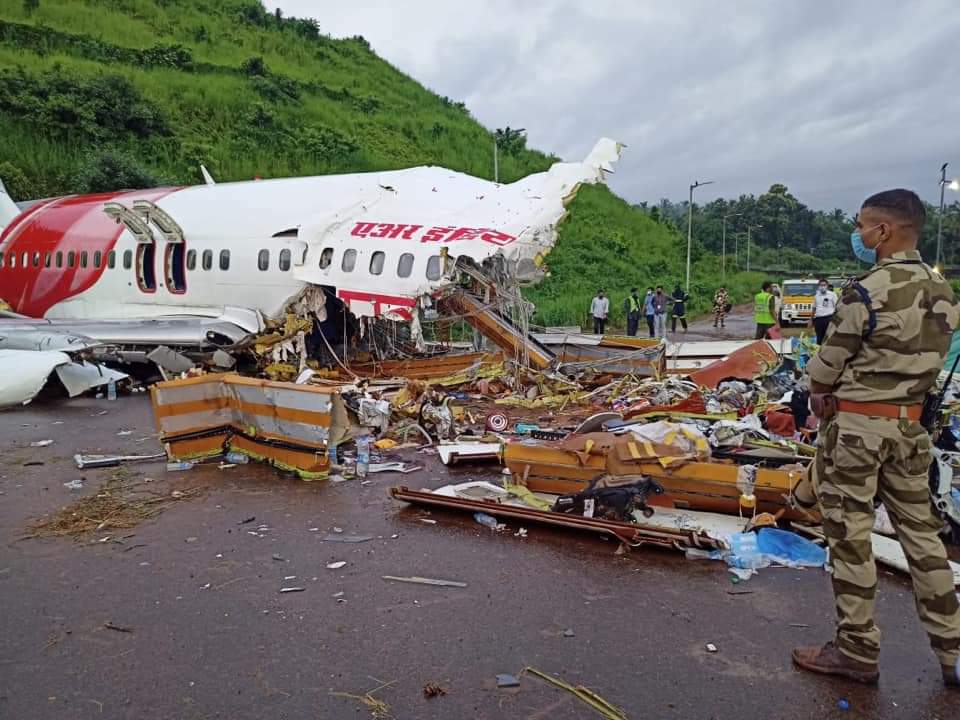
Kozhikode, Aug 8: A tailwind or crosswind could be the reason for the Air India Express flight mishap at Kozhikode international airport in Kerala, according to some aviation experts. 

Team of DGCA and AIE already reached the spot. With the death of the captain and co-pilot in the mishap, the investigation would be focusing mainly on the voice recorders and other technical aspects.

It is learnt that the ill-fated aircraft, IX 1344 with 190 onboard including crew, was initially planning to land on runway-28 of the airport. But later the pilot opted runway-10 which is toward the other direction. Pilots would be taking the decisions on the basis of inputs from ATC.

The questions now doing the rounds are what made the pilot opt runway-10 and whether the tabletop runway lacked adequate safety parameters.

An aviation expert, who didn't want to be quoted, said that Capt Deepak Sathe, who was commandeering the aircraft, was a well-experienced pilot and was also familiar with the terrains. Hence the chances of any error from his part was very unlikely. Hence a fair in-depth probe was required to find the exact cause.

Though the Kozhikode airport has an Instrument Landing System, it was of category-I for which pilot's visibility is very crucial toward a touchdown. Since it is a tabletop airport and rough weather prevailing in the region, the chances of tailwind was also high, said sources.

There had been safety concerns about the airport over quite some time. In 2011 aviation safety consultant captain Mohan Ranganathan reportedly gave a report citing the safety issues, especially the buffer zones at the end of the runway.

However, an AAI officer said that rectification steps were already done by last year by widening the Runway End Safety Area (RESA) from 90 metre to 240 metre. However, the length of the runway had to be reduced to 2,700 metre from 2,850. The AAI was also constantly pressing for increasing the runway length to 3,150 metres. But that was getting delayed due to land acquisition issues pending with the state government.

stm88 info live rtp slot

slot auto scatter hitam

Comments

Add new comment

  • Coastaldigest.com reserves the right to delete or block any comments.
  • Coastaldigset.com is not responsible for its readers’ comments.
  • Comments that are abusive, incendiary or irrelevant are strictly prohibited.
  • Please use a genuine email ID and provide your name to avoid reject.