South Africa orders removal of rabbit from Mandela statue's ear

January 23, 2014

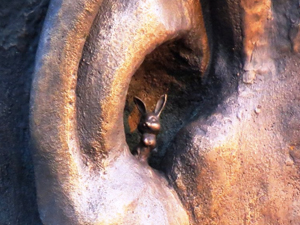
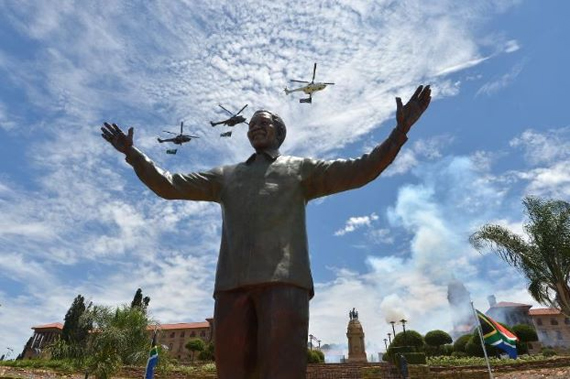
South_AfricaJohannesburg, Jan 22: The South African government has ordered the removal of a rabbit that was secretly sculpted into a recently unveiled statue of Nelson Mandela, an official said today.

The artists who built the nine metre (30-foot), bronze colossus in Pretoria, added a rabbit into the ear of the statue, without clearance from government.

"We want to restore the integrity of the sculpture as soon as possible," Mogomotsi Mogodiri, spokesman for the ministry of arts and culture said.

The government said it was unaware of the rabbit's existence until a local newspaper brought it to their attention.

The two bronze sculptors -- Andre Prinsloo and Ruhan Janse van Vuuren -- who added the mammal as their 'signature' of the work, have apologised for doing so without permission.

"We accepted their apology," Mogodiri said, adding it was unclear how long it would take to extract the rabbit from the statue's ear.

The boss of the company that was contracted by government to erect the statue, which in turn hired the two artists, said the artists' action was "regrettable" and akin to a "senseless prank".

Dali Tambo, chairman of Koketso Growth said it had from the beginning been decided against engraving the statue.

But the names of the artists were going to be installed at a plaque near the statue.

"It is regrettable that the artists chose this way of expressing their opinion about not signing the sculpture," said Tambo, who is also the son of one of the leading anti-apartheid politicians, Oliver Tambo.

Built at a cost of eight million rand (about $740,000), the 4.5-tonne sculpture is the largest of Mandela statues erected around the world.

It was unveiled just a day after Mandela was buried.

Mandela, who became South Africa's first black president after 27 years in apartheid prisons, died on December 5, 2013 at the age of 95.

Mandela_statues_ear

Comments

Add new comment

  • Coastaldigest.com reserves the right to delete or block any comments.
  • Coastaldigset.com is not responsible for its readers’ comments.
  • Comments that are abusive, incendiary or irrelevant are strictly prohibited.
  • Please use a genuine email ID and provide your name to avoid reject.
Agencies
June 9,2020

Soon, you may be able to withdraw cash from an ATM without touching any part of the machine. AGS Transact Technologies, a provider of cash and digital payment solutions and automation technology, on Monday said it has successfully developed and tested a touchless ATM solution in light of the COVID-19 pandemic.

The ‘contactless' solution, currently under demo at interested banks, enables a customer to perform all the steps required to withdraw cash from an ATM using the mobile app itself. 

The customer simply has to scan the QR code displayed on the ATM screen and follow the directions on their respective bank's mobile application. 

This includes entering the amount and mPIN required to dispense the cash from the ATM machine. 

According to the company, the QR code feature makes cash withdrawals quicker and more secure, and negates the chances of compromising the ATM Pin or card skimming.

"The new Touchless ATM solution is an extension of the flagship QR Cash solution which ensures safety of the users and will provide a seamless cash withdrawal experience with enhanced security," said Ravi B. Goyal, Chairman and MD, AGS Transact Technologies Ltd.

With minimum investment, the banks can enable this solution for their ATM networks by upgrading the existing software.

AGSTTL has so far installed, maintained and managed a network of over 72,000 ATMs across the country and also provides customised solutions to leading banks. 

The company earlier introduced UPI-QR based Cash withdrawal solution in partnership with Bank of India. 

This is how the solution works.

Open the Bank mobile application on your smartphone and select QR Cash Withdrawal. Enter the amount you wish to withdraw on the mobile app and scan the QR code on the ATM screen.

Next, confirm the amount by clicking on ‘proceed' in the app and enter the mPin to authenticate the transaction. Now collect the cash and receipt and you are done.

"The seamless, cardless and touchless withdrawal method is designed to provide easy transaction flow, without the need to touch the ATM screen or enter the pin," said Mahesh Patel, President and Group Chief Technology Officer, AGS Transact Technologies.

Comments

Add new comment

  • Coastaldigest.com reserves the right to delete or block any comments.
  • Coastaldigset.com is not responsible for its readers’ comments.
  • Comments that are abusive, incendiary or irrelevant are strictly prohibited.
  • Please use a genuine email ID and provide your name to avoid reject.
News Network
April 28,2020

Los Angeles, Apr 28: People who experience loss of smell as one of the COVID-19 symptoms are likely to have a mild to moderate clinical course of the disease, according to a study which may help health care providers determine which patients require hospitalisation.

The findings, published in the journal International Forum of Allergy & Rhinology, follows an earlier study that validated the loss of smell and taste as indicators of infection with the novel coronavirus, SARS-CoV-2.

According to the scientists from the University of California (UC) San Diego Health in the US, patients who reported loss of smell were 10 times less likely to be hospitalised for COVID-19 compared to those without the symptom.

"One of the immediate challenges for health care providers is to determine how to best treat persons infected by the novel coronavirus," said Carol Yan, first author of the current study and rhinologist from the UC San Diego Health.

"If they display no or mild symptoms, can they return home to self-quarantine or will they likely require hospitalisation? These are crucial questions for hospitals trying to efficiently and effectively allocate finite medical resources," Yan said.

The findings, according to the researchers, suggest that loss of smell may be predictive of a milder clinical course of COVID-19.

"What's notable in the new findings is that it appears that loss of smell may be a predictor that a SARS-CoV-2 infection will not be as severe, and less likely to require hospitalisation," Yan said.

"If an infected person loses that sense, it seems more likely they will experience milder symptoms, barring other underlying risk factors," she added.

Risk factors for COVID-19 previously reported by other studies include age, and underlying medical conditions, such as chronic lung disease, serious heart conditions, diabetes, and obesity.

In the current study, the scientists made a retrospective analysis between March 3 and April 8 including 169 patients who tested positive for COVID-19 at UC San Diego Health.

They assessed olfactory and gustatory data for 128 of the 169 patients, 26 of whom required hospitalisation.

According to the researchers, patients who were hospitalised for COVID-19 treatment were significantly less likely to report anosmia or loss of smell -- 26.9 per cent compared to 66.7 per cent for COVID-19-infected persons treated as outpatients.

Similar percentages were found for loss of taste, known as dysgeusia, they said.

"Patients who reported loss of smell were 10 times less likely to be admitted for COVID-19 compared to those without loss of smell," said study co-author Adam S. DeConde.

"Moreover, anosmia was not associated with any other measures typically related to the decision to admit, suggesting that it's truly an independent factor and may serve as a marker for milder manifestations of Covid-19," DeConde said.

The researchers suspect that the findings hint at some of the physiological characteristics of the infection.

"The site and dosage of the initial viral burden, along with the effectiveness of the host immune response, are all potentially important variables in determining the spread of the virus within a person and, ultimately, the clinical course of the infection," DeConde said.

If the SARS-CoV-2 virus initially concentrates in the nose and upper airway, where it impacts olfactory function, that may result in an infection that is less severe and sudden in onset, decreasing the risk of overwhelming the host immune response, respiratory failure, and hospitalisation, the scientists added.

"This is a hypothesis, but it's also similar to the concept underlying live vaccinations," DeConde explained.

"At low dosage and at a distant site of inoculation, the host can generate an immune response without severe infection," he added.

Loss of smell, according to the study, might also indicate a robust immune response which has been localised to the nasal passages, limiting effects elsewhere in the body.

Citing the limitations of the study, the scientists said they relied upon self-reporting of anosmia from participants, which posed a greater chance of recall bias among patients once they had been diagnosed with COVID-19.

They added that patients with more severe respiratory disease requiring hospitalisation may not be as likely to recognise or recall the loss of smell.

So the researchers said more expansive studies are needed for validating the results.

Comments

Add new comment

  • Coastaldigest.com reserves the right to delete or block any comments.
  • Coastaldigset.com is not responsible for its readers’ comments.
  • Comments that are abusive, incendiary or irrelevant are strictly prohibited.
  • Please use a genuine email ID and provide your name to avoid reject.
Agencies
January 4,2020

Washington D.C: One of the greatest spectacles of modern art is still thriving in the Australian outback as confirmed by satellite imagery of NASA. The Marree Man is a massive geoglyph depicting an aboriginal hunter, that spans over 2.6 miles in the Southern Australian region.

Discovered by a pilot in 1998, its origin still remains a mystery even to this date.

The Marree Man was given a new lease of life in 2016 when a group of people from the neighboring town of Marree plowed its lines to avert its fading due to erosion.

After NASA shared the image of the art-work that was taken in June, the efforts of the good samaritans turned out to be a total success, reported CNN Travel.

The restoration team believes that the refurbished Marree Man would last longer than its original version.

According to NASA, "They [the team] created wind grooves, designed to trap water and encourage the growth of vegetation. They hope that eventually, the man will turn green."

In a previous article, CNN reported that an entrepreneur by the name of Dick Smith took upon himself to unravel the geoglyph's mystery in 2016. His team combed through all the available evidence but couldn't find anything conclusive.

In 2018 he even offered a 5,000 Australian dollar reward for anyone who knows the identity of its creator.

Nobody turned up with an answer but it was speculated that unknown artist lives in Alice Springs or even might be an American.

Comments

Add new comment

  • Coastaldigest.com reserves the right to delete or block any comments.
  • Coastaldigset.com is not responsible for its readers’ comments.
  • Comments that are abusive, incendiary or irrelevant are strictly prohibited.
  • Please use a genuine email ID and provide your name to avoid reject.