


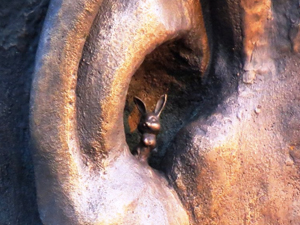
South Africa orders removal of rabbit from Mandela statue's ear

January 23, 2014

South_AfricaJohannesburg, Jan 22: The South African government has ordered the removal of a rabbit that was secretly sculpted into a recently unveiled statue of Nelson Mandela, an official said today.

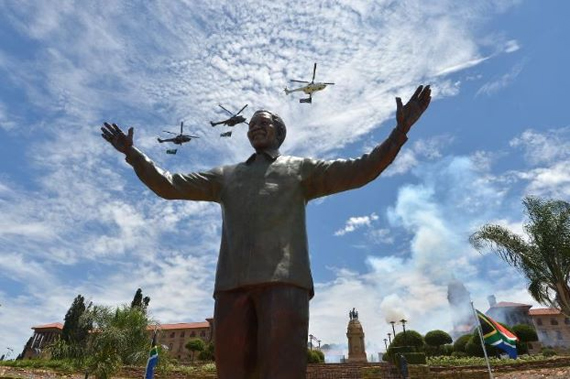
The artists who built the nine metre (30-foot), bronze colossus in Pretoria, added a rabbit into the ear of the statue, without clearance from government.

"We want to restore the integrity of the sculpture as soon as possible," Mogomotsi Mogodiri, spokesman for the ministry of arts and culture said.

The government said it was unaware of the rabbit's existence until a local newspaper brought it to their attention.

The two bronze sculptors -- Andre Prinsloo and Ruhan Janse van Vuuren -- who added the mammal as their 'signature' of the work, have apologised for doing so without permission.

"We accepted their apology," Mogodiri said, adding it was unclear how long it would take to extract the rabbit from the statue's ear.

The boss of the company that was contracted by government to erect the statue, which in turn hired the two artists, said the artists' action was "regrettable" and akin to a "senseless prank".

Dali Tambo, chairman of Koketso Growth said it had from the beginning been decided against engraving the statue.

But the names of the artists were going to be installed at a plaque near the statue.

"It is regrettable that the artists chose this way of expressing their opinion about not signing the sculpture," said Tambo, who is also the son of one of the leading anti-apartheid politicians, Oliver Tambo.

Built at a cost of eight million rand (about $740,000), the 4.5-tonne sculpture is the largest of Mandela statues erected around the world.

It was unveiled just a day after Mandela was buried.

Mandela, who became South Africa's first black president after 27 years in apartheid prisons, died on December 5, 2013 at the age of 95.

Mandela_statues_ear

Comments

Add new comment

  • Coastaldigest.com reserves the right to delete or block any comments.
  • Coastaldigset.com is not responsible for its readers’ comments.
  • Comments that are abusive, incendiary or irrelevant are strictly prohibited.
  • Please use a genuine email ID and provide your name to avoid reject.
Agencies
January 26,2020

New Delhi, Jan 26: Google on Sunday marked India's 71st Republic Day by dedicating a doodle illustrating the country's rich cultural heritage that permeates and unites the diverse nation.

From its world-famous landmarks like the Taj Mahal and India Gate, to the wide array of fauna such as its national bird (the Indian peafowl), to classical arts, textiles, and dances, the doodle, designed by Singapore-based artist Meroo Seth, brings together the rich cultural heritage of the country.

Republic Day marks the completion of India's transition towards becoming an independent republic after its constitution came into effect. The governing document had taken nearly three years of careful deliberation to finalise, and its eventual enactment was joyfully celebrated across the country.

While the Constitution was adopted by the Indian Constituent Assembly on 26 November 1949, it came into effect on January 26 -- a day when Declaration of Indian Independence (Purna Swaraj) was proclaimed by the Indian National Congress back in 1929, as opposed to the Dominion status offered by the British Regime.

Festivities embody the essence of diversity found in one of the world's most populous nations, celebrated over a three-day period with cultural events displaying national pride.

Last year's doodle on Republic Day, designed by artist Reshidev RK, had featured Rashtrapati Bhavan in the background along with a display of the country's iconic monuments and heritage.

Comments

Add new comment

  • Coastaldigest.com reserves the right to delete or block any comments.
  • Coastaldigset.com is not responsible for its readers’ comments.
  • Comments that are abusive, incendiary or irrelevant are strictly prohibited.
  • Please use a genuine email ID and provide your name to avoid reject.
Agencies
July 4,2020

Twitter has joined efforts to do away with racially loaded terms such as master, slave and blacklist from its coding language in the wake of the death of African-American George Floyd and ensuing Black Lives Matter protests.

The project started even before the current movement for racial justice escalated following the death of 46-year-old George Floyd in police custody in May.

The use of terms such as "master" and "slave" in programming language originated decades ago. While "master" is used to refer to the primary version of a code, "slave" refers to the replicas. Similarly, the term "Blacklist" is used to refer to items which are meant to be automatically denied.

The efforts to change these terms in favour of more inclusive language at Twitter were initiated by Regynald Augustin and Kevin Oliver and the microblogging platform is now backing their efforts.

"Inclusive language plays a critical role in fostering an environment where everyone belongs. At Twitter, the language we have been using in our code does not reflect our values as a company or represent the people we serve. We want to change that. #WordsMatter," Twitter's engineering team said in a post on Thursday.

As per the recommendations from the team, the term "whitelist" could be replaced by "allowlist" and "blacklist" by "denylist".

Similarly, "master/slave" could be replaced by "leader/follower", "primary/replica" or "primary/standby".

Twitter, however, is not the first to start a project to bring inclusivity in programming language.

According to a report in CNET, the team behind the Drupal online publishing software started using "primary/replica" in place of "master/slave" as early as in 2014.

The use of the terms "master/slave" was also dropped by developers of the Python programming language in 2018.

Now similar efforts are underway at Microsoft's Github and LinkedIn divisions as well, said the report.

Comments

Add new comment

  • Coastaldigest.com reserves the right to delete or block any comments.
  • Coastaldigset.com is not responsible for its readers’ comments.
  • Comments that are abusive, incendiary or irrelevant are strictly prohibited.
  • Please use a genuine email ID and provide your name to avoid reject.
Agencies
January 16,2020

Claiming that e-commerce giants like Amazon import as much as 80 per cent of the items sold on their platforms, small manufacturers' body has said that their business models do not benefit local industry and are creating jobs of delivery boys only.

"Neither manufacturers nor traders are getting any benefit from the business models of Amazon and Flipkart because they largely import their products from China and Korea and sell here. Nearly 80 per cent of their products are imported," said Anil Bhardwaj, Secretary General, Federation of Indian Micro and Small & Medium Enterprises (FISME).

Bhardwaj said that the global e-commerce players generally source and sell products through their own preferred suppliers and as a result a large number of local manufacturers and traders get crowded out.

He listed out deep discounting and buying products from preferred companies as unfair practices.

"Even if they buy products from local suppliers the commission charged is very high," Bhardwaj said adding that the issues related to unfair practices have been raised with Commerce Ministry on multiple occasions.

FISME maintains that the technology-driven retail is way forward and one cannot be oblivious of the benefits it brings to consumers but at the same time the local industry can also not be ignored given its role in job creation.

"If both traders and local manufacturers are crowded out then how would the local industry survive and employment be generated?" asked Bhardwaj.

As Amazon Founder and CEO Jeff Bezos is currently on his three-day visit to India, the local traders are up in arms against the "unfair" trade practices of the tech giant. Delhi-based Confederation of All India Traders (CAIT) has launched a countrywide protest against the company and has organised protests across 300 cities.

In a setback to Amazon and Walmart-backed Flipkart, the fair market watchdog Competition Commission of India (CCI) has ordered probe into the business operations of both the companies on multiple counts including deep-discounts and exclusive tie-up with preferred sellers.

"For the first time some concrete step has been taken against Amazon and Flipkart who are continuously violating the FDI policy in indulging in a vicious racket of controlling and monopolising not only the e-commerce but even the retail trade as well," CAIT National Secretary General Praveen Khandelwal said after the CCI order.

Comments

Add new comment

  • Coastaldigest.com reserves the right to delete or block any comments.
  • Coastaldigset.com is not responsible for its readers’ comments.
  • Comments that are abusive, incendiary or irrelevant are strictly prohibited.
  • Please use a genuine email ID and provide your name to avoid reject.