



South Korea's top court formally ousts President Park Geun-hye

March 10, 2017

Seoul, Mar 10: In a historic, unanimous ruling Friday, South Korea's Constitutional Court formally removed impeached President Park Geun-hye from office over a corruption scandal that has plunged the country into political turmoil, worsened an already serious national divide and prompted calls for sweeping reforms.
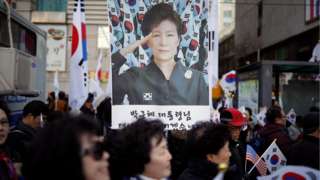
GeunIt was a stunning fall for Park, the country's first female leader and the daughter of a dictator who rode a lingering conservative nostalgia for her father to victory in 2012, only to see her presidency descend into a scandal.

The ruling by the eight-member panel opens her up to possible criminal proceedings and makes her South Korea's first democratically elected leader to be removed from office since democracy came in the country in the late 1980s.

Park's "acts of violating the constitution and law are a betrayal of the public trust," acting Chief Justice Lee Jung-mi said. "The benefits of protecting the constitution that can be earned by dismissing the defendant are overwhelmingly big. Hereupon, in a unanimous decision by the court panel, we issue a verdict: We dismiss the defendant, President Park Geun-hye."

South Korea must hold an election within two months to choose Park's successor. Liberal Moon Jae-in, who lost to Park in the 2012 election, currently enjoys a comfortable lead in opinion surveys. Whoever becomes the next leader will take over a country facing a hostile North Korea, a stagnant economy and deep social and political divides.

Pre-verdict surveys showed that 70 to 80 percent of South Koreans had wanted the court to approve Park's impeachment. But there have been worries that Park's ouster would further polarize the country and cause violence between her supporters and opponents.

Sensing history, thousands of people — both pro-Park supporters, many of them dressed in army-style fatigues and wearing red berets, and those who wanted Park gone — gathered around the Constitutional Court building and a huge public square in downtown Seoul.

A big television screen was set up near the court so people could watch the verdict live. Hundreds of police were on hand for any protests, wearing helmets with visors and black, hard-plastic breastplates and shin guards. The streets near the court were lined with police buses and barricades.

Park's parliamentary impeachment in December came after weeks of Saturday rallies that drew millions who wanted her resignation. Overwhelmed by the biggest rallies in decades, the voices of Park supporters were largely ignored. But they've recently regrouped and staged fierce pro-Park rallies since.

People on both sides have threatened not to accept a Constitutional Court decision that they disagree with. One of Park's lawyers told the court last month that there will be "a rebellion and blood will drench the asphalt" if Park is booted from office. Many participants at anti-Park rallies had said they would stage a "revolution" if the court rejected Park's impeachment.

"If Park accepts the ruling and soothes those who opposed her impeachment, things will be quiet," said Yoon Tae-Ryong, a political scientist at Seoul's Konkuk University. "But looking at what she's done so far, I think that might be wishful thinking."

Others disagreed, saying violent protests won't be supported by the general public.

Prosecutors have arrested and indicted a slew of high-profile figures over the scandal, including Park's confidante Choi Soon-sil, top Park administration officials and Samsung heir Lee Jae-yong. But Park has avoided a direct investigation thanks to a law that gives a sitting president immunity from prosecution for most of the alleged crimes.

Since she's now no longer in power, prosecutors can summon, question and possibly arrest her. Her critics want to see Park appear on TV while dressed in prison garb, handcuffed and bound like others involved in the scandal. But some analysts worry that could create a backlash by conservatives.

Even after the election, imprisoning Park could still be a burden for a new government, which must pursue national unity to overcome security, economic and other problems, said Chung Jin-young, a professor at Kyung Hee University. Others say it won't be difficult.

Among the most serious problems facing South Korea is China's retaliation against the deployment of a US high-tech missile defense system in the South. Ties with North Korea are terrible, with Pyongyang seeking to expand its nuclear and missile arsenal. Japan hasn't sent back its ambassador, which it recalled two months ago over history disputes. South Korea also worries about the Trump administration asking for a greater financial contribution for US troop deployment in the South.

Park rose to power in 2012 largely thanks to the support of voters who believed her father guided the country out of poverty after the 1950-53 Korean War and that his daughter would show the same charismatic leadership to revive the economy.

But her father was also a burden because there are many who remember the senior Park as a ruthless thug. These critics have linked her alleged unclear and high-handed decision-making and attempts to infringe upon freedom of speech to her father's high-handed style.

"The nostalgia for Park Chung-hee's developmental dictatorship, which has existed as a sort of myth since the '60s, has been shattered along with Park Geun-hye's impeachment," said Lim Jie-Hyun, a professor at Sogang University. "When people voted for Park Geun-hye, they didn't do so because of her."

Park Geun-hye has offered a public apology several times and acknowledged she got some help from Choi for editing speeches and on the issue of public relations. But Park has denied any legal wrongdoing.

The two women became friends in the 1970s, around the time when Park began serving as first lady after her mother was killed during a failed 1974 assassination attempt on her father. Park Geun-hye said Choi helped her "when I had difficulties" in the past. The two women had 573 phone calls between 18 April, 2016 and 26 October, 2016, according to an investigation report by prosecutors.

Prime Minister Hwang Kyo-ahn has led the government as acting leader since Park's impeachment and he will continue to do so until South Korea elects a new president by May. Some media reports said Hwang might run for the presidency as a conservative candidate. If that happens, he should resign to run and a deputy prime minister will serve as another interim leader.

In 2004, then President Roh Moo-hyun was impeached by parliament for alleged election law violations and incompetence, but the Constitutional Court later reinstated his power.

Comments

Add new comment

  • Coastaldigest.com reserves the right to delete or block any comments.
  • Coastaldigset.com is not responsible for its readers’ comments.
  • Comments that are abusive, incendiary or irrelevant are strictly prohibited.
  • Please use a genuine email ID and provide your name to avoid reject.
News Network
July 11,2020

Singapore, Jul 11: Singapore Prime Minister Lee Hsien Loong has secured a “clear mandate” with his ruling People’s Action Party (PAP) winning 83 of the 93 contested parliamentary seats in the general election held amidst the Covid-19 pandemic, with the Opposition gaining ground by winning a record 10 seats.

The ruling party, in power since independence in 1965, secured 61.24 percent of the total votes cast in the election, down from 69.9 percent in 2015. About 2.6 million Singaporeans voted on Friday.

“We have a clear mandate, but the percentage of the popular vote is not as high as I had hoped for,” 68-year old Lee told a PAP’s post-results press conference on Saturday morning.

The opposition Workers’ Party secured 10 seats and defeated a team in the Group Representation Constituency of Sengkang led by former Minister in the Prime Minister’s Office Ng Chee Meng who is also the Secretary-General of the power National Trades Union Congress (NTUC).

The Prime Minister assured it is “only right” that Workers’ Party’s Indian-origin secretary-general Pritam Singh be “formally designated” as the Leader of the Opposition, and that he will be provided with “appropriate staff support and resources to perform his duties”.

Lee took the results in “these circumstances” as an “endorsement” of the party’s policies and plans as he had called the elections amidst Covid-19 pandemic.

For latest updates and live news on coronavirus, click here

“We’ll take this forward and work with Singapore to realise those plans and solve the problems which we have,” Channel News Asia quoted the premier as saying.

Lee, who leads the PAP as secretary-general, said, “Singaporeans understand what’s at stake and why we must come together to uphold our national interests.”

He pledged to use this mandate “responsibly” to deal with the Covid-19 situation and economic downturn, to take Singapore “safely through the crisis and beyond”.

“The results reflect the pain and uncertainty that Singaporeans feel in this crisis, the loss of income, the anxiety about jobs, the disruption caused by the circuit breaker and the safe distancing restrictions,” he said.

This was not a “feel-good” election, said Lee, Singapore’s third prime minister who faces the city state’s worst recession with the economy projected to shrink between 7 and 4 per cent.

Lee acknowledged that the result also showed a “clear desire” for a diversity of voices in Parliament.

“Singaporeans want the PAP to form the government, but they, and especially the younger voters, also want to see more opposition presence in parliament,” he noted.

Lee added that he looks forward to the participation and contribution of the Opposition in parliament.

Singh, whose Workers’ Party team retained Aljunied Group Representation Constituency (GRC), will have 10 elected MPs now, up from six previously. His fellow member also retained the Hougang single-member constituency seat.

“Whether it works out… and whether it’s seen as a strengthening of Singapore will depend not only on what the PAP does but also on what the Opposition does because the Opposition now has 10 MPs elected from constituencies,” said Lee.

He assured that the ruling party will listen to Singaporeans and do its best to address their concerns, and “try to win” their support, whether or not they voted for the PAP.

When asked by the media if the party had lost the youth vote, he noted that different generations have different life experiences, and the young have significantly different life aspirations and priorities compared to the older generations.

“That’ll have to be reflected in our political process and in the government’s policies because, in the end, the government’s policies must be to achieve the aspirations of every generation of Singaporeans,” Lee said, assuring Singaporeans.

He hoped that the new generations of Singaporeans “look critically, but with an open mind” at what previous generations have done, “examine what’s relevant and what continues to make sense to them in a new environment” and “learn from these experiences hard-won by their parents and grandparents”.

This is so that they do not have to “learn them all over again and pay a high price which has already been paid”.

Lee added that he was, naturally, disappointed at the loss of the newly formed Sengkang GRC, which the Workers’ Party won with 52.13 percent of the valid votes.

“Ng Chee Meng and his team -- Lam Pin Min, Amrin Amin and Raymond Lye -- always knew it was going to be a tough fight,” he said.

“They gave it their all, but Sengkang voters have spoken, and we respect their decision.”

Lee described it as a “major loss to my team” and to the fourth-generation leaders, especially as Ng is the secretary-general of the Labour Movement, the NTUC.

Singh, 43, told a press conference following the results that his team would “continue to endeavour for good outcomes on the ground” and to represent voters “faithfully in parliament”.

“Today’s results are positive, but we have to hit the ground running. We should not get over our head with the results. There’s much work to do. And I can assure you this Workers’ Party team is committed to serve Singapore,” he stressed.

The PAP contested all 93 seats and the Workers’ Party 21 seats. Nine other political parties also contested the elections.

A total of 192 candidates contested for seats through 17 Group Representation Constituencies (GRCs).

Comments

Add new comment

  • Coastaldigest.com reserves the right to delete or block any comments.
  • Coastaldigset.com is not responsible for its readers’ comments.
  • Comments that are abusive, incendiary or irrelevant are strictly prohibited.
  • Please use a genuine email ID and provide your name to avoid reject.
Agencies
May 30,2020

Washington, May 30: US President Donald Trump on Friday said that America is terminating its relationship with the World Health Organization as he blamed it and China for the deaths and destruction caused by the COVID-19 pandemic across the globe.

Stating that the funding of the WHO would now be diverted to other global public health organisations, Trump announced a series of decisions against China including issuing proclamation to deny entry to certain Chinese nationals and tightening of regulations against Chinese investments in America.

"Because they (WHO) have failed to make the requested and greatly needed reforms, we will be today terminating our relationship with the World Health Organization and redirecting those funds to other worldwide and deserving urgent global public health needs, Trump said.

Comments

Add new comment

  • Coastaldigest.com reserves the right to delete or block any comments.
  • Coastaldigset.com is not responsible for its readers’ comments.
  • Comments that are abusive, incendiary or irrelevant are strictly prohibited.
  • Please use a genuine email ID and provide your name to avoid reject.
News Network
June 18,2020

Washington, Jun 18: US Defence officials are concerned over China's use of COVID-19 situation to gain stakes in strategically important companies of United States as the impact of novel coronavirus has left several companies in dire need of capital.

Amid the pandemic, it getting hard for the defence department to keep an eye on national security and help protect smaller companies down the chain, CNN reported.

"We are paying close attention to any indicators that China is leveraging Covid-19 to take advantage of a situation where defence companies need capital more than ever," a defence official told CNN.

In April, Ellen Lord, undersecretary of defence for acquisition and sustainment said it is paying close attention to 'adversaries' against the 'economic warfare' with the United States.

"We have to be very, very careful about the focused efforts some of our adversaries have to really undergo sort of economic warfare with us, which has been going on for some time," Ellen Lord, undersecretary of defence for acquisition and sustainment was quoted as saying by CNN.

US Committee on Foreign Investment protects its interest against hostile countries gaining ownership in strategically important companies. But the pandemic is changing the definition of national security concerns to include drugs, protective gear and medical supplies.

"These are now national security needs and we probably should have been thinking about it a long time ago in terms of biowarfare that we should have a trusted industrial base or a set of trusted allies -- the UK, or NATO allies or Japan or Korea -- who are trusted in that regard," Bill Greenwalt, a former Pentagon official.

Give the threat posed by foreign acquisition, Pentagon has been offering tools to help small US businesses defend themselves against adversarial investment and conducting background checks with other government agencies to ensure transparency.

US President Donald Trump's trade adviser Peter Navarro recently told CNN if Trump wins reelection, Washington DC will likely take offshore supply chains as national security priorities.

"If we fail to do that in the face of this crisis, we will have failed this country and all future generations of Americans," Navarro said.

The US State Department has also warned US allies to "avoid economic overreliance on China" and "guard their critical infrastructure" from China's influence.

Chad P Bown, a senior fellow at the Peterson Institute for International Economics, pointed to recent China's economic coercion of Australia on the political matter saying, "this is how China operates and everybody knows it."

Comments

Add new comment

  • Coastaldigest.com reserves the right to delete or block any comments.
  • Coastaldigset.com is not responsible for its readers’ comments.
  • Comments that are abusive, incendiary or irrelevant are strictly prohibited.
  • Please use a genuine email ID and provide your name to avoid reject.