SP confirms arrest of Bajrang Dal leader Bharat in Ashraf murder case

CD Network
July 2, 2017

Mangaluru, Jul 2: Finally a senior police officer has confirmed the arrest of Bharat Kumar Kumdelu, a notorious criminal and Bajrang Dal leader, in connection with the coldblooded murder of SDPI activist Mohammed Ashraf Kalayi.gns

“We have arrested Bharat. Bharat will be produced in court after interrogation and police custody will be taken for further investigation,” said H Sudhir Kumar Reddy, superintendent of police of Dakshina Kannada.

Confirming arrest of prime accused Bharat Kumdelu, 30, a resident of Bantwal, C H Sudhir Kumar Reddy, superintendent of police, DK said that he is secured and is being interrogated. Bharat will be produced in court after interrogation and police custody will be taken for further investigation.

Ashraf (33), president of SDPI’s Ammunje zonal unit, was hacked to death by a gang of miscreants at Benjanapadavu in Bantwal taluk in broad daylight on June 21. Police have already arrested six persons in connection with the case and most of them have close ties with Hindutva organizations.

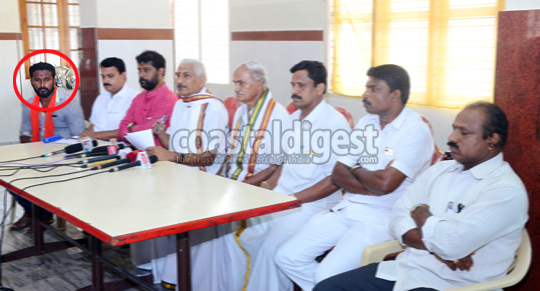
30-year-old Bharat had shared dais with RSS leader Prabhakar Bhat at a press meet in Mangaluru on May 28 wherein the latter had justified the attack on two Muslim passersby by rowdysheeters in Kalladka.

According to highly place sources, Bharat had planned the murder in Benjanapadavu. He himself had also collected weapons like sickle, knives and given to other accused.

Police said they had an intention to create communal violence after the incident. The murder plot was hatched by two rowdy sheeters - Dhivyaraj Shetty, who was arrested earlier, and Bharat Kumdelu.

The other accused are Pavan Kumar, 24, Pudu village, Bantwal; Santosh, 23, Thumbay village; Shivaprasad, 24, Bollari house, Thumbay; Ranjith, 28, resident of Pudu village and Abhin Rai, 23, Thenkabellur village.

Barring Santosh all the other have criminal cases registered against them. Abhin Rai was booked during Tipu Jayanthi violence in Bantwal, last year and a case was booked against Pavan in 2012 for placing pig head at a mosque in Bantwal to create communal tension.

ashrafmurder1 copy

Comments

mohammad.n
 - 
Friday, 7 Jul 2017

GST forgotten! These MPs and leaders fill their stomach at the cost of poor people's life. Poor people kill and poor people die. Rich will be rich always. I dont know when the people will wake up. May be someday US , Russia and others countries will come and say they will solve our problem as they do in the middle east. May be then we can wake up

Harish vamachara
 - 
Friday, 7 Jul 2017

nice coverage Coastaldigest.com, thanks alot for the support.

Add new comment

  • Coastaldigest.com reserves the right to delete or block any comments.
  • Coastaldigset.com is not responsible for its readers’ comments.
  • Comments that are abusive, incendiary or irrelevant are strictly prohibited.
  • Please use a genuine email ID and provide your name to avoid reject.
Ram Puniyani
February 4,2020

As democracy is seeping in slowly all over the world, there is an organization which is monitoring the degree of democracy in the individual countries, The Economist Intelligence Unit. As such in each country there are diverse factors which on one hand work to deepen it, while others weaken it. Overall there is a march from theoretical democracy to substantive one. The substantive democracy will herald not just the formal equality, freedom and community feeling in the country but will be founded on the substantive quality of these values. In India while the introduction of modern education, transport, communication laid the backdrop of beginning of the process, the direction towards deepening of the process begins with Mahatma Gandhi when he led the non-cooperation movement in 1920, in which average people participated. The movement of freedom for India went on to become the ‘greatest ever mass movement’ in the World.

The approval and standards for democracy were enshrined in Indian Constitution, which begins ‘We the people of India’, and was adopted on 26th January 1950. With this Constitution and the policies adopted by Nehru the process of democratization started seeping further, the dreaded Emergency in 1975, which was lifted later restored democratic freedoms in some degree. This process of democratisation is facing an opposition since the decade of 1990s after the launch of Ram Temple agitation, and has seen the further erosion with BJP led Government coming to power in 2014. The state has been proactively attacking civil liberties, pluralism and participative political culture with democracy becoming flawed in a serious way. And this is what got reflected in the slipping of India by ten places, to 51st, in 2019. On the index of democracy India slipped down from the score of 7.23 to 6.90. The impact of sectarian BJP politics is writ on the state of the nation, country.

Ironically this lowering of score has come at a time when the popular protests, the deepening of democracy has been given a boost and is picking up with the Shaheen Bagh protests. The protest which began in Shaheen Bagh, Delhi in the backdrop of this Government getting the Citizenship amendment Bill getting converted into an act and mercilessly attacking the students of Jamia Milia Islamia, Aligarh Muslim University along with high handed approach in Jamia Nagar and neighbouring areas.  From 15th December 2019, the laudable protest is on.

It is interesting to note that the lead in this protest has been taken by the Muslim women, from the Burqa-Hijab clad to ‘not looking Muslim’ women and was joined by students and youth from all the communities, and later by the people from all the communities. Interestingly this time around this Muslim women initiated protest has contrast from all the protests which earlier had begun by Muslims. The protests opposing Shah Bano Judgment, the protests opposing entry of women in Haji Ali, the protests opposing the Government move to abolish triple Talaq. So far the maulanas from top were initiating the protests, with beard and skull cap dominating the marches and protests. The protests were by and large for protecting Sharia, Islam and were restricted to Muslim community participating.

This time around while Narendra Modi pronounced that ‘protesters can be identified by their clothes’, those who can be identified by their external appearance are greatly outnumbered by all those identified or not identified by their appearance.

The protests are not to save Islam or any other religion but to protect Indian Constitution. The slogans are structured around ‘Defence of democracy and Indian Constitution’. The theme slogans are not Allahu Akbar’ or Nara-E-Tadbeer’ but around preamble of Indian Constitution. The lead songs have come to be Faiz Ahmad Faiz’s ‘Hum Dekhenge’, a protest against Zia Ul Haq’s attempts to crush democracy in the name of religion. Another leading protest song is from Varun Grover, ‘Tanashah Aayenge…Hum Kagaz nahin Dikhayenge’, a call to civil disobedience against the CAA-NRC exercise and characterising the dictatorial nature of the current ruling regime.

While BJP was telling us that primary problem of Muslim women is Triple talaq, the Muslim women led movements has articulated that primary problem is the very threat to Muslim community. All other communities, cutting across religious lines, those below poverty line, those landless and shelter less people also see that if the citizenship of Muslims can be threatened because of lack of some papers, they will be not far behind in the victimization process being unleashed by this Government.

While CAA-NRC has acted as the precipitating factor, the policies of Modi regime, starting from failure to fulfil the tall promises of bringing back black money, the cruel impact of demonetisation, the rising process of commodities, the rising unemployment, the divisive policies of the ruling dispensation are the base on which these protest movements are standing. The spread of the protest movement, spontaneous but having similar message is remarkable. Shaheen Bagh is no more just a physical space; it’s a symbol of resistance against the divisive policies, against the policies which are increasing the sufferings of poor workers, the farmers and the average sections of society.

What is clear is that as identity issues, emotive issues like Ram Temple, Cow Beef, Love Jihad and Ghar Wapasi aimed to divide the society, Shaheen Bagh is uniting the society like never before. The democratisation process which faced erosion is getting a boost through people coming together around the Preamble of Indian Constitution, singing of Jan Gan Man, waving of tricolour and upholding the national icons like Gandhi, Bhagat Singh, Ambedkar and Maulana Azad. One can feel the sentiments which built India; one can see the courage of people to protect what India’s freedom movement and Indian Constitution gave them.

Surely the communal forces are spreading canards and falsehood against the protests. As such these protests which is a solid foundation of our democracy. The spontaneity of the movement is a strength which needs to be channelized to uphold Indian Constitution and democratic ethos of our beloved country.


Comments

Add new comment

  • Coastaldigest.com reserves the right to delete or block any comments.
  • Coastaldigset.com is not responsible for its readers’ comments.
  • Comments that are abusive, incendiary or irrelevant are strictly prohibited.
  • Please use a genuine email ID and provide your name to avoid reject.
News Network
February 14,2020

Bhuj, Feb 14: In a horrifying incident, as many as 68 undergraduate girls were paraded through their college into the restroom and forced to individually remove their undergarments to prove that they were not menstruating. 

This shameful exercise was conducted at Shri Sahjanand Girls’ Institute (SSGI) in Gujarat’s Bhuj under the supervision of principal and other teachers. 

It all began after the hostel rector complained to the principal that some of the inmates had been violating the Hindu religious norms specifically for menstruating females.

According to the sect’s norms, menstruating females are barred from entering the temple and kitchen. They are even forbidden from touching other students. However, the hostel administration reportedly complained to principal Rita Raninga that some girls who were having their periods not just mingled with other hostel inmates, but also entered the kitchen and ventured near the temple on the premises. 

“It was sheer mental torture and we don’t have words to describe it,” a student who underwent the traumatic experience said, adding that there were total 68 girls who were forced to pass through the test.

“The hostel administration levelled this allegation and insulted us on Wednesday. On Thursday, when we were attending lectures, rector Anjaliben called the principal and complained about this. We were forced to leave our classrooms and queue up outside in the passage. The principal abused and insulted us, asking which of us were having our periods. Two of us who were menstruating stepped aside,” said another victim.

“Despite this, we were all taken to the washroom. There, female teachers asked us to individually remove our undergarments so they could check if we were menstruating,” she added.

Another teenage undergraduate said, “We come from farflung villages. The college campus houses a school that runs classes from Class 1to 12. They provide hostel facilities to the school students. The college does not have its own hostel. We live with the school-kids in their hostel.”

She added, “The principal, hostel rector and the trustees harass us regularly over the issue of menstruation. We are punished for having periods. This happens even if we follow their religious rules. They made us remove our undergarments because they thought some of us were lying about not having periods, and mingling with the others against rules. But the humiliation meted out to us on Thursday was the last straw. When we protested against this, trustee Pravin Pindoria told us that we could take legal action if we wanted but we would have to first leave the hostel. He also forced the students to sign a letter saying nothing happened in college. But enough is enough.”

Kutch University authorities have, meanwhile, swung into action and a five-member team including in-charge vice-chancellor, Darshna Dholakia, and two other senior female professors visited the college on Thursday. “We will speak to the students and the college authority and later initiate appropriate action based on the findings,” Dholakia said.

Run by followers of Swaminarayan Mandir, the college was set up in 2012 but moved into a new building on the premises of Shree Swaminarayan Kanya Mandir in 2014. The college which offers BCom, BA and BSc courses has about 1,500 students of which 68, who come from remote villages, stay in the hostel on campus. The college is known for its pro-Hindutva stance.

Comments

Add new comment

  • Coastaldigest.com reserves the right to delete or block any comments.
  • Coastaldigset.com is not responsible for its readers’ comments.
  • Comments that are abusive, incendiary or irrelevant are strictly prohibited.
  • Please use a genuine email ID and provide your name to avoid reject.
News Network
January 11,2020

Bengaluru, Jan 11: India’s second-biggest IT company, Infosys Ltd, said it found no evidence of financial misconduct by its executives following a investigation into whistleblower complaints.

Bengaluru-headquartered Infosys, which earlier on Friday raised its revenue forecasts due to upbeat demand from Western clients, said an audit committee report exonerated Chief Executive Officer Salil Parekh and Chief Financial Officer Nilanjan Roy of all allegations, including accusations that the duo prevented employees from presenting data on large deals.

“I’m very happy that CEO Salil Parekh and CFO Nilanjan Roy have emerged from this stronger,” Infosys Chairman Nandan Nilekani told reporters. “The last two years since Salil has been here the company has changed dramatically for the better.”

Parekh took over as Infosys CEO in January 2018, after his predecessor Vishal Sikka quit following a public row with the company’s founder executives amid whistleblower allegations of wrongdoing.

The company earlier said it expected revenue to grow between 10 per cent and 10.5 per cent on a constant currency basis in the year ending March 2020, compared with its previous forecast of between 9 per cent and 10 per cent.

“We continue to see momentum in the market and we have an extremely robust pipeline driven by segment leaders,” CEO Parekh told a news conference.

“With the strength of large deal wins and digital momentum, we were able to clearly see that we have support to raise our guidance.”

Comments

Add new comment

  • Coastaldigest.com reserves the right to delete or block any comments.
  • Coastaldigset.com is not responsible for its readers’ comments.
  • Comments that are abusive, incendiary or irrelevant are strictly prohibited.
  • Please use a genuine email ID and provide your name to avoid reject.