



Stolen truck kills 4 in Stockholm; Sweden calls it terror

April 8, 2017

Stockholm, Apr 8: A truck ploughed into a crowd on a shopping street and crashed into a department store in central Stockholm on Friday, killing four people and wounding 15 in what the prime minister said appeared to be a terrorist attack.sweden1

Police said they had arrested one person in a northern Stockholm suburb after earlier circulating a picture of a man wearing a grey hoodie in connection with the investigation into the attack on Drottninggatan (Queen Street) using a hijacked beer truck.
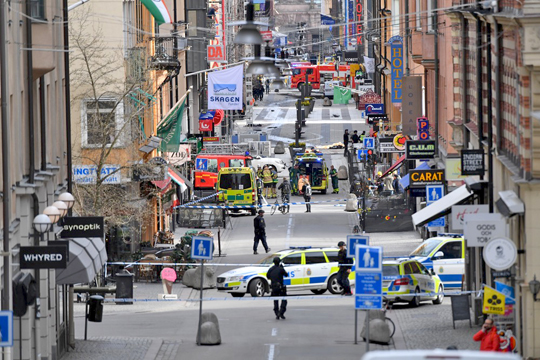
Sweden2

Swedish public broadcaster SVT reported Swedish police had arrested a second man and that he had a connection to the previously arrested person, citing police sources. The police declined to comment on whether it had arrested any additional suspects.

"Our message will always be clear: you will not defeat us, you will not govern our lives, you will never, ever win," Prime Minister Stefan Lofven, who had earlier described the assault as a terrorist attack, told a news conference.

There was no immediate claim of responsibility.

Police said security at Swedish borders had been heightened. They did not rule out the possibility other attackers were involved.

SWERVING

"I turned around and saw a big truck coming towards me. It swerved from side to side. It didn't look out of control. It was trying to hit people," Glen Foran, an Australian tourist in his 40s, told Reuters.

"It hit people; it was terrible. It hit a pram with a kid in it, demolished it," he said.

"It took a long time for police to get here. I suppose from their view it was quick, but it felt like forever."

The area of the attack in central Stockholm was evacuated, including the main rail station, and remained cordoned off late on Friday. All subway traffic was halted on police orders and government offices were closed.

A Reuters witness at the scene saw police officers put what appeared to be two bodies into body bags.

Bloody tyre tracks showed the path of the truck, which was stolen by a masked hijacker while making a beer delivery to a tapas bar further up Drottninggatan, according to Spendrups Brewery spokesman Marten Lyth.

"We were standing by the traffic lights at Drottninggatan and then we heard some screaming and saw a truck coming," a witness who declined to be named told Reuters.

"Then it drove into a pillar at (department store) Ahlens City, where the hood started burning. When it stopped we saw a man lying under the tyre. It was terrible to see," said the man, who saw the incident from his car.

Police said four people had died and 15 were injured. National news agency TT said those hurt included the delivery driver, who had tried to stop the hijack.

Several attacks in which trucks or cars have driven into crowds have taken place in Europe in the past year. Al Qaeda in 2010 urged its followers to use trucks as a weapon. Islamic State claimed responsibility for an attack in Nice, France, last July, when a truck killed 86 people celebrating Bastille Day, and one in Berlin in December, when a truck smashed through a Christmas market, killing 12 people.

"Hijacking a truck, that has happened before," Magnus Ranstorp, head of terrorism research at the Swedish Defence University, told Reuters.

"And this is a pretty cunning modus operandi. To drive to Ahlens and stop ... There is a way down to the subway just a few metres away from there, and then you ... can jump on any train you want and quickly disappear."

#OPENSTOCKHOLM

Stockholmers opened up their homes and offered lifts to people who were unable to get home or needed a place to stay.

"Our thoughts are going out to those that were affected, and to their families," Sweden's King Carl Gustaf said in a statement, while European Union chief executive Jean-Claude Juncker said an attack on any of the bloc's member states "is an attack on us all".

The attack was the latest to hit the Nordic region after shootings in Danish capital Copenhagen in 2015 that killed three people and the 2011 bombing and shooting by far right extremist Anders Behring Breivik that killed 77 people in Norway.

Sweden has not seen a large-scale attack, although in December 2010 a failed suicide bombing killed the attacker only a few hundred yards from the site of Friday's incident.

Comments

Add new comment

  • Coastaldigest.com reserves the right to delete or block any comments.
  • Coastaldigset.com is not responsible for its readers’ comments.
  • Comments that are abusive, incendiary or irrelevant are strictly prohibited.
  • Please use a genuine email ID and provide your name to avoid reject.
News Network
April 19,2020

Washington, Apr 19: President Donald Trump has expressed his doubts over the official Chinese figures on the number of deaths in their country due to the novel coronavirus pandemic, claiming that the fatalities were way ahead of the US.

Trump's comments come two days after another 1,300 fatalities were added to the official count in the city of Wuhan, where the outbreak started. The revision puts China's overall death toll to more than 4,600.

"We are not number one; China is number one just so you understand," Trump told reporters at a White House news conference on Saturday. "They are way ahead of us in terms of death. It's not even close."

According to Trump, when highly-developed healthcare systems of the UK, France, Belgium, Italy and Spain had high fatality rates, it was O.33 in China.

The president asserted that the actual number was much more than the official Chinese death toll figures, which he said were "unrealistic".

"You know it, I know it and they know it, but you don't want to report it. Why?" he asked. "You will have to explain that. Someday I will explain it."

He also highlighted that on a per-capita basis, the mortality rate in the US was far lower than other nations of Western Europe.

Comments

Add new comment

  • Coastaldigest.com reserves the right to delete or block any comments.
  • Coastaldigset.com is not responsible for its readers’ comments.
  • Comments that are abusive, incendiary or irrelevant are strictly prohibited.
  • Please use a genuine email ID and provide your name to avoid reject.
News Network
June 8,2020

Wellington, Jun 8: New Zealand lifted all domestic coronavirus restrictions on Monday after its final COVID-19 patient was given the all clear, with Prime Minister Jacinda Ardern revealing she danced around her living room when told about the milestone.

While strict border controls will remain in place, Ardern said restrictions such as social distancing and limits on public gatherings were no longer needed.

"We are confident we have eliminated transmission of the virus in New Zealand for now," she said in a televised address, saying Kiwis had "united in unprecedented ways to crush the virus".

The South Pacific nation, with a population of five million, has had 1,154 confirmed COVID-19 cases and 22 deaths.

There have been no new infections for 17 days and, until Monday, just one active case for more than a week.

Details of the final patient were not released for privacy reasons but it is believed to be a woman aged in her 50s who was linked to a cluster at an Auckland nursing home.

Ardern said the sacrifices made by New Zealanders, including a drastic seven-week lockdown that helped curb infection rates, had been rewarded now that there were no active cases in the country.

Asked about her reaction upon hearing the news, she replied: "I did a little dance" with baby daughter Neve.

"She was caught a little by surprise but she joined in, having absolutely no idea why I was dancing around the lounge."

New Zealand's move down to Level 1, the lowest rating on its four-tier virus response system, means nightclubs can operate without dance floor restrictions and theatres will reopen.

It also means sporting events can proceed with crowds in the stands, a change New Zealand Rugby (NZR) said offered its Super Rugby Aotearoa competition the opportunity to achieve a world first when it kicks off this weekend.

"We're incredibly proud, and grateful, to be the first professional sports competition in the world to be in a position to have our teams play in front of their fans again," NZR chief executive Mark Robinson said.

While many other sporting competitions around the globe have announced plans to restart, the vast majority will be played either with no crowds or with numbers severely restricted.

On a broader level, Ardern said easing restrictions would help New Zealand's economy.

"We now have a head start on economic recovery because at level one we become one of the most open, if not the most open, economies in the world," she said.

The prime minister said modelling showed the economy would operate at just 3.8 percent below normal at Level 1, compared with a 37 percent impairment at Level 4 lockdown.

Comments

Add new comment

  • Coastaldigest.com reserves the right to delete or block any comments.
  • Coastaldigset.com is not responsible for its readers’ comments.
  • Comments that are abusive, incendiary or irrelevant are strictly prohibited.
  • Please use a genuine email ID and provide your name to avoid reject.
News Network
May 19,2020

May 19: A Chinese laboratory has been developing a drug it believes has the power to bring the coronavirus pandemic to a halt.

The outbreak first emerged in China late last year before spreading across the world, prompting an international race to find treatments and vaccines.

A drug being tested by scientists at China's prestigious Peking University could not only shorten the recovery time for those infected, but even offer short-term immunity from the virus, researchers say.

Sunney Xie, director of the university's Beijing Advanced Innovation Center for Genomics, told AFP that the drug has been successful at the animal testing stage.

"When we injected neutralising antibodies into infected mice, after five days the viral load was reduced by a factor of 2,500," said Xie.

"That means this potential drug has (a) therapeutic effect."

The drug uses neutralising antibodies -- produced by the human immune system to prevent the virus infecting cells -- which Xie's team isolated from the blood of 60 recovered patients.

A study on the team's research, published Sunday in the scientific journal Cell, suggests that using the antibodies provides a potential "cure" for the disease and shortens recovery time.

Xie said his team had been working "day and night" searching for the antibody.

"Our expertise is single-cell genomics rather than immunology or virology. When we realised that the single-cell genomic approach can effectively find the neutralising antibody we were thrilled."

He added that the drug should be ready for use later this year and in time for any potential winter outbreak of the virus, which has infected 4.8 million people around the world and killed more than 315,000.

"Planning for the clinical trial is underway," said Xie, adding it will be carried out in Australia and other countries since cases have dwindled in China, offering fewer human guinea pigs for testing.

"The hope is these neutralised antibodies can become a specialised drug that would stop the pandemic," he said.

China already has five potential coronavirus vaccines at the human trial stage, a health official said last week.

But the World Health Organization has warned that developing a vaccine could take 12 to 18 months.

Scientists have also pointed to the potential benefits of plasma -- a blood fluid -- from recovered individuals who have developed antibodies to the virus enabling the body's defences to attack it.

More than 700 patients have received plasma therapy in China, a process which authorities said showed "very good therapeutic effects".

"However, it (plasma) is limited in supply," Xie said, noting that the 14 neutralising antibodies used in their drug could be put into mass production quickly.

Using antibodies in drug treatments is not a new approach, and it has been successful in treating several other viruses such as HIV, Ebola and Middle East Respiratory Syndrome (MERS).

Xie said his researchers had "an early start" since the outbreak started in China before spreading to other countries.

Ebola drug Remdesivir was considered a hopeful early treatment for COVID-19 -- clinical trials in the US showed it shortened the recovery time in some patients by a third -- but the difference in mortality rate was not significant.

The new drug could even offer short-term protection against the virus.

The study showed that if the neutralising antibody was injected before the mice were infected with the virus, the mice stayed free of infection and no virus was detected.

This may offer temporary protection for medical workers for a few weeks, which Xie said they are hoping to "extend to a few months".

More than 100 vaccines for COVID-19 are in the works globally, but as the process of vaccine development is more demanding, Xie is hoping that the new drug could be a faster and more efficient way to stop the global march of the coronavirus.

"We would be able to stop the pandemic with an effective drug, even without a vaccine," he said.

Comments

Add new comment

  • Coastaldigest.com reserves the right to delete or block any comments.
  • Coastaldigset.com is not responsible for its readers’ comments.
  • Comments that are abusive, incendiary or irrelevant are strictly prohibited.
  • Please use a genuine email ID and provide your name to avoid reject.