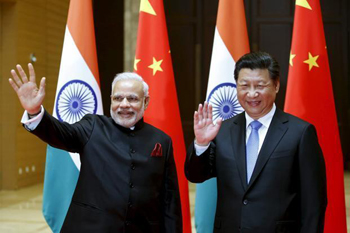
Stop behaving like spoilt kid; even US won't mess with us: China to India

December 23, 2016

New Delhi, Dec 23: China's official media has warned India against using the Dalai Lama "card", saying New Delhi should stop behaving like a "spoilt kid" and learn lessons from how China handled Donald Trump after the US President-elect challenged 'One-China' policy.

modi1"Sometimes, India behaves like a spoilt kid, carried away by the lofty crown of being 'the biggest democracy in the world.' India has the potential to be a great nation, but the country's vision is shortsighted," an article in the state-run Global Times said.

It said India "should draw some lessons from the recent interactions between Beijing and Trump over Taiwan."

"After putting out feelers to test China's determination to protect its essential interests, Trump has met China's restrained but pertinent countermeasures, and must have understood that China's bottom line - sovereign integrity and national unity - is untouchable," the paper said.

While the article did not elaborate on counter measures, China besides protesting to Mr Trump over his phone call to the Taiwanese President and his comments questioning One-China policy, also seized an "unmanned underwater vehicle" in the disputed South China Sea, the first such incident in the area.

The drone was returned subsequently after protests from US and Mr Trump, an incident seen as an attempt by China to flex its muscles ahead of the President-elect taking over office next month.

The drone operated by a US survey vessel in the South China Sea was seized by a Chinese navy ship.

"Even the US would have to think twice before it messes with China on such sensitive problems, so what makes India so confident that it could manage?," the article sounding strident in it tone and tenor said, referring to India going to Mongolia's assistance by granting USD one billion aid after Beijing imposed a blockade in retaliation to Ulaanbaatar hosting Dalai Lama last month despite China protests.

The Mongolian Ambassador to India had sought New Delhi's help to overcome China's counter measures. However, the Mongolian government has given in and pledged that it will never invite Dalai Lama again.

Comments

Add new comment

  • Coastaldigest.com reserves the right to delete or block any comments.
  • Coastaldigset.com is not responsible for its readers’ comments.
  • Comments that are abusive, incendiary or irrelevant are strictly prohibited.
  • Please use a genuine email ID and provide your name to avoid reject.
Agencies
February 16,2020

Wuhan, Feb 16: The death toll from China's coronavirus epidemic has climbed to 1,665 after 142 more people died, mostly in the worst-hit Hubei Province, and the confirmed cases jumped to 68,500, officials said on Sunday, as top WHO experts scramble to assist Beijing contain the virus spread.

China's National Health Commission confirmed 2,009 new cases across the country.

Hubei and its provincial capital Wuhan, where the virus first emerged in December, reported 1,843 of the new cases. The latest report brought the total confirmed cases in Hubei to 56,249 cases.

Of the new deaths, 139 were in Hubei, two in Sichuan, and one in Hunan, the state-run Xinhua news agency reported.

The number of new cases, however, appears to have started dropping and a top Chinese health official has said efforts to control the outbreak have reached the “most crucial stage".

The report said 9,419 infected patients had been discharged from hospital after recovery so far.

The coronavirus has posed a severe threat to the medical staff as more than 1,700 Chinese health officials have been infected by the virus while treating the patients and six of them have died.

Experts from the World Health Organisation are expected in Beijing on Sunday to join Chinese health authorities in containing the virus, which has spread to several other countries forcing them to temporarily stop tourist arrivals from China.

The health commission said a joint mission with WHO experts will pay field visits to China's three provincial-level regions to learn the effectiveness of the epidemic control measures.

One task of the mission will be to come up with standard medicine to cure the disease, according to the health commission.

Several antiviral drugs are under clinical trials and Chinese researchers have narrowed down their focus to a few existing drugs, including Chloroquine Phosphate, Favipiravir and Remdesivir, said Zhang Xinmin, director of the China National Centre for Biotechnology Development.

Experts have asked people to frequently wash hands and face, and wear masks.

Authorities have begun quarantining large quantity of bank notes and coins in the affected areas and sanitising them with UV light before releasing them back into circulation to stop the virus from spreading.

Comments

Add new comment

  • Coastaldigest.com reserves the right to delete or block any comments.
  • Coastaldigset.com is not responsible for its readers’ comments.
  • Comments that are abusive, incendiary or irrelevant are strictly prohibited.
  • Please use a genuine email ID and provide your name to avoid reject.
Agencies
March 1,2020

Washington, Mar 1: The US Federal Communications Commission (FCC) has proposed a fine of over $200 million for all major US mobile carriers for selling the location data of customers to some agencies.

The Federal Communications Commission today proposed fines against the nation's four largest wireless carriers for apparently selling access to their customers' location information without taking reasonable measures to protect against unauthorised access to that information. As a result, T-Mobile faces a proposed fine of more than $91 million, AT&T faces a proposed fine of more than $57 million, Verizon faces a proposed fine of more than $48 million, and Sprint faces a proposed fine of more than $12 million, the FCC said in a statement on Friday.

The Enforcement Bureau of FCC opened this investigation after reports surfaced that a Missouri Sheriff, Cory Hutcheson, used a "location-finding service" operated by Securus, a provider of communications services to correctional facilities, to access the location information of the wireless carriers' customers without their consent between 2014 and 2017.

"American consumers take their wireless phones with them wherever they go. And information about a wireless customer's location is highly personal and sensitive. The FCC has long had clear rules on the books requiring all phone companies to protect their customers' personal information. And since 2007, these companies have been on notice that they must take reasonable precautions to safeguard this data and that the FCC will take strong enforcement action if they don't. Today, we do just that," said FCC Chairman Ajit Pai.

"This FCC will not tolerate phone companies putting Americans' privacy at risk."

The FCC also admonished these carriers for apparently disclosing their customers' location information, without their authorisation, to a third party

The four major US carriers mentioned sold access to their customers' location information to "aggregators," who then resold access to such information to third-party location-based service providers (like Securus).

Although their exact practices varied, each carrier relied heavily on contract-based assurances that the location-based services providers (acting on the carriers' behalf) would obtain consent from the wireless carrier's customer before accessing that customer's location information.

Comments

Add new comment

  • Coastaldigest.com reserves the right to delete or block any comments.
  • Coastaldigset.com is not responsible for its readers’ comments.
  • Comments that are abusive, incendiary or irrelevant are strictly prohibited.
  • Please use a genuine email ID and provide your name to avoid reject.
News Network
May 8,2020

May 8: Thousands of migrants have been stranded “all over the world” where they face a heightened risk of COVID-19 infection, the head of the UN migration agency International Organization for Migration (IOM) has said.

IOM Director-General António Vitorino said that more onerous health-related travel restrictions might discriminate disproportionately against migrant workers in future.

“Health is the new wealth,” Vitorino said, citing proposals by some countries to introduce the so-called immunity passports and use mobile phone apps designed to prevent the spread of the new coronavirus.

“In lots of countries in the world, we already have a system of screening checks to identify the health of migrants, above all malaria, tuberculosis… HIV-AIDS, and now I believe that there will be increased demands in health controls for regular migrants,” he said on Thursday.

Travel restrictions to try to limit the spread of the pandemic has left people on the move more vulnerable than ever and unable to work to support themselves, Vitorino told journalists via videoconference.

“There are thousands of stranded migrants all over the world.

 “In South-East Asia, in East Africa, in Latin America, because of the closing of the borders and with the travel restrictions, lots of migrants who were on the move; some of them wanted to return precisely because of the pandemic,” he said.

They are blocked, some in large groups, some in small, in the border areas, in very difficult conditions without access to minimal care, especially health screening, Vitorino said.

“We have been asking the governments to allow the humanitarian workers and the health workers to have access to (them),” he said.

Turning to Venezuelan migrants, who are believed to number around five million amidst a worsening economic crisis in the country, the IOM chief said “thousands… have lost their jobs in countries like Ecuador and Colombia and are returning back to Venezuela in large crowds without any health screening and being quarantined when they go back”.

In a statement, the IOM highlighted the plight of migrants left stranded in the desert in west, central and eastern Africa, either after having been deported without the due process, or abandoned by the smugglers.

The IOM’s immediate priorities for migrants include ensuring that they have access to healthcare and other basic social welfare assistance in their host country.

Among the UN agency’s other immediate concerns is preventing the spread of new coronavirus infection in more than 1,100 camps that it manages across the world.

They include the Cox’s Bazar complex in Bangladesh, home to around one million mainly ethnic Rohingya from Myanmar, the majority having fled persecution.

So far, no cases of infection have been reported there, the IOM chief said, adding that preventative measures have been communicated to the hundreds of thousands of camp residents, while medical capacity has been boosted.

Beyond the immediate health threat of COVID-19 infection, migrants also face growing stigmatization from which they need protection, Vitorino said.

Allowing hate speech and xenophobic narratives to thrive unchallenged also threatens to undermine the public health response to COVID-19, he said, before noting that migrant workers make up a significant percentage of the health sector in many developed countries including the UK, the US and Switzerland.

Populist narratives targeting migrants as carriers of disease could also destabilise national security through social upheaval and countries’ post-COVID economic recovery by removing critical workers in agriculture and service industries, he said.

Remittances have already seen a 30 per cent drop during the pandemic, Vitorino said, citing the World Bank data, meaning that some USD 20 billion has not been sent home to families in countries where up to 15 per cent of their gross domestic product comes from pay packets earned abroad.

Vitorino, in a plea, urged to give the health of migrants as much attention as that of the host populations in all countries.

“It is quite clear that health is the new wealth and that health concerns will be introduced in the mobility systems - not just for migration - but as a whole; where travelling for business or professional reasons, health will be the new gamechanger in town.

“If the current pandemic leads to a two or even three-tier mobility system, then we will have to try to solve the problem – the problem of the pandemic - but at the same time we have created a new problem of deepening the inequalities,” he said.


Comments

Add new comment

  • Coastaldigest.com reserves the right to delete or block any comments.
  • Coastaldigset.com is not responsible for its readers’ comments.
  • Comments that are abusive, incendiary or irrelevant are strictly prohibited.
  • Please use a genuine email ID and provide your name to avoid reject.