



Suspected Babbar Khalsa member arrested in US

December 19, 2013

Khalsa_memberWashington, Dec 19: An Indian-American man has been arrested by the FBI on charges of providing material support to Sikh separatist groups in India planning terrorist attacks.

The Federal Bureau of Investigation (FBI) on Wednesday arrested Balwinder Singh, 39, of Reno on charges of conspiracy to provide material support to terrorists, conspiracy to murder or otherwise harm persons in a foreign country and other lesser counts involving immigration records.

Singh, aka Jhajj, aka Happy, Possi, Baljit Singh, is allegedly linked to two terrorist organisations -- Babbar Khalsa International (BKI) and Khalistan Zindabad Force (KZF).

He is scheduled to appear before a US Magistrate Judge on December 20 for an initial appearance and arraignment.

Singh, a citizen of India who fled to the US and claimed asylum, is now a permanent US resident.

He has been charged in an indictment with one count of conspiracy to murder, kidnap, and maim persons in a foreign country, one count of conspiracy to provide material support to terrorists, one count of making a false statement on an immigration document, two counts of use of an immigration document procured by fraud, and one count of unlawful production of an identification document.

If convicted, Singh faces up to life in prison and fines of up to USD 250,000 on each count.

In the indictment, the FBI alleged that the object of the conspiracy was to advance the goals of BKI and KZF by raising money and obtaining weapons to support acts of terrorism in India.

It is alleged that the conspiracy began around November 30, 1997 after which Singh used a false identity and obtained false identification documents in the United States so that he could travel back to India without being apprehended by the Indian authorities.

The indictment alleged that Singh communicated with other co-conspirators by telephone while he was in the US to discuss acts of terrorism to be carried out in India.

Singh, the indictment alleged, sent money to co-conspirators in India for the purchase of weapons that would be provided to members of the BKI and KZF to support acts of terrorism in India.

It is alleged that Singh travelled from the United States to Pakistan, India, and other countries to meet with co-conspirators to assist in the planning of terrorism in India, and that Singh provided advice to co-conspirators about how to carry out acts of terrorism.

Comments

Add new comment

  • Coastaldigest.com reserves the right to delete or block any comments.
  • Coastaldigset.com is not responsible for its readers’ comments.
  • Comments that are abusive, incendiary or irrelevant are strictly prohibited.
  • Please use a genuine email ID and provide your name to avoid reject.
Agencies
July 28,2020

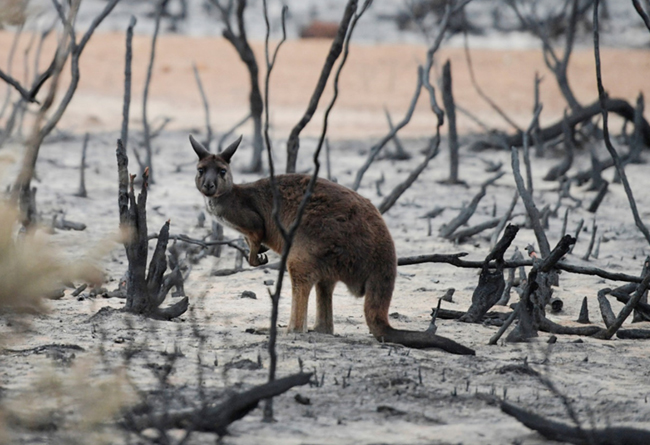
Sydney, Jul 28: Nearly 3 billion koalas, kangaroos and other native Australian animals were killed or displaced by bushfires in 2019 and 2020, a study by the World Wide Fund for Nature (WWF) said on Tuesday, triple the group's earlier estimates.

Some 143 million mammals, 2.46 billion reptiles, 180 million birds and 51 million frogs were impacted by the country's worst bushfires in decades, the WWF said.

When the fires were still blazing, the WWF estimated the number of affected animals at 1.25 billion. The fires destroyed more than 11 million hectares (37 million acres) across the Australian southeast, equal to about half the area of the United Kingdom.

"This ranks as one of the worst wildlife disasters in modern history," said WWF-Australia Chief Executive Officer Dermot O'Gorman in a statement.

The project leader Lily Van Eeden, from the University of Sydney, said the research was the first continent-wide analysis of animals impacted by the bushfires, and "other nations can build upon this research to improve understanding of bushfire impacts everywhere".

The total number included animals which were displaced because of destroyed habitats and now faced lack of food and shelter or the prospect of moving to habitat that was already occupied.

The main reason for raising the number of animal casualties was that researchers had now assessed the total affected area, rather than focusing on the most affected states, they said.

After years of drought made the Australian bush unusually dry, the country battled one of its worst bushfire seasons ever from September 2019 to March 2020, resulting in 34 human deaths and nearly 3,000 homes lost.

Comments

Add new comment

  • Coastaldigest.com reserves the right to delete or block any comments.
  • Coastaldigset.com is not responsible for its readers’ comments.
  • Comments that are abusive, incendiary or irrelevant are strictly prohibited.
  • Please use a genuine email ID and provide your name to avoid reject.
News Network
April 16,2020

Islamabad, Apr 16: The number of coronavirus cases in Pakistan topped 6000 while the death toll due to the virus has reached 117, Dawn reported citing official data on Wednesday.

Over 1,446 people have recovered in the country from the deadly virus that has killed over 1.3 lakh people worldwide.

The total number of cases in the country has reached 6297 with Punjab being the worst affected province with 3,016 cases. Meanwhile, Sindh has 1,688 cases of the deadly virus.

Khyber Pakhtunkhwa has reported 47 new cases of the coronavirus, taking the provincial total to 912. Most of the new cases are of Tableeghi Jamaat members who have travel history.

Balochistan has reported four new cases of COVID-19, taking the provincial total to 281 according to provincial government spokesperson Liaquat Shahwani.

On Tuesday, Prime Minister Imran Khan had announced the extension of the nationwide lockdown with relaxation to some sectors.

Addressing the media in Islamabad on Tuesday, Khan said, "We made the hard decision of imposing lockdown in the country which was very well implemented due to cooperation of the people."

The countrywide lockdown was imposed last month in a bid to stem the spread of coronavirus. Later, a two-week extension was announced in the restrictions until April 14.

Comments

Add new comment

  • Coastaldigest.com reserves the right to delete or block any comments.
  • Coastaldigset.com is not responsible for its readers’ comments.
  • Comments that are abusive, incendiary or irrelevant are strictly prohibited.
  • Please use a genuine email ID and provide your name to avoid reject.
Agencies
January 20,2020

For the first time in the 15 years of the Global Risks Report, the climate change and environment risk has occupied all the top five slots.

According to the 15th edition of the World Economic Forum's (WEF) Global Risks Report, the top five risks in terms of likelihood are extreme weather, climate action failure, natural disasters, biodiversity loss and human-made environmental disasters. They all fall in the one category of climate change and related environmental disasters.

WEF President Borge Brende said the world was feeling long-mounting and interconnected risks.

The report also points to how citizens are protesting across the world as discontent rises with failed systems that are creating inequality. The citizens' discontent had hardened with systems that had failed to promote advancement, it said.

"Disapproval of how governments are addressing profound economic and social issues has sparked protests throughout the world, potentially weakening the ability of governments to take decisive action should a downturn occur. Without economic and social stability, countries could lack the financial resources, fiscal margin, political capital or social support needed to confront key global risks," it said.

Listing the grim scenario, Borge said the global economy was faced with "synchronised slowdown", the past five years had been the warmest on record and cyber attacks were expected to increase this year.

The report warns that while the myriad risks were rising, time was running out on how to prevent them.

Borge said the growing palpability of shared economic, environmental and societal risks indicated that the horizon had shortened for preventing "or even mitigating" some of the direst consequences of global risks.

"It's sobering that in the face of this development, when the challenges before us demand immediate collective action, fractures within the global community appear to only be widening," he said.

The report points to grave concern about the consequences of continued environmental degradation, including the record pace of species decline.

Pointing to an unsettled geopolitical environment, the report said today's risk landscape was one in which new centres of power and influence were forming and old alliance structures and global institutions were being tested.

"While these changes can create openings for new partnership structures in the immediate term, they are putting stress on systems of coordination and challenging norms around shared responsibility. Unless stakeholders adapt multilateral mechanisms for this turbulent period, the risks that were once on the horizon will continue to arrive," it said.

Calling it a "an unsettled world", the WEF report notes that powerful economic, demographic and technological forces were shaping a new balance of power. "The result is an unsettled geopolitical landscape in which states are increasingly viewing opportunities and challenges through unilateral lenses," it said.

"What were once givens regarding alliance structures and multilateral systems no longer hold as states question the value of long-standing frameworks, adopt more nationalist postures in pursuit of individual agendas and weigh the potential geopolitical consequences of economic decoupling. Beyond the risk of conflict, if stakeholders concentrate on immediate geo-strategic advantage and fail to re-imagine or adapt mechanisms for coordination during this unsettled period, opportunities for action on key priorities may slip away," the WEF said.

In a chapter on risks to economic stability and social cohesion, it said a challenging economic climate might persist this year and members of the multi-stakeholder community saw "economic confrontations" and "domestic political polarisation" as the top risks in 2020.

The report also warned of downward pressure on the global economy from macroeconomic fragilities and financial inequality. These pressures continued to intensify in 2019, increasing the risk of economic stagnation.

Low trade barriers, fiscal prudence and strong global investment, once seen as fundamentals for economic growth, are fraying as leaders advance nationalist policies. The margins for monetary and fiscal stimuli are also narrower than before the 2008-2009 financial crisis, creating uncertainty about how well countercyclical policies will work.

The strategic partners for the WEF report included Marsh & McLennan and Zurich Insurance Group. The academic advisers were National University of Singapore, Oxford Martin School, University of Oxford and Wharton Risk Management and Decision Processes Center, University of Pennsylvania.

Comments

Add new comment

  • Coastaldigest.com reserves the right to delete or block any comments.
  • Coastaldigset.com is not responsible for its readers’ comments.
  • Comments that are abusive, incendiary or irrelevant are strictly prohibited.
  • Please use a genuine email ID and provide your name to avoid reject.