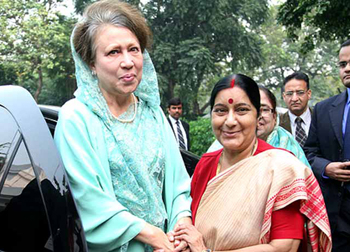
Swaraj meets BNP chief Khaleda Zia

June 27, 2014

Khaleda swarajDhaka, Jun 27: External Affairs Minister Sushma Swaraj today held a meeting here with former Bangladesh Prime Minister and chairperson of Bangladesh Nationalist Party (BNP) Khaleda Zia.

Swaraj, who held a series of meetings with the top leadership here yesterday including Prime Minister Sheikh Hasina besides holding delegation-level talks with her Bangladeshi counterpart A H Mahmud Ali, held talks for nearly half-an-hour with Zia at her hotel.

The meeting was termed as a "courtesy meeting" by Indian officials.

The external affairs minister's meeting with Zia comes in the backdrop of the Indian government's efforts to reach out to all sections of Bangladesh society.

Interestingly, the BNP chairperson did not meet President Pranab Mukherjee during his first official foreign visit here after assuming office last year.

Zia's party had cited security reasons for her calling off the meeting with Mukherjee in view of a two-day general strike called by BNP's ally Jamaat-e-Islami to press for a halt to the trial of fundamentalist leaders for war crimes during Bangladesh's liberation war in 1971.

Comments

Add new comment

  • Coastaldigest.com reserves the right to delete or block any comments.
  • Coastaldigset.com is not responsible for its readers’ comments.
  • Comments that are abusive, incendiary or irrelevant are strictly prohibited.
  • Please use a genuine email ID and provide your name to avoid reject.
News Network
April 13,2020

Vienna, Apr 13: Top oil-producing countries agreed on "historic" output cuts to prop up prices hammered by the coronavirus crisis and a Russia-Saudi price war, sending crude prices soaring on Monday.

The US benchmark WTI climbed 7.7 percent to $24.52 a barrel in early Asian trade while Brent was up 5.0 percent at $33.08.

OPEC producers dominated by Saudi Arabia and allies led by Russia thrashed out a compromise deal via videoconference Sunday after Mexico had balked at an earlier agreement struck on Friday.

In the compromise reached Sunday they agreed to a cut of 9.7 million barrels per day from May, according to Mexican Energy Minister Rocio Nahle, down slightly from 10 million barrels a day envisioned earlier.

OPEC Secretary General Mohammad Barkindo called the cuts "historic".

"They are largest in volume and the longest in duration, as they are planned to last for two years," he said.

The agreement between the Vienna-based Organization of the Petroleum Exporting Countries and partners foresees deep output cuts in May and June followed by a gradual reduction in cuts until April 2022.

Barkindo added that the deal "paved the way for a global alliance with the participation of the G20".

Saudi Energy Minister Prince Abdulaziz bin Salman, who chaired the meeting together with his Russian and Algerian counterparts, also confirmed that the discussions "ended with consensus".

Comments

Add new comment

  • Coastaldigest.com reserves the right to delete or block any comments.
  • Coastaldigset.com is not responsible for its readers’ comments.
  • Comments that are abusive, incendiary or irrelevant are strictly prohibited.
  • Please use a genuine email ID and provide your name to avoid reject.
Agencies
July 8,2020

Washington, Jul 7: President Donald Trump on Tuesday formally started the withdrawal of the United States from the World Health Organization, making good on threats to deprive the UN body of its top funding source over its response to the coronavirus.

Public health advocates and Trump's political opponents voiced outrage at the departure from the Geneva-based body, which leads the global fight on maladies from polio to measles to mental health -- as well as Covid-19, at a time when cases have again been rising around the world.

After threatening to suspend the $400 million (Dh1.47 billion) in annual US contributions and then announcing a withdrawal, the Trump administration has formally sent a notice to UN Secretary-General Antonio Guterres, a State Department spokesperson said.

The withdrawal is effective in one year -- July 6, 2021 -- and Joe Biden, Trump's presumptive Democratic opponent, is virtually certain to stop it and stay in the WHO if he wins the November election.

A spokesman for Guterres and the global health body itself confirmed that the United States, a key founding WHO member, gave its notice.

In a speech earlier in the day, WHO chief Tedros Adhanom Ghebreyesus said of Covid-19, "National unity and global solidarity are more important than ever to defeat a common enemy."

In line with conditions set when the WHO was set up in 1948, the United States can leave within one year but must meet its remaining assessed financial obligations, the UN spokesman said.

'Total control'

In late May, Trump said that China exerted "total control" over the WHO and accused the UN body led by Tedros, an Ethiopian doctor and diplomat, of failing to implement reforms.

Blaming China for the coronavirus, Trump, a frequent critic of the UN, said the United States would redirect funding "to other worldwide and deserving, urgent, global public health needs."

Democratic lawmakers have accused Trump of seeking to deflect criticism from his handling of the pandemic in the United States, which has suffered by far the highest death toll of any nation despite the president's stated hope that the virus will disappear.

"To call Trump's response to Covid chaotic and incoherent doesn't do it justice," said Senator Robert Menendez, the top Democrat on the Foreign Relations Committee.

"This won't protect American lives or interests -- it leaves Americans sick and America alone," he wrote on Twitter.

Representative Ami Bera, himself a physician, said that the United States and World Health Organization had worked "hand in hand" to eradicate smallpox and nearly defeat polio.

"Our cases are increasing," Bera said of Covid-19. "If the WHO is to blame: why has the US been left behind while many countries from South Korea to New Zealand to Vietnam to Germany return to normal?"

Even some of Trump's Republican allies had voiced hope that he was exerting pressure rather than making a final decision to abandon the World Health Organization.

The investigative news outlet ProPublica reported last month that most of Trump's aides were blindsided by the WHO withdrawal announcement, which he made during an appearance about China. 

The Trump administration has said that the WHO ignored early signs of human-to-human transmission in China, including warnings from Taiwan -- which, due to Beijing's pressure, is not part of the UN body.

While many public health advocates share some criticism of the WHO, they question what other options the world body had other than to work with China, where Covid-19 was first detected late last year in the city of Wuhan.

The anti-poverty campaign ONE said the United States should work to reform, not abandon, the WHO.

"Withdrawing from the World Health Organization amidst an unprecedented global pandemic is an astounding action that puts the safety of all Americans the world at risk," it said.

Comments

Add new comment

  • Coastaldigest.com reserves the right to delete or block any comments.
  • Coastaldigset.com is not responsible for its readers’ comments.
  • Comments that are abusive, incendiary or irrelevant are strictly prohibited.
  • Please use a genuine email ID and provide your name to avoid reject.
Agencies
July 3,2020

The dollar's dominance will slowly melt away over the coming year on weakening global demand and a sombre U.S. economic outlook, according to a Reuters poll of currency forecasters whose views depend on there being no second coronavirus shock.

Despite fears a surge in new Covid-19 cases would delay economies reopening and stymie a tentative recovery, world stocks have rallied - with the S&P 500 finishing higher in June, marking its biggest quarterly percentage gain since the height of the technology boom in 1998.

Caught between bets in favour of riskier investments, weak U.S. economic prospects as well as an easing in the thirst for dollars after the Federal Reserve flooded markets with liquidity, the greenback fell nearly 1.0 per cent last month. It was its worst monthly performance since December.

While there was a dire prognosis from the top U.S. medical expert on the coronavirus' spread, the June 25-July 1 poll of over 70 analysts showed weak dollar projections as Fed Chair Jerome Powell on Monday reiterated the economic outlook for the world's largest economy was uncertain.

"The dollar rises in two instances: when you see risk off or when there is a situation where the U.S. is leading the global recovery, and we don't think that's going to be the case anytime soon," said Gavin Friend, senior FX strategist at NAB Group in London.

"The U.S. is playing fast and loose with the virus, and chronologically they're behind the rest of the world."

Currency speculators, who had built up trades against the dollar to the highest in two years during May, increased their out-of-favour dollar bets further last week, the latest positioning data showed.

About 80 per cent of analysts, 53 of 66, said the likely path for the dollar over the next six months was to trade around current levels, alternating between slight gains and losses in a range. That suggests the greenback may be at a crucial crossroad as more currency strategists have turned bearish.

But more than 90 per cent, or 63 of 68, said a second shock from the pandemic would push the dollar higher. Five said it would push the U.S. currency lower.

Much will also depend on debt servicing and repayments by Asian, European and other international borrowers in U.S. dollars.

While an early shortage of dollars in March from the pandemic's first shock pushed the Fed to open currency swap lines with major central banks, international funding strains have eased significantly since. In recent weeks, usage of the facility has reduced dramatically.

That trend is expected to continue over the next six months with major central banks' usage of swap lines to "stay around current levels", according to 32 of 46 analysts. While 13 predicted a sharp drop, only one respondent said use of them would "rise sharply".

The dollar index, which measures the greenback's strength against six other major currencies, has slipped over 5 per cent since touching a more than three-year high in March.

When asked which currencies would perform better against the dollar by end-December, a touch over half of 49 respondents said major developed market ones, with the remaining almost split between commodity-linked and emerging market currencies.

"The dollar is so overvalued, and has been overvalued for a long time, it's time now for it to come back down again, as we head towards the (U.S.) election," added NAB's Friend.

Over the last quarter, the euro has staged a 1.8 per cent comeback after falling by a similar margin during the first three months of the year. For the month of June, the euro was up 1.2 per cent against the dollar.

The single currency was now expected to gain about 2.5 per cent to trade at $1.15 in a year from around $1.12 on Wednesday, slightly stronger than $1.14 predicted last month. While those findings are similar to what analysts have been predicting for nearly two years, there was a clear shift in their outlook for the euro, with the range of forecasts showing higher highs and higher lows from last month.

"In comparison to even a month or two ago, the outlook in Europe has improved significantly," said Lee Hardman, currency strategist at MUFG.

"I think that makes the euro look relatively more attractive and cheap against the likes of the dollar. We're not arguing strongly for the euro to surge higher, we're just saying, after the weakness we have seen in recent years, there is the potential for that weakness to start to reverse."


Comments

Add new comment

  • Coastaldigest.com reserves the right to delete or block any comments.
  • Coastaldigset.com is not responsible for its readers’ comments.
  • Comments that are abusive, incendiary or irrelevant are strictly prohibited.
  • Please use a genuine email ID and provide your name to avoid reject.