


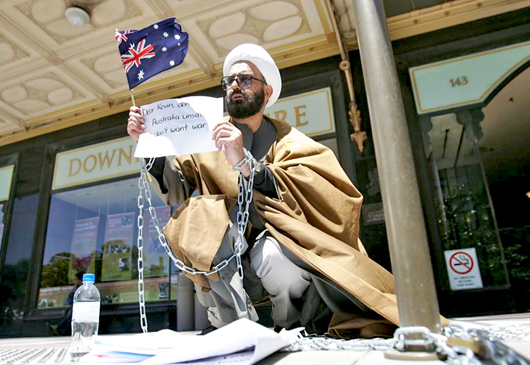
Sydney siege ends after 16 hrs, three dead

December 16, 2014

Sydney siege

Sydney, Dec 16: Heavily armed police officers ended a hostage crisis at the Lindt Chocolate Cafe here around 2:45 am local time on Tuesday, storming its premises where an armed man — said to be a self-proclaimed Sheik — held employees and customers, including two Indians, captive for more than 16 hours.

The two Indians, Vishwakant Ankireddy and Pushpendra Ghosh, both employees of Infosys, are safe.

The number of casualties was not immediately clear, but agencies reported that three people were dead, including the gunman.

“Sydney siege is over. More details to follow,” the New South Wales Police said in a tweet.

Earlier, the police said that the hostage-taker was Man Haron Monis, an Iranian-born man in his 50s with a criminal record, who called himself Sheik Haron.

Monis was carrying a black flag with white Arabic script similar to those used by Islamic militants on other continents, and the flag was later displayed in the window of the cafe.

Five people, including two cafe employees, had fled by 7 pm local time, but it was not clear whether the assailant had allowed them to leave or they had escaped. Helicopters hovered over the city, the train network was temporarily stopped and buildings, including the nearby Sydney Opera House, were shut down.

According to “The Age”, Monis was out on bail in two separate criminal cases. He was charged in November 2013 for murdering his ex-wife, Noleen Hayson Pal, who was stabbed and set on fire in an apartment in Werrington.

In April 2014, Monis was charged for sexual assault. The police said that Monis held himself out as a spiritual healer and conducted business on Station Street, Wentworthville. A website apparently associated with Monis includes condemnation of the US and Australia for their military actions against Islamic militants in Iraq and Afghanistan.

A Muslim community leader in Sydney, Dr Jamal Rifi, said in a televised interview: “Everything he stands for is wrong. It has nothing to do with Islam.”

Prime Minister Tony Abbott, before Monis was publicly identified, referred to him as “an armed person claiming political motivation.” The US Consulate General in Sydney, about a block from the cafe, and the Consulate General of India in Sydney, barely 400 metres from the cafe, were evacuated.

An Islamic State spokesman, Abu Muhammad al-Adnani, issued a statement in September asking Muslims in Australia to carry out attacks. On September 12, Abbott raised Australia's terrorism alert level to high from medium. He gave the police broader powers to arrest terror suspects and tightened restrictions on the media's reporting on national security matters. Two weeks later, police fatally shot a man who attacked them with a knife.

Comments

Add new comment

  • Coastaldigest.com reserves the right to delete or block any comments.
  • Coastaldigset.com is not responsible for its readers’ comments.
  • Comments that are abusive, incendiary or irrelevant are strictly prohibited.
  • Please use a genuine email ID and provide your name to avoid reject.
Agencies
January 10,2020

New York, Jan 10: The US's National Transportation Safety Board (NTSB) announced that it has accepted an invitation from Tehran to participate in its investigation into the crash of a Ukrainian plane amid speculations that an Iranian missile might have brought down the plane.

The federal agency said in a statement on Thursday that the Iran Civil Aviation Organization has notified them that they could take part in the investigation of the plane crash that occurred shortly after taking off from Tehran on Wednesday, killing all 176 people on board, reports the Efe news.

"The NTSB has designated an accredited representative to the investigation of the crash," said the independent US government agency tasked with investigating transport accidents.

Since the aircraft was a US-made Boeing 737-800, international regulations allow Washington to be a part of the accident investigation.

However, it remains unclear to what extent the NTSB representative will be able to play an active role in the probe, as US sanctions complicate cooperation with Iran, and the two countries have no diplomatic relations.

The NTSB announcement came hours after US intelligence sources told several media outlets that the Kiev-bound Ukrainian International Airlines (UIA) flight 752 could have been accidentally shot down by an Iranian missile.

Canadian Prime Minister Justin Trudeau later confirmed that his government had "evidence" indicating that the aircraft "was shot down by an Iranian surface to air missile", although he added it may have been unintentional.

The accident occurred on the same day after Iran launched more than a dozen ballistic missiles at two US military bases in Iraq, in retaliation for the killing of Iranian Major General Qasem Soleimani in an American drone attack in Baghdad on January 3.

However, the Iranian authorities have denied that they had accidentally shot down the plane and claimed the accusations were a part of a psychological warfare campaign against Tehran.

Iranian foreign ministry spokesman Abbas Mousavi said they welcomed the presence of experts from countries whose citizens have died in the tragic accident, and requested Trudeau and any other government to provide any information they had regarding the crash.

Comments

Add new comment

  • Coastaldigest.com reserves the right to delete or block any comments.
  • Coastaldigset.com is not responsible for its readers’ comments.
  • Comments that are abusive, incendiary or irrelevant are strictly prohibited.
  • Please use a genuine email ID and provide your name to avoid reject.
News Network
April 13,2020

Vienna, Apr 13: Top oil-producing countries agreed on "historic" output cuts to prop up prices hammered by the coronavirus crisis and a Russia-Saudi price war, sending crude prices soaring on Monday.

The US benchmark WTI climbed 7.7 percent to $24.52 a barrel in early Asian trade while Brent was up 5.0 percent at $33.08.

OPEC producers dominated by Saudi Arabia and allies led by Russia thrashed out a compromise deal via videoconference Sunday after Mexico had balked at an earlier agreement struck on Friday.

In the compromise reached Sunday they agreed to a cut of 9.7 million barrels per day from May, according to Mexican Energy Minister Rocio Nahle, down slightly from 10 million barrels a day envisioned earlier.

OPEC Secretary General Mohammad Barkindo called the cuts "historic".

"They are largest in volume and the longest in duration, as they are planned to last for two years," he said.

The agreement between the Vienna-based Organization of the Petroleum Exporting Countries and partners foresees deep output cuts in May and June followed by a gradual reduction in cuts until April 2022.

Barkindo added that the deal "paved the way for a global alliance with the participation of the G20".

Saudi Energy Minister Prince Abdulaziz bin Salman, who chaired the meeting together with his Russian and Algerian counterparts, also confirmed that the discussions "ended with consensus".

Comments

Add new comment

  • Coastaldigest.com reserves the right to delete or block any comments.
  • Coastaldigset.com is not responsible for its readers’ comments.
  • Comments that are abusive, incendiary or irrelevant are strictly prohibited.
  • Please use a genuine email ID and provide your name to avoid reject.
News Network
May 19,2020

May 19: A Chinese laboratory has been developing a drug it believes has the power to bring the coronavirus pandemic to a halt.

The outbreak first emerged in China late last year before spreading across the world, prompting an international race to find treatments and vaccines.

A drug being tested by scientists at China's prestigious Peking University could not only shorten the recovery time for those infected, but even offer short-term immunity from the virus, researchers say.

Sunney Xie, director of the university's Beijing Advanced Innovation Center for Genomics, told AFP that the drug has been successful at the animal testing stage.

"When we injected neutralising antibodies into infected mice, after five days the viral load was reduced by a factor of 2,500," said Xie.

"That means this potential drug has (a) therapeutic effect."

The drug uses neutralising antibodies -- produced by the human immune system to prevent the virus infecting cells -- which Xie's team isolated from the blood of 60 recovered patients.

A study on the team's research, published Sunday in the scientific journal Cell, suggests that using the antibodies provides a potential "cure" for the disease and shortens recovery time.

Xie said his team had been working "day and night" searching for the antibody.

"Our expertise is single-cell genomics rather than immunology or virology. When we realised that the single-cell genomic approach can effectively find the neutralising antibody we were thrilled."

He added that the drug should be ready for use later this year and in time for any potential winter outbreak of the virus, which has infected 4.8 million people around the world and killed more than 315,000.

"Planning for the clinical trial is underway," said Xie, adding it will be carried out in Australia and other countries since cases have dwindled in China, offering fewer human guinea pigs for testing.

"The hope is these neutralised antibodies can become a specialised drug that would stop the pandemic," he said.

China already has five potential coronavirus vaccines at the human trial stage, a health official said last week.

But the World Health Organization has warned that developing a vaccine could take 12 to 18 months.

Scientists have also pointed to the potential benefits of plasma -- a blood fluid -- from recovered individuals who have developed antibodies to the virus enabling the body's defences to attack it.

More than 700 patients have received plasma therapy in China, a process which authorities said showed "very good therapeutic effects".

"However, it (plasma) is limited in supply," Xie said, noting that the 14 neutralising antibodies used in their drug could be put into mass production quickly.

Using antibodies in drug treatments is not a new approach, and it has been successful in treating several other viruses such as HIV, Ebola and Middle East Respiratory Syndrome (MERS).

Xie said his researchers had "an early start" since the outbreak started in China before spreading to other countries.

Ebola drug Remdesivir was considered a hopeful early treatment for COVID-19 -- clinical trials in the US showed it shortened the recovery time in some patients by a third -- but the difference in mortality rate was not significant.

The new drug could even offer short-term protection against the virus.

The study showed that if the neutralising antibody was injected before the mice were infected with the virus, the mice stayed free of infection and no virus was detected.

This may offer temporary protection for medical workers for a few weeks, which Xie said they are hoping to "extend to a few months".

More than 100 vaccines for COVID-19 are in the works globally, but as the process of vaccine development is more demanding, Xie is hoping that the new drug could be a faster and more efficient way to stop the global march of the coronavirus.

"We would be able to stop the pandemic with an effective drug, even without a vaccine," he said.

Comments

Add new comment

  • Coastaldigest.com reserves the right to delete or block any comments.
  • Coastaldigset.com is not responsible for its readers’ comments.
  • Comments that are abusive, incendiary or irrelevant are strictly prohibited.
  • Please use a genuine email ID and provide your name to avoid reject.