



Symbolic 'Doomsday Clock' moves closer to midnight

January 27, 2017

Washington, Jan 27: Comments by US President Donald Trump on nuclear weapons and climate change have helped make the world less safe, the Bulletin of the Atomic Scientists warned on Thursday, moving its symbolic "Doomsday Clock" 30 seconds closer to midnight.
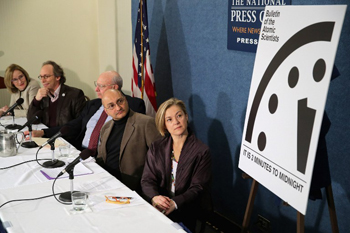
doomsdayThe clock which serves as a metaphor for how close humanity is to destroying the planet was last changed in 2015, from five to three minutes before midnight.

It is now set at two and a half minutes to midnight, amid concerns about "a rise in strident nationalism worldwide, President Donald Trump's comments on nuclear arms and climate issues, a darkening global security landscape that is colored by increasingly sophisticated technology, and a growing disregard for scientific expertise," said a statement by the group of scientists and intellectuals, including 15 Nobel laureates.

Trump has made contradictory statements about climate change, at times calling it a hoax and other times saying he would keep an open mind about it.

On the nuclear issue, Trump said in December that the US must build up its nuclear arsenal+ .

Responding to a statement by Russian President Vladimir Putin that Moscow needs to strengthen its own nuclear force, Trump responded with a tweet: "The United States must greatly strengthen and expand its nuclear capability until such time as the world comes to its senses regarding nukes."

"The Doomsday Clock is closer to midnight than it has ever been in the lifetime of almost everyone in this room," Lawrence Krauss, chair of the Bulletin's board of sponsors, told reporters at the National Press Club in Washington.

"The last time it was closer was 63 years ago in 1953 after the then Soviet Union exploded its first hydrogen bomb, creating the modern arms race," he added.

"More than that, this is the first time that the words and stated policies of one or two people placed in high positions have so impacted on our perception of the existential threats we believe the world faces," he said, alluding to Trump and Putin.

Krauss cited intelligence reports that accuse Russia of interfering with the US presidential campaign to favor Trump's victory as symbolic of the "deeper global threat" posed by cybertechnology.

"The question of whether the fabric of democracy may be imperiled by reducing faith in both the integrity of election and the very information on which an informed public can base their voting becomes suspect," said Krauss, a theoretical physicist at Arizona State University.

He also said the bulletin "is extremely concerned about the willingness of governments — including the current US administration — to ignore or discount some science or evidence during their decision-making process."

Last year, the warmest year in modern times due to human-driven climate change, world leaders "actually increased the threat of nuclear war and unchecked climate change through a variety of provocative statements and actions including careless rhetoric about the use of nuclear weapons," said Krauss.

An amid escalating rhetoric on the nuclear front, he called on Russia and the United States, which possess the large majority of the world's nuclear weapons, to focus in the coming year on reducing their arsenals.

"President Trump and President Putin, who claim great respect for each other, can choose to act together as statesmen or act as petulant children risking our future," he said.

"Regardless, these issues are too important to be left in the hands of a few men. We therefore call upon all people to speak out and send a loud message to your leaders that you will not allow them to needlessly threaten your future and the future of your children."

In an opinion piece published in the New York Times, Krauss and another bulletin scientist, David Titley, wrote that Trump was a key factor in their decision.

"Never before has the Bulletin decided to advance the clock largely because of the statements of a single person," they wrote.

"But when that person is the new president of the United States, his words matter."

The Doomsday Clock was created in 1947. It has changed 19 times since then, ranging from two minutes to midnight in 1953 to 17 minutes before midnight in 1991.

Comments

Add new comment

  • Coastaldigest.com reserves the right to delete or block any comments.
  • Coastaldigset.com is not responsible for its readers’ comments.
  • Comments that are abusive, incendiary or irrelevant are strictly prohibited.
  • Please use a genuine email ID and provide your name to avoid reject.
Agencies
June 19,2020

Denser places, assumed by many to be more conducive to the spread of the coronavirus that causes COVID-19, are not linked to higher infection rates, say researchers.

The study, led by Johns Hopkins University, published in the Journal of the American Planning Association, also found that dense areas were associated with lower COVID-19 death rates.

"These findings suggest that urban planners should continue to practice and advocate for compact places rather than sprawling ones, due to the myriad well-established benefits of the former, including health benefits," says study lead author Shima Hamidi from Johns Hopkins Bloomberg School of Public Health in the US.

For their analysis, the researchers examined SARS-CoV-2 infection rates and COVID-19 death rates in 913 metropolitan counties in the US.

When other factors such as race and education were taken into account, the authors found that county density was not significantly associated with county infection rate.

The findings also showed that denser counties, as compared to more sprawling ones, tended to have lower death rates--possibly because they enjoyed a higher level of development including better health care systems.

On the other hand, the research found that higher coronavirus infection and COVID-19 mortality rates in counties are more related to the larger context of metropolitan size in which counties are located.

Large metropolitan areas with a higher number of counties tightly linked together through economic, social, and commuting relationships are the most vulnerable to the pandemic outbreaks.

According to the researchers, recent polls suggest that many US citizens now consider an exodus from big cities likely, possibly due to the belief that more density equals more infection risk.

Some government officials have posited that urban density is linked to the transmissibility of the virus.

"The fact that density is unrelated to confirmed virus infection rates and inversely related to confirmed COVID-19 death rates is important, unexpected, and profound," said Hamidi.

"It counters a narrative that, absent data and analysis, would challenge the foundation of modern cities and could lead to a population shift from urban centres to suburban and exurban areas," Hamidi added.

The analysis found that after controlling for factors such as metropolitan size, education, race, and age, doubling the activity density was associated with an 11.3 per cent lower death rate.

The authors said that this is possibly due to faster and more widespread adoption of social distancing practices and better quality of health care in areas of denser population.

The researchers concluded that a higher county population, a higher proportion of people age 60 and up, a lower proportion of college-educated people, and a higher proportion of African Americans were all associated with a greater infection rate and mortality rate.

Comments

Add new comment

  • Coastaldigest.com reserves the right to delete or block any comments.
  • Coastaldigset.com is not responsible for its readers’ comments.
  • Comments that are abusive, incendiary or irrelevant are strictly prohibited.
  • Please use a genuine email ID and provide your name to avoid reject.
Agencies
July 2,2020

Paris, Jul 2: Several interacting exoplanets have already been spotted by satellites. But a new breakthrough has been achieved with, for the first time, the detection directly from the ground of an extrasolar system of this type.

An international collaboration including CNRS researchers has discovered an unusual planetary system, dubbed WASP-148, using the French instrument SOPHIE at the Observatoire de Haute-Provence (CNRS/Aix-Marseille Universite).

The scientists analysed the star's motion and concluded that it hosted two planets, WASP-148b and WASP-148c. The observations showed that the two planets were strongly interacting, which was confirmed from other data.

Whereas the first planet, WASP-148b, orbits its star in nearly nine days, the second one, WASP-148c, takes four times longer. This ratio between the orbital periods implies that the WASP-148 system is close to resonance, meaning that there is enhanced gravitational interaction between the two planets. And it turns out that the astronomers did indeed detect variations in the orbital periods of the planets.

While a single planet, uninfluenced by a second one, would move with a constant period, WASP-148b and WASP-148c undergo acceleration and deceleration that provides evidence of their interaction.

The study will shortly be published in the journal Astronomy & Astrophysics.

Comments

Add new comment

  • Coastaldigest.com reserves the right to delete or block any comments.
  • Coastaldigset.com is not responsible for its readers’ comments.
  • Comments that are abusive, incendiary or irrelevant are strictly prohibited.
  • Please use a genuine email ID and provide your name to avoid reject.
Agencies
May 20,2020

In a bid to help struggling small businesses in Covid-19 times, Facebook has introduced Shops to help set up a single online store for customers to access on both Facebook and Instagram.

While Facebook Shops is being rolled out from Wednesday, the company will introduce Instagram Shop, a new way to discover and buy products in Instagram Explore, this summer, starting in the US.

The social networking giant also announced that it will invest in features across its family of apps to inspire people to shop and make buying and selling online easier.

"Creating a Facebook Shop is free and simple. Businesses can choose the products they want to feature from their catalogue and then customise the look and feel of their shop with a cover image and accent colours that showcase their brand," Facebook said in a statement late Tuesday.

Any seller, no matter their size or budget, can bring their business online and connect with customers wherever and whenever it's convenient for them.

People can find Facebook Shops on a business' Facebook Page or Instagram profile, or discover them through stories or ads.

"From there, you can browse the full collection, save products you're interested in and place an order — either on the business' website or without leaving the app if the business has enabled checkout in the US," informed the company.

Last month, Facebook announced $40 million in grants for 10,000 small businesses in the US to help them get through these challenging time.

The grants will go to small businesses in 34 locations where Facebook employees live and work.

The company said that in Facebook Shops, users will be able to message a business through WhatsApp, Messenger or Instagram Direct to ask questions, get support, track deliveries and more.

In the future, they will be able to view a business' shop and make purchases right within a chat in WhatsApp, Messenger or Instagram Direct.

Later this year, Facebook will add a new shop tab in the navigation bar, so people can get to Instagram Shop in just one tap.

Facebook said it is making it easier to shop for products in real time.

Soon, sellers, brands and creators will be able to tag products from their Facebook Shop or catalogue before going live and those products will be shown at the bottom of the video so people can easily tap to learn more and purchase.

"We're starting to test this with businesses on Facebook and Instagram, and we'll roll it out more broadly in the coming months," said the company.

Facebook is also working with partners like Shopify, BigCommerce, WooCommerce, ChannelAdvisor, CedCommerce, Cafe24, Tienda Nube and Feedonomics to support small businesses.

Comments

Add new comment

  • Coastaldigest.com reserves the right to delete or block any comments.
  • Coastaldigset.com is not responsible for its readers’ comments.
  • Comments that are abusive, incendiary or irrelevant are strictly prohibited.
  • Please use a genuine email ID and provide your name to avoid reject.