


Syrian warplanes strike near Damascus during fragile truce

January 2, 2017

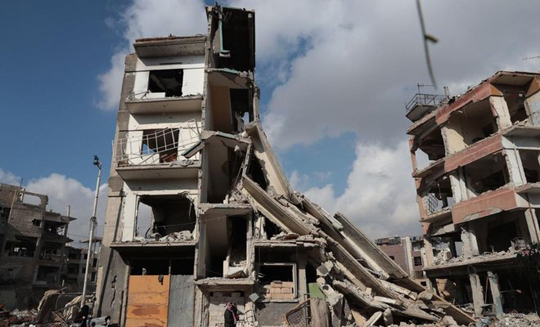
Beirut, Jan 2: Syrian government warplanes resumed their bombardment of a rebel-held valley near Damascus on Sunday after nearly 24 hours with no air raids, a rebel official and monitors said, during the third day of a fragile cease-fire.
syria

The truce deal, brokered by Russia and Turkey which back opposing sides in the conflict and welcomed unanimously by the United Nations Security Council, has been repeatedly violated since it began, with warring sides trading the blame.

Rebels on Saturday warned they would abandon the truce if the government side continued to violate it, asking the Russians, who support President Bashar Assad, to rein in army and militia attacks in the valley by 8 p.m.

Bombardments ceased before that time — although some clashes continued — but began again late on Sunday.

It was not immediately clear if the rebels would abandon the truce as a result.
Like previous Syria cease-fire deals it has been shaky from the start with repeated outbreaks of violence in some areas, but has largely held elsewhere.

The raids hit areas of Wadi Barada, where government forces and their allies launched an operation more than a week ago, a spokesman for the Jaish Al-Nasr rebel group and the British-based Syrian Observatory for Human Rights said.

There was a “fierce attack and attempt by Assad and Shiite militias to raid Wadi Barada” from nearby hills, the rebel spokesman, Mohammed Rasheed, said.

State media and the Observatory said hundreds of people had left Wadi Barada in the past day for government-controlled areas nearby.

Earlier on Sunday government warplanes carried out several air strikes in the southern Aleppo countryside, the Observatory and rebel officials said.

Government forces also advanced overnight against rebels in the Eastern Ghouta area near Damascus, seizing 10 farms, the Observatory said.

A second rebel official suggested that low-level clashes on the ground would not necessarily derail the truce, but that air strikes were a “clear violation.”

Russia’s defense ministry has accused the insurgents in turn of violating the cease-fire numerous times.

A military news outlet run by Lebanese group Hezbollah, an ally of Assad, said the Syrian army had been targeting militants from the former Nusra Front both in southern Aleppo province and in Wadi Barada.

The army has said the group, previously Al-Qaeda’s Syria branch, is not included in the cease-fire deal but rebels say it is — just one point of friction and confusion in the deal which could lead to its collapse.

The latest truce agreement is the first not to involve the United States or the United Nations — a reflection of Moscow’s growing diplomatic influence after a long campaign of Russian air strikes helped Assad recapture the northern city of Aleppo last month.

That victory has greatly strengthened the president’s position as the warring sides prepare for peace talks in the Kazakh capital Astana this month.

Comments

Add new comment

  • Coastaldigest.com reserves the right to delete or block any comments.
  • Coastaldigset.com is not responsible for its readers’ comments.
  • Comments that are abusive, incendiary or irrelevant are strictly prohibited.
  • Please use a genuine email ID and provide your name to avoid reject.
Agencies
May 7,2020

Dubai, May 7: Indians in the UAE have voiced scepticism about a "massive" operation announced by New Delhi to bring home some of the hundreds of thousands of nationals stranded by coronavirus restrictions.

"It is just propaganda," said Ishan, an Indian expatriate in Dubai, one of seven emirates in the UAE and long a magnet for foreign workers.

He was reacting to his government's announcement this week that it would deploy passenger jets and naval ships to bring home citizens stuck in a host of countries.

India's consulate in Dubai said it received about 200,000 requests from nationals seeking repatriation -- mostly workers who have lost their jobs in the pandemic.

One vessel was heading to the UAE, India's government said, while two flights were scheduled to depart the UAE for India on Thursday.

But the plans drew scorn from Ishan, who was a manager at a luxury services company before he was made redundant last month.

"It's like throwing a dog a bone," the 35-year-old complained on Wednesday, dismissing the Indian government's efforts as a drop in the ocean.

"Let's say they repatriate 400 people on the first day, and about 5,000 people in 10 days, what difference has it made?"

India banned all incoming commercial flights in late March as it imposed one of the world's strictest lockdowns to tackle the spread of coronavirus.

The UAE is home to a 3.3-million-strong Indian community, who make up around 30 per cent of the Gulf state's population.

To the anger of some Indian expatriates, the evacuees will have to pay for their passage home and spend two weeks in quarantine on arrival.

"We are upset over the failure of our government," Ishan said. "What about the people with no money? How are you helping them?"

The Indian consulate could not be reached for comment.

Ibrahim Khalil, head of the Kerala Muslim Cultural Center in Dubai, said the consulate had asked him to select 100 Indian nationals for repatriation.

"We are planning to pay for the tickets of those who cannot afford it," he said, adding that the elderly, pregnant and those suffering from illnesses were a priority.

But one Indian woman, eight months pregnant in the neighbouring emirate of Sharjah, was not one of the lucky ones chosen to go back home in one of Thursday's planned departures.

"We called them but nobody would pick up," the 26-year-old, who requested anonymity, told AFP.

She arrived in the UAE a few months ago to visit her husband, who lives in a shared apartment with another family to save money.

"We have no insurance here and the medical expenses are too costly," said the woman, who was anxious to leave to give birth at home.

"I just hope that I am chosen to go back to India. I don't know why I haven't been considered."

Comments

Add new comment

  • Coastaldigest.com reserves the right to delete or block any comments.
  • Coastaldigset.com is not responsible for its readers’ comments.
  • Comments that are abusive, incendiary or irrelevant are strictly prohibited.
  • Please use a genuine email ID and provide your name to avoid reject.
Agencies
July 8,2020

Jeddah, Jul 8: The Organization of Islamic Cooperation (OIC) writes to the members of the United Nations Security Council (UNSC), urging the body to come in the way of a plan announced by Israel for annexation of significant portions of the occupied West Bank.

The letter was addressed by the 57-member organization’s Secretary-General Yousef al-Othaimeen to the UNSC’s members as well as the members of the Middle East Quartet — the European Union, Russia, United Nations, and United States— the Arabic-language Rai al-Youm news website reported on Tuesday.

The letter urged the Council to adopt “the necessary measures” that would prevent the annexation and compel Israel to stop all its illegal activities.

The OIC also urged the UNSC to hold an emergency meeting to “salvage the [remaining] opportunities for peace, and revive attempts at reinstatement of the political process under international supervision.” Such meeting, it added, had to enable realization of “the two-state solution, and [creation of] a Palestinian state with East Jerusalem [al-Quds] as its capital.”

Israel’s Prime Minister Benjamin Netanyahu announced the plan to annex 30 percent of the occupied Palestinian territory — namely the areas upon which the regime has built its illegal settlements as well as the Jordan Valley — after US President Donald Trump backed the annexation in January.

Trump pledged the support while unveiling details of his Middle East scheme called the “deal of the century.”

The highly controversial scheme allegedly seeks to resolve the Palestinian-Israeli conflict, but is heavily tilted in favor of the occupying regime. As well as backing the annexation, the scheme re-endorses Washington’s incendiary recognition in late 2017 of al-Quds as “Israel’s capital,” although Palestinians want the occupied holy city’s eastern part to serve as the capital of their future state.

Palestinians have roundly rejected either the American design or the Israeli plan that is rooted in it.

Tel Aviv had previously announced July 1 as the date it sought to start implementing the annexation plan. It, however, is yet to get it off the ground amid far-and-wide international condemnation and speculation that the plan was announced in the first place to deflect attention from a massive corruption scandal involving Netanyahu.

Countries warn Israel of consequences to bilateral ties

Also on Tuesday, Egypt, France, Germany, and Jordan warned Israel against going ahead with the plan, saying that doing so could have consequences for their bilateral relations with the Tel Aviv regime.

In a statement distributed by the German Foreign Ministry, the countries said their foreign ministers had discussed how to restart talks between Israel and the Palestinian Authority.

Most other European countries have likewise communicated their objection to the plan.

“We concur that any annexation of Palestinian territories occupied in 1967 would be a violation of international law and imperil the foundations of the peace process,” the European and Middle Eastern foreign ministers said, referring to the year, when Israel occupied the West Bank.

“We would not recognize any changes to the 1967 borders that are not agreed by both parties in the conflict,” they added. “It could also have consequences for the relationship with Israel.”

Israel had no immediate response. In a separate statement, however, Netanyahu’s office communicated Tel Aviv’s intransigence on the matter.

The statement said the Israeli premier had told his British counterpart Boris Johnson on Monday that he was committed to Trump’s “realistic” plan.

“Israel is prepared to conduct negotiations on the basis of President Trump’s peace plan, which is both creative and realistic, and will not return to the failed formulas of the past,” the statement alleged.

Comments

Add new comment

  • Coastaldigest.com reserves the right to delete or block any comments.
  • Coastaldigset.com is not responsible for its readers’ comments.
  • Comments that are abusive, incendiary or irrelevant are strictly prohibited.
  • Please use a genuine email ID and provide your name to avoid reject.
Agencies
July 22,2020

Dubai, Jul 22: Saudi Arabia's Minister of Haj and Umrah, Dr Muhammad Saleh Benten, has inspected the facilities and arrangement made for the Haj pilgrims in Makkah and the holy sites.

Speaking to the Saudi Press Agency after the tour, the minister said that the Saudi government has worked out unprecedented plans for the running of this year's Haj, enabling pilgrims to perform their rituals in ease and comfort.
 
This year's Haj, which has been scaled back dramatically to include only around 1,000 Muslim pilgrims as Saudi Arabia battles a coronavirus surge, will begin on July 29, authorities said Monday.

"The comprehensive, foolproof plans will be implemented by the security, health and service agencies. The plans include the provision of the best health services, and the most appropriate crowd control, strictly in line with the precautionary measures and preventive protocols, formulated by the Ministry of Health to ensure full safety of pilgrims from the coronavirus pandemic," Dr Benten said.

According to the Saudi Gazette, Benten emphasised the eagerness of the government of the Custodian of the Two Holy Mosques, King Salman bin Abdulaziz of Saudi Arabia and Saudi Crown Prince Mohammed bin Salman bin Abdulaziz Al Saud to implement the Haj operation by following the highest health standards and precautionary measures in order to ensure the safety of the pilgrims.

Earlier, the minister inspected the arrangements and facilities for the reception and accommodation of pilgrims at Four Point Hotel in Makkah.

He was briefed by ministry officials with regard to receiving and accommodating pilgrims during the period from 4 to 8 of Dhul Hijjah before leaving for Mina.

Benten also visited the tents in Arafat and the facilities in Muzdalifah.

After that, his inspection tour visited the tent city of Mina, where he viewed one of the towers designated for the housing of pilgrims. 

According to the Saudi Gazette, he was impressed with the services and facilities being arranged for the accommodation and serving of food for the pilgrims.

To complete his visit, the minister watched a visual presentation of the mechanism for providing logistical services for the pilgrims during their travel from accommodation to Jamarat to undertake the stoning ritual.

Meanwhile, Maj. Gen. Mohammed Bin Wasl Al Ahmadi, assistant commander of the Haj security forces for the Grand Mosque and its premises, said on Tuesday that the security plan for this year's pilgrimage prioritises on organisational, security, humanitarian and health aspects.

He said the Haj security forces have installed entry and exit mechanisms from the Grand Mosque during Haj, with passages for pilgrims extending from the southern and western premises of venue as well as special passages around the circumambulation and Saey areas.

Comments

Add new comment

  • Coastaldigest.com reserves the right to delete or block any comments.
  • Coastaldigset.com is not responsible for its readers’ comments.
  • Comments that are abusive, incendiary or irrelevant are strictly prohibited.
  • Please use a genuine email ID and provide your name to avoid reject.