



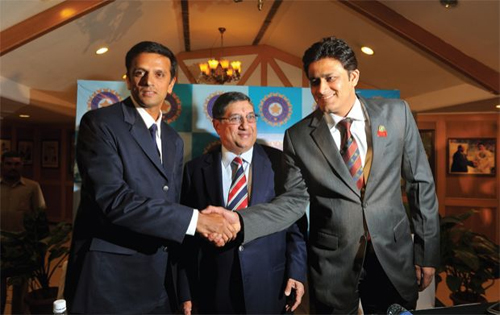
His favourite book is The Godfather. His favourite film probably goes by the same name, but we don't know if he watches films at all. Most of his cars have the registration number 9001. He loves his immaculate Savile Row and Armani suits and his scotch in the evening. If there is something he regrets, he once told a TV interviewer in jest, it is his golf handicap that has gone from eight to double digits. He hates losing.
He is the president of the Board of Control for Cricket in India (BCCI); the next ICC chairman, set to take over in June 2014; the 'de-facto' owner — he denies it — of the Chennai Super Kings; former president of the All India Chess Federation; and the reigning supremo of the Tamil Nadu Cricket Association and the Tamil Nadu Golf Federation. Meet Narayanswami Srinivasan, a man, who does not know the meaning of giving up.
These days, it is not just cricket that is in trouble. Olympic sports, always a poor country cousin to cricket in India, too, has been in trouble. It was always in a bit of a mess, but the pain has become more acute now. Some years ago, the Indian sports officials decided they could conduct a successful Commonwealth Games. Those Games in 2010 went off well, India won almost a 100 medals, but the mess began thereafter.
Reports of financial wrongdoing, large-scale corruption and much else began emerging. Soon after that, a whole lot of people connected with the Commonwealth Games were made to shift their residences temporarily from their posh homes to Tihar jail. Then in November 2012, within a few months after India won its best-ever haul of six medals, it was suspended by the International Olympic Committee (IOC). Reason: the IOC felt that 'tainted' officials ought to be shown the door, but the Indians disagreed, and the IOC simply banished the Indians and forced onto them the ignominy of walking behind an Olympic flag instead of the Indian tricolour. It hurt when a bunch of Indian youngsters won medals, including gold, at an Asian Youth Games, but were forced to stand behind an Olympic Council of Asia flag.
Last week, India's only five-time Winter Olympian, Shiva Keshavan and his two colleagues Himanshu Thakur and Nadeem Iqbal, too, were not allowed to carry the Indian colours. The whole nation seemed to be up in arms.
Yes, Olympic sports in India needed a saviour.
And in he walked. He was a former president of the Indian Triathlon Federation, who went on to head the Asian Triathlon Federation.
Side by side, from being the Secretary-General of the Squash Rackets Federation of India, he became its president and was then elected president of the Asian Squash Federation in 2005. He was re-elected to this position in 2005 and by 2009 he was the Patron of the Association. In between in 2008, he took over as the president of the World Squash Federation (WSF) from Jahangir Khan. In 2012, he became the World Body's president for a second term. Coming into the Indian Olympic Association (IOA) as an associate vice-president, he was elected a vice-president in 2005 and in 2007, he was appointed as an executive committee member of the Sports Development Authority of Tamil Nadu. A member of the Audit Committee for the Delhi Commonwealth Games 2010, he was also on the executive board for the Games. He sure knew his way up.
As a president of the WSF, he twice, though unsuccessfully, made presentations to the IOC to include his sport in the Olympic programme. It was supposed to be a creditable presentation, but it lost out to wrestling, a sport that has won India medals in the past two Olympic Games.
This past week, he became the new IOA president. Unopposed, just as many of his elections in other sporting bodies, have been. That he was also being called a 'proxy' for the 'tainted' officials is another matter. Outside of the sports arena, he was a respectable industrialist and a former executive director of India Cements and his interests included sugar, shipping, power, and trading and finance. As if that was not enough, he is also the honorary consul for the Government of Latvia with jurisdiction for Tamil Nadu and Kerala. Meet Narayanswamy Ramachandran, the new IOA president and brother of N Srinivasan.
Indian sports can be divided into two categories — cricket and the rest (that means Olympic sports). One brother, 'Srini' held the reins in cricket and 'Rami' was the master of the rest. Under normal circumstances, that would merit a headline by itself: Brothers ruling Indian sport. Alas, not all stories are fairytales. The two brothers are hardly, well… brotherly, or even friends.
A LOT has been said and written about how Srinivasan returned from the United States at the age of 23 to take over his father's business. Then began a series of tales, which saw him take control, and then lose control of the business at India Cements. But the man who never gives up waited for his time.
He cultivated friends in the right places and after 10 years, got his business back. He may attribute it to luck, but luck, if any, was just a footnote. It was a result of his tenacity and ability to bounce back.
His has been a tale of nurturing and leveraging powerful relationships. Murasoli Maran, nephew of DMK supremo M Karunanidhi, was his friend and it was with his help that he wrested back the control of his business. That Maran's son, Kalanidhi, also a media baron, became the owner of Sunrisers Hyderabad, when the team came up for grabs in the last season, would seem a coincidence, but insiders say, Srinivasan's presence helped. Besides, Kalanidhi also owns an airline.
Srinivasan's friends included the late BS Adityan, a former IOA president and a business magnate, who owned a string of newspapers and a TV channel, NDTV-Hindu. Adityan was a director at India Cements till he passed away in 2013.
Interestingly, Ramachandran too, was once a director in the company. Of course, elder brother Srini was all-powerful. Then suddenly in 2009, Srinivasan bought over Ramachandran's stake in the company and both refused to talk about it, calling it a private transaction. To date, no one is clear, why Ramachandran, 61 then, and three years younger than his elder brother, decided to suddenly leave.
As time went by, Srnivasan grew and grew while Ramachandran stayed in the shadows. Or so it seemed.
Ruthless to those who dared to oppose him and benevolent beyond imagination to those he considered 'loyalists', Srinivasan has as many admirers as detractors. For every official, who he has sidelined or brushed aside in his march to numero uno position in Indian cricket, there is somewhere a cricketer, local or national, he has given a job. He has backed no less than a dozen teams, probably more, at local and national leagues and the list of cricketers he has had on his rolls is like a who's who of Indian cricket — current India and Chennai Super Kings captain MS Dhoni, former India captains S Venkataraghavan and Rahul Dravid and many, many more have played for his teams.
It is said that when it came to giving the former players monies for their contribution to Indian cricket, many other BCCI officials felt it should be done in instalments to ensure the ex-cricketers stayed ingratiated to the Board. Srinivasan rejected the idea and gave the money in one go. The likes of Sunil Gavaskar, Kapil Dev, Ravi Shastri, Dilip Vengsarkar, Syed Kirmani were among those who got Rs 1.5 crore each from the Rs 75 crore or so that was distributed among the 174 cricketers who retired before 2004.
Srinivasan's detractors allege that he has caused losses of hundreds of crores to the BCCI because of various deals — allegations that have not yet been proved. Srinivasan himself is unfazed.
When it comes to the alleged 'conflict of interest' of 'owning' an IPL team and also being the president of the BCCI, Srinivasan claims the team belongs to India Cements, and not him. That he is also the managing director of India Cements is another matter.
Srinivasan's son-in-law, Gurunath Meiyappan, who for the past six seasons was seen hobnobbing with the Chennai Super Kings, was arrested last year and questioned in connection with alleged betting and fixing matches in the IPL. Both charges are yet to be proved in a court of law.
The Justice Mudgal Committee, which was set up by the Supreme Court to look into the IPL scandal, has reported that Meiyappan did indulge in betting, but also said that it is unclear if he was involved in passing information, which could have led to fixing. The report has also claimed that Meiyappan was very much the face of Chennai Super Kings, while Srinivasan and Indian skipper MS Dhoni, who was questioned by the Committee, have claimed that Meiyappan was a mere “enthusiast”. That an enthusiast could sit on the auction table and be with the team on the ground is a little difficult to swallow. And there hangs a tale, whether or not Chennai Super Kings should be banned from the IPL as per the rules of the competition. The Mudgal report has been submitted and the matter will be taken up by the Supreme Court on 7 March.
Ramachandran may be relatively low-profile, but he, too, is no stranger to controversies. Clean Sports India (CSI), a non-profit organisation run by a bunch of sportspersons and officials, claims Ramachandran misled the government to get the Rashtriya Khel Protsahan Puraskar in 2011 by the President. The case will come up for hearing in the Delhi High Court on 21 February.
The CSI also alleges a case of conflict of interest (much like that of his elder brother Srinivasan) against Ramachandran. He is said to have given an undertaking to the WSF (which he currently heads) in 2012 that he had no commercial interest in the game, and projected himself just as a patron of Squash and Racquet Federation of India (SRFI). They claim he was then serving as the president of SRFI, but currently, the president of the SRFI is KS Tripathi.
While Ramachandran's election brought in immediate results and the Indian trio in the Sochi Winter Olympics will be able to walk with the Indian flag at the closing ceremony, Indian cricket and Srinivasan, who only a week earlier was named as the next ICC chairman, are under a cloud.
It is said Srinivasan does little without consulting his astrologer, who goes by the name of Vaastu Venkatesan. Years ago, the religiously inclined Srini ensured the rebuilding of the then dilapidated Ganesh temple outside the Chepauk Stadium (now the MA Chidambaram Stadium) in Chennai, from there the Gods watched his rise in the Tamil Nadu Cricket Association, which he has ruled for years
These days, Vaastu Venkatesan must be a busy man, and Srini needs a bit more than tenacity; he also needs the Lords' blessings more than ever before.

Comments
Add new comment