


Taliban Attack Near Afghan Parliament Kills More Than 30

January 11, 2017

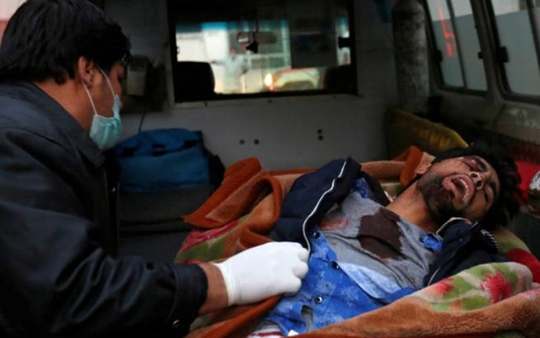
Kabul, Jan 11: A Taliban suicide attack in the Afghan capital Kabul on Tuesday killed more than 30 people and wounded some 70 others, as twin blasts hit a crowded area of the city during the afternoon rush hour.
Afgan

Saleem Rasouli, a senior public health official, said 33 people had been killed and more than 70 wounded on the Darul Aman road, near an annexe to the new Indian-financed parliament building. Most of the victims were parliamentary staff members.

The Islamist militant Afghan Taliban movement, which immediately claimed responsibility for the attack, said its target had been a minibus carrying staff from the National Directorate of Security (NDS), Afghanistan's main intelligence agency. It put casualties at around 70.

It said one suicide bomber attacked the minibus in the Darul Aman area, and was followed almost immediately by a car bomber, who killed security forces attending the scene.

"Right after the explosion, I jumped in a stream and then I saw some injured people and a bus which was totally burnt out," said Sajadullah Khan, a witness who was walking by when the blasts occurred.

President Ashraf Ghani condemned the "criminal" attacks and vowed that the perpetrators would not be safe anywhere in the country.

"The Taliban shamelessly claim credit for the attack on civilians and they're proud of it," he said in a statement.

The attack underlined the security threat posed by Islamist militants fighting to topple the Afghan government and drive out foreign troops stationed there for the last 15 years.

Afghan armed forces control no more than two thirds of national territory, and have struggled to contain the Taliban insurgency since the bulk of NATO soldiers withdrew at the end of 2014.

Several thousand, mainly Americans, remain in training and counter-terrorism roles.

The United States recently announced plans to send 300 Marines to the volatile southern province of Helmand, large parts of which are under Taliban control, as part of a regular rotation of troops helping train and advise Afghan forces.

Earlier on Tuesday, a suicide bomber killed seven people and wounded nine when he detonated his explosives in a house in Helmand used by an NDS unit.

Thousands of civilians have been killed in Afghanistan in the 15 years since the Taliban government was brought down in the US-led campaign of 2001.

In July, the UN Assistance Mission in Afghanistan reported that 1,601 civilians had been killed in the first half of the year, a record since it began collating figures in 2009.

As well as the Taliban and associated groups including the Haqqani network, militants pledging loyalty to Islamic State have carried out major attacks in Kabul, most recently in November when more than 30 people were killed by a suicide bomber in a Shi'ite mosque.

Comments

Add new comment

  • Coastaldigest.com reserves the right to delete or block any comments.
  • Coastaldigset.com is not responsible for its readers’ comments.
  • Comments that are abusive, incendiary or irrelevant are strictly prohibited.
  • Please use a genuine email ID and provide your name to avoid reject.
News Network
March 24,2020

New Delhi, Mar 24: Reports of a person in China dying due to a virus called hantavirus have spread panic at a time when the world is battling the pandemic of novel coronavirus, which began in China.

The novel coronavirus has killed over 16,000 people around the world and the outbreak is yet to be brought under control.

This morning, hantavirus became one of the top trends on Twitter after the Chinese state media tweeted about one person in the country dying due the virus. However, it turns out, hantavirus is not a new virus and has been infecting humans for decades.

Global Times, a state-run English-language newspaper, wrote on Twitter on Tuesday, "A person from Yunnan Province died while on his way back to Shandong Province for work on a chartered bus on Monday. He was tested positive for hantavirus. Other 32 people on bus were tested."

Global Times's hantavirus report on Twitter has been shared over 6,000 times.

On Tuesday, hantavirus was one of the top trends on Twitter.

WHAT IS HANTAVIRUS?

Some people are calling it a new virus but so is not the case. United States's National Center for Biotechnology Information (NCBI) in a journal writes that currently, the hantavirus genus includes more than 21 species.

"Hantaviruses in the Americas are known as 'New World' hantaviruses and may cause hantavirus pulmonary syndrome [HPS]," CDC says. "Other hantaviruses, known as 'Old World' hantaviruses, are found mostly in Europe and Asia and may cause hemorrhagic fever with renal syndrome [HFRS]."

Any man, woman, or child who is around mice or rats that carry harmful hantaviruses can get HPS.

People get HPS when they breath in hantaviruses. This can happen when rodent urine and droppings that contain a hantavirus are stirred up into the air. People can also become infected when they touch mouse or rat urine, droppings, or nesting materials that contain the virus and then touch their eyes, nose, or mouth. They can also get HPS from a mouse or rat bite.

In the US, 10 confirmed cases of hantavirus infection in people who visited Yosemite National Park in California, US, in November 2012, were reported. Similarly, in 2017, CDC assisted health officials in investigating an outbreak of Seoul virus infection that infected 17 people in seven states.

WHAT ARE THE SYMPTOMS OF HANTAVIRUS?

If people get HPS, they will feel sick one to five weeks after they were around mice or rats that carried a hantavirus.

At first people with HPS will have:

Fever
Severe muscle aches
Fatigue

After a few days, they will have a hard time breathing. Sometimes people will have headaches, dizziness, chills, nausea, vomiting, diarrhoea, and stomach pain.

Usually, people do not have a runny nose, sore throat, or a rash.

Comments

Add new comment

  • Coastaldigest.com reserves the right to delete or block any comments.
  • Coastaldigset.com is not responsible for its readers’ comments.
  • Comments that are abusive, incendiary or irrelevant are strictly prohibited.
  • Please use a genuine email ID and provide your name to avoid reject.
News Network
June 2,2020

Jun 2: Pakistan's COVID-19 cases reached 76,398 on Tuesday after 3,938 new infections were reported across the country, while the death toll due to the coronavirus has gone up to 1,621, according to the health ministry.

The Ministry of National Health Services said that 78 COVID-19 deaths were recorded in the last 24 hours, taking the total number of fatalities in Pakistan to 1,621.

A total of 27, 110 people have recovered, it said.

Sindh has 29,647 patients, Punjab 27,850, Khyber-Pakhtunkhwa 10,485, Balochistan 4,514, Islamabad 2,893, Gilgit-Baltistan 738 and Pakistan-occupied Kashmir 271, it added.

The authorities have conducted 577,974 tests, including 16,548 in the last 24 hours.

The jump in the number of cases comes a day after Prime Minister Imran Khan said that people should learn to live with COVID-19 until a vaccine is developed.

Khan addressed the media after chairing the meeting of National Coordination Committee, the highest body to tackle the pandemic.

"Coronavirus will not go away until the vaccine is discovered. We need to learn to live with it and we can live with it if we follow precautions," he said.

He said the one million volunteers of the government's coronavirus force will raise awareness of the need to follow guidelines.

The government also said that all sectors will be opened slowly after deciding the negative list of businesses which will not be allowed.

Comments

Add new comment

  • Coastaldigest.com reserves the right to delete or block any comments.
  • Coastaldigset.com is not responsible for its readers’ comments.
  • Comments that are abusive, incendiary or irrelevant are strictly prohibited.
  • Please use a genuine email ID and provide your name to avoid reject.
News Network
February 28,2020

Washington, Feb 28: US intelligence agencies are monitoring the global spread of coronavirus and the ability of governments to respond, sources familiar with the matter said on Thursday, warning that there were concerns about how India would cope with a widespread outbreak.

While there are only a few known cases in India, one source said the country's available countermeasures and the potential for the virus to spread given India's dense population was a focus of serious concern.

US intelligence agencies are also focusing on Iran, where the country's deputy health minister has fallen ill during a worsening outbreak.

US Secretary of State Mike Pompeo said on Tuesday the United States was "deeply concerned" Tehran may have covered up details about the spread of coronavirus. A US government source said Iran's response was considered ineffective because the government only has minimal capabilities to respond to the outbreak.

Another source said US agencies were also concerned about the weak ability of governments in some developing countries to respond to an outbreak.

The US House of Representatives Intelligence Committee has received a briefing on the virus from the spy agencies. "The Committee has received a briefing from the IC (intelligence community) on coronavirus, and continues to receive updates on the outbreak on a daily basis," an official of the House Intelligence Committee told Reuters.

"Addressing the threat has both national security and economic dimensions, requiring a concerted government-wide effort and the IC is playing an important role in monitoring the spread of the outbreak, and the worldwide response," the official added.

A source familiar with the activities of the Senate Intelligence Committee, led by Republican Senator Richard Burr and Democratic Senator Mark Warner, said the panel was receiving daily updates. The role of US intelligence agencies in responding to the coronavirus epidemic at this point principally involves monitoring the spread of the illness around the world and assessing the responses of governments.

They are working closely with health agencies, such as the US Center for Disease Control, in sharing information they collect and targeting further intelligence gathering.

One source said US agencies would use a wide range of intelligence tools, ranging from undercover informants to electronic eavesdropping tools, to track the virus' impact.

Comments

Add new comment

  • Coastaldigest.com reserves the right to delete or block any comments.
  • Coastaldigset.com is not responsible for its readers’ comments.
  • Comments that are abusive, incendiary or irrelevant are strictly prohibited.
  • Please use a genuine email ID and provide your name to avoid reject.