


Tens of thousands flee clashes between Syria army, IS

March 4, 2017

Manbij (Syria), Mar 4: Tens of thousands of Syrian civilians have fled ferocious fighting between Russian-backed regime forces and Islamic State group jihadists over the past week in the country's ravaged north. Supported by Russian air power and artillery, Syrian government forces have waged a fierce offensive against IS, seizing around 90 villages from the jihadists since mid-January.wirw
Their aim, according to the Syrian Observatory for Human Rights monitoring group, is IS-held Khafsah, the main station pumping water into Aleppo. Residents of Syria's second city have been without mains water for 47 days after the jihadists cut the supply.

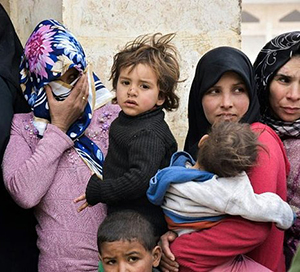
The fighting over the past week has sparked an exodus of "more than 30,000 civilians, most of them women and children," Observatory head Rami Abdel Rahman said Saturday.

Most of the displaced went to areas around Manbij, under the control of the Syrian Democratic Forces (SDF), an alliance of Kurdish and Arab fighters backed by the United States that is also fighting IS, the monitor said. An AFP correspondent in Manbij saw dozens of displaced families speeding towards the relative safety of the town on motorcycles and in small buses and cars.

Many of them looked exhausted as they lined up at a checkpoint manned by the Manbij Military Council, the SDF unit that controls the town, to be searched and get permission to enter.

Ibrahim al-Quftan, co-chair of Manbij's civil administration, told AFP that as many as 40,000 displaced people had arrived in the town in recent days. "The numbers of displaced people here are still rising because of the clashes between the Syrian regime and Daesh (IS)," Quftan said.

"These people are suffering very difficult circumstances." Manbij is already hosting "tens of thousands of displaced people that fled previous clashes in the area and are living in difficult circumstances," according to Abdel Rahman.

"This will make it difficult (for local authorities) to welcome a new wave of displaced people, given their inability to tend to their pressing needs," he said. Since civil war broke out in Syria in March 2011, more than half of its pre-war population has been forced to flee their homes.

The northern province of Aleppo hosts tens of thousands of displaced Syrians, many in camps near the border with Turkey. Rebel backer Ankara sent its own troops into Syria in August to fight IS jihadists as well as Kurdish units in an operation dubbed "Euphrates Shield."

Turkey considers the Kurdish People's Protection Units (YPG), which makes up most of the SDF, a "terrorist" group because of its ties to outlawed Kurdish militia in southeast Turkey. On February 23, the Turkish-backed rebels of Euphrates Shield captured the town of Al-Bab, which had been IS's last remaining bastion in Aleppo province.

Comments

Add new comment

  • Coastaldigest.com reserves the right to delete or block any comments.
  • Coastaldigset.com is not responsible for its readers’ comments.
  • Comments that are abusive, incendiary or irrelevant are strictly prohibited.
  • Please use a genuine email ID and provide your name to avoid reject.
News Network
January 16,2020

Dubai, Jan 16: The UAE Ministry of Climate Change and Environment on Wednesday announced that it has banned the import of birds, some eggs and meat products from Hungary and Slovakia.

The ministry said the decision was taken following a notification from the World Organization for Animal Health (OIE) on the outbreak of a highly pathogenic strain of bird flu, H5N2, in the two countries.

Accordingly, the ministry has banned "the import of all species of domestic and wild live birds, ornamental birds, chicks, hatching eggs, meats and meat products and non-heat-treated wastes from Hungary and Slovakia".

It has also regulated the import of poultry meat and non-heat-treated products, requiring a health certificate for the export of meat and meat products from the two countries to release consignments into the UAE.

A health certificate will be needed for the import of eggs, the ministry added.

However, thermally-treated poultry products (meat and eggs) have been cleared for import from all parts of Hungary and Slovakia.

Kaltham Ali Kayaf, Acting Director, Animal Development & Health Department at the ministry, said: "These measures reiterate the ministry's keenness in achieving its strategic objectives including enhancing bio-security levels and eliminating pathogens before they enter the country. In doing so, the ministry prevents the bird flu virus and related risks and impacts on the country's poultry health and safety, in addition to protecting public health and well-being."

Comments

Add new comment

  • Coastaldigest.com reserves the right to delete or block any comments.
  • Coastaldigset.com is not responsible for its readers’ comments.
  • Comments that are abusive, incendiary or irrelevant are strictly prohibited.
  • Please use a genuine email ID and provide your name to avoid reject.
News Network
May 7,2020

Dubai, May 7: Saudi Arabia will emerge as the victor of the oil price war that sent global crude markets into a spin last month, according to two experts in the energy industry.

Jason Bordoff, professor and founding director of the Center for Global Energy policy at New York’s Columbia University, said: “While 2020 will be remembered as a year of carnage for oil nations, at least one will most likely emerge from the pandemic stronger, both economically and geopolitically: Saudi Arabia.”

Writing in the American publication Foreign Policy, Bordoff said that the Kingdom’s finances can weather the storm from lower oil prices as a result of the drastically reduced demand for oil in economies under pandemic lockdowns, and that it will end up with higher oil revenues and a bigger share of the global market once it stabilizes.

Bordoff’s view was reinforced by Sir Mark Moody-Stuart, former chairman of Royal Dutch Shell and one of the longest-standing directors of Saudi Aramco. In an interview with the Gulf Intelligence energy consultancy, he said that low-cost oil producers such as Saudi Arabia would emerge from the pandemic with increased market share.

“Oil is the only commodity where the lowest-cost producers have contained their production and allowed high-cost producers to benefit. When demand recovers this year or next, we will emerge from it with the lowest-cost producers having increased their market share,” Moody-Stuart said.

Bordfoff said that it would take years for the high-cost American shale industry to recover to pre-pandemic levels of output. “Depending on how long oil demand remains depressed, US oil production is projected to decline from its pre-coronavirus peak of around 13 million barrels per day.

“Shale's heady growth in recent years (with production growing by about 1 million to 1.5 million barrels per day each year) also reflected irrational exuberance in financial markets. Many US companies struggling with uneconomical production only managed to stay afloat with infusions of cheap debt. One quarter of US shale oil production may have been uneconomic even before prices crashed,” he said.

Moody-Stuart said that recent statements about cuts to the Saudi Arabian budget as a result of falling oil revenues were “an important step to wean the population of the Kingdom off an entitlement feeling. It means that everybody is joining in it.”

The former Shell boss said that other big oil companies would follow Shell’s recent decision to cut its dividend for the first time in more than 70 years. But he added that Aramco would stick by its commitment to pay $75 billion of dividends this year.

“When a company looks at its forecasts it looks ahead for one year, so for this year it (the dividend) is fine,” he said.

Bordoff added that Saudi Arabia’s action in cutting oil production in response to the pandemic would improve its global position.

“Saudi Arabia has improved its standing in Washington. Following intense pressure from the White House and powerful senators, the Kingdom’s willingness to oblige by cutting production will reverse some of the damage done when it was blamed for the oil crash after it surged production in March,” he said.

“Only a few weeks ago, the outlook for Saudi Arabia seemed bleak. But looking out a few years, it’s difficult to see the Kingdom in anything other than a strengthened position,” Bordoff said.

Comments

Add new comment

  • Coastaldigest.com reserves the right to delete or block any comments.
  • Coastaldigset.com is not responsible for its readers’ comments.
  • Comments that are abusive, incendiary or irrelevant are strictly prohibited.
  • Please use a genuine email ID and provide your name to avoid reject.
Agencies
May 1,2020

Saudi Arabia has initiated refund of work visa fee to foreigners unable to travel to the Kingdom due to the suspension of international flights in the aftermath of Covid-19 pandemic.

Several work visas were cancelled, following which the Ministry of Human Resources and Social Development, in cooperation and coordination with the Ministry of Foreign Affairs, announced the refund. The cancellation and refunding of the stamped visas will be considered effective from the date of issuance of the royal decree on March 18, reported Saudi Gazette.

As a precautionary measure to curb the spread of coronavirus, the Kingdom suspended all international flight. The ministry of health in Saudi Arabia on Wednesday announced 1,325 new Covid-19 coronavirus cases and 169 recoveries. With this, the total number of cases in the Kingdom now stands at 21,402, while recoveries stand at 2,953, as on Wednesday reported KT.

Comments

Add new comment

  • Coastaldigest.com reserves the right to delete or block any comments.
  • Coastaldigset.com is not responsible for its readers’ comments.
  • Comments that are abusive, incendiary or irrelevant are strictly prohibited.
  • Please use a genuine email ID and provide your name to avoid reject.