


Tens of thousands flee clashes between Syria army, IS

March 4, 2017

Manbij (Syria), Mar 4: Tens of thousands of Syrian civilians have fled ferocious fighting between Russian-backed regime forces and Islamic State group jihadists over the past week in the country's ravaged north. Supported by Russian air power and artillery, Syrian government forces have waged a fierce offensive against IS, seizing around 90 villages from the jihadists since mid-January.wirw
Their aim, according to the Syrian Observatory for Human Rights monitoring group, is IS-held Khafsah, the main station pumping water into Aleppo. Residents of Syria's second city have been without mains water for 47 days after the jihadists cut the supply.

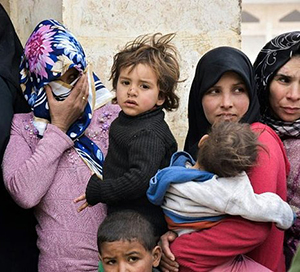
The fighting over the past week has sparked an exodus of "more than 30,000 civilians, most of them women and children," Observatory head Rami Abdel Rahman said Saturday.

Most of the displaced went to areas around Manbij, under the control of the Syrian Democratic Forces (SDF), an alliance of Kurdish and Arab fighters backed by the United States that is also fighting IS, the monitor said. An AFP correspondent in Manbij saw dozens of displaced families speeding towards the relative safety of the town on motorcycles and in small buses and cars.

Many of them looked exhausted as they lined up at a checkpoint manned by the Manbij Military Council, the SDF unit that controls the town, to be searched and get permission to enter.

Ibrahim al-Quftan, co-chair of Manbij's civil administration, told AFP that as many as 40,000 displaced people had arrived in the town in recent days. "The numbers of displaced people here are still rising because of the clashes between the Syrian regime and Daesh (IS)," Quftan said.

"These people are suffering very difficult circumstances." Manbij is already hosting "tens of thousands of displaced people that fled previous clashes in the area and are living in difficult circumstances," according to Abdel Rahman.

"This will make it difficult (for local authorities) to welcome a new wave of displaced people, given their inability to tend to their pressing needs," he said. Since civil war broke out in Syria in March 2011, more than half of its pre-war population has been forced to flee their homes.

The northern province of Aleppo hosts tens of thousands of displaced Syrians, many in camps near the border with Turkey. Rebel backer Ankara sent its own troops into Syria in August to fight IS jihadists as well as Kurdish units in an operation dubbed "Euphrates Shield."

Turkey considers the Kurdish People's Protection Units (YPG), which makes up most of the SDF, a "terrorist" group because of its ties to outlawed Kurdish militia in southeast Turkey. On February 23, the Turkish-backed rebels of Euphrates Shield captured the town of Al-Bab, which had been IS's last remaining bastion in Aleppo province.

Comments

Add new comment

  • Coastaldigest.com reserves the right to delete or block any comments.
  • Coastaldigset.com is not responsible for its readers’ comments.
  • Comments that are abusive, incendiary or irrelevant are strictly prohibited.
  • Please use a genuine email ID and provide your name to avoid reject.
News Network
April 5,2020

Beirut, Apr 5: The novel coronavirus has put global trade on hold, placed half of the world population in confinement and has the potential to topple governments and reshape diplomatic relations.

The United Nations has appealed for ceasefires in all the major conflicts rocking the planet, with its chief Antonio Guterres on Friday warning "the worst is yet to come". But it remains unclear what the pandemic's impact will be on the multiple wars roiling the Middle East.

Here is an overview of the impact so far on the conflicts in Syria, Yemen, Libya and Iraq:

The COVID-19 outbreak turned into a pandemic just as a ceasefire reached by the two main foreign power brokers in Syria's nine-year-old war -- Russia and Turkey -- was taking effect.

The three million people living in the ceasefire zone, in the country's northwestern region of Idlib, had little hope the deal would hold.

Yet fears the coronavirus could spread like wildfire across the devastated country appear to have given the truce an extended lease of life.

According to the Syrian Observatory for Human Rights, the month of March saw the lowest civilian death toll since the conflict started in 2011, with 103 deaths.

The ability of the multiple administrations in Syria -- the Damascus government, the autonomous Kurdish administration in the northeast and the jihadist-led alliance that runs Idlib -- to manage the coronavirus threat is key to their credibility.

"This epidemic is a way for Damascus to show that the Syrian state is efficient and all territories should be returned under its governance," analyst Fabrice Balanche said.

However the pandemic and the global mobilisation it requires could precipitate the departure of US-led troops from Syria and neighbouring Iraq.

This in turn could create a vacuum in which the Islamic State jihadist group, still reeling from the demise of its "caliphate" a year ago, could seek to step up its attacks.

The Yemeni government and the Huthi rebels initially responded positively to the UN appeal for a ceasefire, as did neighbouring Saudi Arabia, which leads a military coalition in support of the government.

That rare glimmer of hope in the five-year-old conflict was short-lived however and last week Saudi air defences intercepted ballistic missiles over Riyadh and a border city fired by the Iran-backed rebels.

The Saudi-led coalition retaliated by striking Huthi targets in the rebel-held capital Sanaa on Monday.

Talks have repeatedly faltered but the UN envoy Martin Griffiths is holding daily consultations in a bid to clinch a nationwide ceasefire.

More flare-ups in Yemen could compound a humanitarian crisis often described as the worst in the world and invite a coronavirus outbreak of catastrophic proportions.

In a country where the health infrastructure has collapsed, where water is a rare commodity and where 24 million people require humanitarian assistance, the population fears being wiped out if a ceasefire doesn't allow for adequate aid.

"People will end up dying on the streets, bodies will be rotting in the open," said Mohammed Omar, a taxi driver in the Red Sea port city of Hodeida.

Much like Yemen, the main protagonists in the Libyan conflict initially welcomed the UN ceasefire call but swiftly resumed hostilities.

Fierce fighting has rocked the south of the capital Tripoli in recent days, suggesting the risk of a major coronavirus outbreak is not enough to make guns fall silent.

Turkey has recently played a key role in the conflict, throwing its weight behind the UN-recognised Government of National Accord.

Fabrice Balanche predicted that accelerated Western disengagement from Middle East conflicts could limit Turkish support to the GNA.

That could eventually favour forces loyal to eastern-based strongman Khalifa Haftar, who launched an assault on Tripoli one year ago and has the backing of Russia, Egypt and the United Arab Emirates.

Western countries have been hit hardest by the pandemic, which could prompt them to divert both military resources and peace-brokering capacity from foreign conflicts.

A report by the International Crisis Group said European officials had reported that efforts to secure a ceasefire in Libya were no longer receiving high-level attention due to the pandemic.

Iraq is no longer gripped by fully-fledged conflict but it remains vulnerable to an IS resurgence in some regions and its two main foreign backers are at each other's throats.

Iran and the United States are two of the countries most affected by the coronavirus but there has been no sign of any let-up in their battle for influence that has largely played out on Iraqi soil.

With most non-US troops in the coalition now gone and some bases evacuated, American personnel are now regrouped in a handful of locations in Iraq.

Washington has deployed Patriot air defence missiles, prompting fears of a fresh escalation with Tehran, whose proxies it blames for a spate of rocket attacks on bases housing US troops.

Comments

Add new comment

  • Coastaldigest.com reserves the right to delete or block any comments.
  • Coastaldigset.com is not responsible for its readers’ comments.
  • Comments that are abusive, incendiary or irrelevant are strictly prohibited.
  • Please use a genuine email ID and provide your name to avoid reject.
Agencies
July 2,2020

With the launch of the Emirates Mars Mission less than a couple of weeks away, the spacecraft that will carry the UAE's Hope Probe to outer space has already been fuelled, it was announced today.

At a virtual briefing by the Mohammed bin Rashid Space Centre (MBRSC) today, the media was informed that scientists are busy giving finishing touches to the Hope Mars Mission, which will give mankind a complete picture of the Martian atmosphere once the UAE's indigenous probe reaches the Red Planet's orbit in 2021.

As the monitoring continues, final charging of the batteries is also ongoing, scientists said.

The space engineers averred that with this mission, the momentum in the region for space awareness will continue not only among young Emiratis but also among other youngsters in the Arab world.

The Hope Probe is scheduled to take off from Japan's Tanegashima Space Centre on July 15 at 00:51:27 UAE time.

The first Arab space mission to the Red Planet remained on track despite the challenges arising from the Covid-19 pandemic.

The spacecraft will provide the first global pictures of the Martian atmosphere and data will be shared freely with over 200 research centres across the world. It will help answer key questions about the global Martian atmosphere and the loss of hydrogen and oxygen gases into space over the span of one Martian year.

450 engineers, technicians and experts are involved in the project.  This comprises of 12,000 tasks in 6 years and entails 5.5 million working hours.

It includes 200 new technologies and 15 scientific partnerships with global universities and institutions.

The spaceship will travel 495 million km. It has a cruise speed of 121,000km/hour.

MBRSC is responsible for the execution and supervision of all stages of the design, development and launch of the Hope Probe. The UAE Space Agency is funding and supervising procedures and necessary details for the implementation of this project. After its launch in mid-July and following a journey of several months, the probe is expected to enter the Red Planet's orbit in 2021, coinciding with the Golden Jubilee of the Union.

Comments

Add new comment

  • Coastaldigest.com reserves the right to delete or block any comments.
  • Coastaldigset.com is not responsible for its readers’ comments.
  • Comments that are abusive, incendiary or irrelevant are strictly prohibited.
  • Please use a genuine email ID and provide your name to avoid reject.
News Network
March 18,2020

Riyadh, Mar 18: Private-sector businesses in Saudi Arabia on Wednesday were ordered to introduce enforced remote working for all employees for 15 days in an attempt to prevent the spread of the coronavirus.

Businesses that require staff to be physically present to ensure they continue to operate — including those in vital or sensitive sectors such as electricity, water and communications — must reduce the number of workers in their offices to the bare minimum. This can be no more than 40 percent of the total number of staff.

In such cases precautionary measures set by the Ministry of Health must be followed. At offices, and staff accommodation, with more than 50 workers, an area at the entrance must be provided where temperatures can be taken and symptoms checked.

Employers must also set up a mechanism for workers to report any symptoms, such as high temperature, coughing or shortness of breath, or contact they have had with infected individuals or people who recently returned from other countries without following proper Ministry of Health quarantine procedures.

Inside offices, a safe amount of space between employees must be maintained at all times. In addition, all health clubs and nurseries provided by employers must close.

Pregnant women and new mothers, people suffering from respiratory diseases, those with immune-system problems or chronic conditions, cancer patients and employees above the age of 55 are to be given 14 days compulsory paid leave, which will not be deducted from their annual entitlement.

Businesses that are excluded from the new measures include pharmacies and supermarkets, and their suppliers. Private-sector organizations that provide services to government agencies must contact them before suspending workplace attendance. Any other business that considers it impossible to operate with only 40 percent of staff in the workplace must submit an exemption request to the authority that supervises it.

Comments

Add new comment

  • Coastaldigest.com reserves the right to delete or block any comments.
  • Coastaldigset.com is not responsible for its readers’ comments.
  • Comments that are abusive, incendiary or irrelevant are strictly prohibited.
  • Please use a genuine email ID and provide your name to avoid reject.