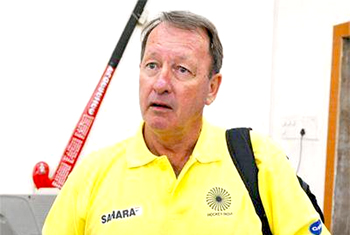
Terry Walsh quits as chief coach of Indian hockey team

November 18, 2014

Terry WalshNew Delhi, Nov 18: India's chief hockey coach Terry Walsh quit from his position after his contractual talks with Hockey India and the Sports Authority of India (SAI) broke down but a fresh proposal is still being worked out for the Australian's consideration.

Walsh, whose contract was to come to an end on Wednesday, had already submitted his resignation last month after his demands for a greater say in team decisions and hand-picked support staff were turned down by HI and SAI.

He had been negotiating to stay on board and met sports minister Sarbananda Sonowal this morning but the talks ended inconclusively, prompting the 60-year-old to head back to Australia without withdrawing his resignation.

However, a fresh proposal will sent to him in the next couple of days for his consideration, leaving the door still open for his return to India.

Walsh, who was present at a press conference, said that he was still optimistic about coaching the Indian team and that the fresh proposal would address all his demands.

Walsh's continuance had become doubtful after reports emerged that he had developed serious differences with Hockey India president Narinder Batra.

Batra had alleged that Walsh had indulged in "financial fraud" during his stint with USA Hockey and he was reluctant to keep the Australian on board.

If Walsh does not come back, it can be counted as a setback to Indian hockey considering that the team had been producing good results under his watch. The men recently won the Asian Games gold medal after a gap of 16 years, which also fetched them qualification for the 2016 Olympic Games in Rio.

Before this, the team won a silver medal in the Commonwealth Games and most recently defeated world champions Australia in an away Test series.

Earlier, a three-member panel had been formed to look into Walsh's demands but it failed to come to any "conclusion".

The panel comprising former hockey captains Ajit Pal Singh, Ashok Kumar and Zafar Iqbal met Walsh, Hockey India Performance Director Roelant Oltmans and Sports Authority of India officials twice but could not come up with a solution to end the logjam.

Apart from a greater say in decisions and support staff of his choice, Walsh has also sought 120 days paid leave in a year during which he has committed to stay available over video conference for players.

Comments

Add new comment

  • Coastaldigest.com reserves the right to delete or block any comments.
  • Coastaldigset.com is not responsible for its readers’ comments.
  • Comments that are abusive, incendiary or irrelevant are strictly prohibited.
  • Please use a genuine email ID and provide your name to avoid reject.
Agencies
April 2,2020

Lausanne, Apr 2: The postponement of the Tokyo Olympics and the shutdown of the sporting calendar because of the coronavirus pandemic are going to hit international sports federations hard financially.

Many sports that are part of the Games depend heavily on the payouts every four years from the International Olympic Committee (IOC).

"The situation is tense and very gloomy. An assessment will be made, but clearly some posts are under threat," said an official of a major international federation.

The 28 international federations (IF) of the sports that were due to be present at the Tokyo Olympics, would have received substantial sums from the IOC.

However, the postponement of the Games until 2021 could lead to a freeze of their payment.

"We have a lot of IF with substantial reserves, but others work on a different business model, they have income from major events which are suspended, which can be a problem for the cashflow if they don't have enough reserves," said Andrew Ryan, director general of the Association of International Olympic Summer Sports Federations (ASOIF), which is responsible for distributing this money.

The five additions to the Tokyo Games programme - karate, surfing, skateboarding, climbing and baseball/softball - are not eligible.

The Olympic payout totalled 520 million after the Rio Games, four years ago.

"The Olympic money could be less than for Rio 2016," Ryan warned before adding: "My advice is to budget the same as in Rio".

The federations receive money on a sliding scale determined by their audience and size.

The three largest (athletics, swimming and gymnastics) can expect approximately 40 million.

For the second tier, made up of cycling, basketball, volleyball, football and tennis, the sum is 25 million.

For group three, which contains eight sports, including boxing, rowing, judo and table tennis, it is 17 million.

The nine sports in the next level (including sailing, canoing and fencing) receive 12 million.

For the three in the last category (rugby, golf, modern pentathlon) the payout is 7 million.

For the largest associations, such as football's FIFA which has a 1.5 billion nest egg, or basketball body FIBA which has CHF 44.4 million (42 million euros) in reserves, IOC aid represents a small proportion of their income.

For others, it is vital.

"Some IF probably don't have the cashflow to survive one year," said Ryan.

For most federations, the postponement of the Olympic Games has a domino effect, forcing them to reschedule their own money-earning competitions.

"The revenues from these events will eventually come in," said Ryan. "But this impacts the cashflow." World Athletics has already postponed the 2021 World Championships in Eugene, Oregon to 2022.

The International Swimming Federation (FINA) will have to do the same for its World Championships scheduled for next summer in Fukuoka, Japan, when they would probably clash with the Tokyo Games.

"One edition of the World Championships means for us 10 million in revenues," said one sports federation official, speaking on condition of anonymity.

"If this income is postponed, totally or partially, for a year, we will face major problems, especially if the IOC money, originally expected in September, is not paid out."

The Singapore-based International Table Tennis Federation has already taken steps, with "the Executive Committee agreeing to reduce their expenses and senior staff offering to take a salary reduction," said marketing director Matt Pound, but, he added,"further cuts will take place if needed."

- 'Significant loss of revenue' -

The ITTF has suspended all its competitions until June and that is costly.

Kim Andersen, the Danish president of London-based World Sailing, said commercial revenues are not immune.

"The IOC will eventually pay out its aid, but what weighs most heavily is the uncertainty about whether our competitions will be held and whether our sponsors will be maintained," he said.

The IOC is not prepared to go into details of what it plans.

"It is not possible at this stage to assess the overall impact" of the postponement of the Tokyo Olympics, an official told AFP.

"It depends on a number of variables that are currently being studied." According to an official of one federation: "the IOC will discuss on a case-by-case basis, sport by sport".

Another option is for the federations to ask for a share of the public aid set up to deal with the coronavirus crisis, in Switzerland, where 22 ASOIF members are based and also in the United Kingdom, home of World Sailing.

"Can sports federations benefit from federal aid? The answer is yes, in principle," Philippe Leuba, State Councillor of the canton of Vaud, in charge of the economy and sport, told.


Comments

Add new comment

  • Coastaldigest.com reserves the right to delete or block any comments.
  • Coastaldigset.com is not responsible for its readers’ comments.
  • Comments that are abusive, incendiary or irrelevant are strictly prohibited.
  • Please use a genuine email ID and provide your name to avoid reject.
Agencies
March 3,2020

Mumbai, Mar 3: India on Tuesday retained their number one spot and captain Virat Kohli remained static at second in the ICC rankings despite a dismal Test series against New Zealand.

India have 116 rating points, six more than New Zealand with third-placed Australia accumulating 108 points. The 0-2 result against New Zealand was India's first series loss in the World Test Championship.

Kohli remains in second position in the batting rankings despite a forgettable Test series in which he made 38 runs in four innings, the ICC said in a statement.

New Zealand opener Tom Blundell and his Indian counterpart Prithvi Shaw and debutant paceman Kyle Jamieson were among the biggest movers in the rankings, released on Tuesday.

Blundell had a successful series against India, scoring 117 runs in four innings, with one half-century, which put him among the top two run-scorers in the series.

The performance meant he was rewarded with a jump of 27 places to No. 46. Shaw, who returned for his first series since his Test debut against West Indies in 2018, and made a punchy 54 in the first innings of the Christchurch Test, rose 17 places to No.76.

Australia's Steve Smith retained his top spot, holding a 25-point advantage over Kohli. Smith's apprentice Marnus Labuschagne jumped one spot to round off the top three, taking the place of New Zealand captain Kane Williamson.

England all-rounder Ben Stokes and India opener Mayank Agarwal moved a spot each and swapped places to break into and fall out of the top 10 respectively.

Among bowlers, Tim Southee's Player of the Series winning performance against India took him into the top five, with a jump of two places to No.4, while Jasprit Bumrah and Trent Boult returned to the top 10, gaining four places each to occupy the seventh and ninth positions respectively.

But the biggest gainer was Jamieson, who rose from No. 80 to 43.

There was only one change in the top ten among all-rounders, with Southee dropping a spot to No.10 and team-mate Neil Wagner falling out of the top 10 with a drop of four spots.

As with the bowling rankings, Jamieson, who frustrated India with handy lower order runs, gained big on the all-rounders' table, rising 26 places to No. 22.

Comments

Add new comment

  • Coastaldigest.com reserves the right to delete or block any comments.
  • Coastaldigset.com is not responsible for its readers’ comments.
  • Comments that are abusive, incendiary or irrelevant are strictly prohibited.
  • Please use a genuine email ID and provide your name to avoid reject.
News Network
May 4,2020

May 4: Yuzvendra Chahal is among the best leg-spinners in international cricket right now but he can be more effective with better use of the crease, says former Pakistan spinner Mushtaq Ahmed.

Ahmed picked Chahal, Australia's Adam Zampa and Pakistan's Shadab Khan among the top leg-spinners in white-ball cricket.

"Chahal as been impressive. He is definitely among the top leg-spinners of the world. And I feel he would be more effective if he uses the crease a lot more," Ahmed said.

Ahmed, who has coached all around the world and is currently a consultant for his native team, said India's ability to take wickets in the middle-overs in the limited overs format through Chahal and Kuldeep Yadav has been a game-changer for them.

Both the wrist-spinners were brought into India's limited overs set-up following the 2017 Champions Trophy. Though, of late, both Chahal and Kuldeep havn't been playing together.

"He (Chahal) can go wide of the crease at times. You got to be smart enough to understand pitches. If it is a flat pitch, you can bowl stump to stump," said Ahmed, one of the best leg-spinners Pakistan has produced.

"If the ball is gripping, you can go wide of the crease because you can trouble even the best of batsmen with that angle. That way your googly also doesn't turn as much as the batsman expects and you end up taking a wicket."

Chahal has taken 91 wickets in 52 ODIs at 25.83 and 55 wickets in 42 T20s at 24.34. He is not a huge turner of the ball but uses his variations very effectively.

Ahmed also feels the likes of Chahal and Kuldeep have benefitted immensely from former captain M S Dhoni's advice from behind the stumps.

"You have got to be one step ahead of the batsman. You should know your field position as per the batsman's strength. I always say attack with fielders not with the ball. If you understand that theory, you will always be successful," the 49-year-old, who played 52 Tests and 144 ODIs, said.

"India has become a force to reckon with in all three formats as it uses its bowlers really well. Dhoni was a master at getting the best out of his bowlers in limited overs cricket and now you have Virat Kohli."

He also said the art of leg-spin remains relevant more than ever.

"You need leg-spinners and mystery spinners in your team as they have the ability to take wickets at any stage of the game. I see a lot of them coming through in the next 10-15 years.

"Most batsmen now like playing express pace but with a good leg-spinner in the team, you are always in the game," added member of the 1992 World Cup-winning squad.

Comments

Add new comment

  • Coastaldigest.com reserves the right to delete or block any comments.
  • Coastaldigset.com is not responsible for its readers’ comments.
  • Comments that are abusive, incendiary or irrelevant are strictly prohibited.
  • Please use a genuine email ID and provide your name to avoid reject.