



Thailand's popular Tiger Temple to shut down soon

June 1, 2016

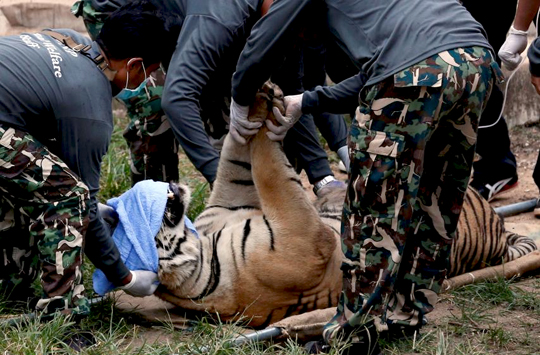
Bangkok, Jun 1: Thailand may close down its famed Tiger Temple, popular among Indian and foreign tourists, as wildlife officials have started relocating its 137 tigers, mostly Bengal tigers, amid allegations of illegal trafficking and animal mistreatment by temple authorities.
tiger

In the first batch, more than 100 tigers will be taken away from Wat Pa Luangta Bua Yannasampanno, popularly known as the Tiger Temple, said the Department of National Parks, Wildlife and Plant Conservation.

The popular Buddist temple at Kanchanaburi, 140 kilometres from Bangkok, where visitors can pet and take selfies with tigers, started keeping and breeding tigers 15 years ago and has promoted itself as a spiritual sanctuary where wild animals and humans can peacefully coexist.

The temple authorities have been accused of being involved in illegal wildlife trade and animal mistreatment for almost a decade by government officials and animal rights activists.

However, the monks who live in the temple grounds deny abusing the tigers or trafficking any animals and refuse to handover animals to authorities as the place earns thousands of dollars a month from tourism.

Suphitphong Phakcharung, vice-president of the Wat Pa Luang Ta Bua Foundation, said the group opposed to the action because the temple had raised the tigers for more than 10 years without a problem.

The Wildlife department's deputy director Adisorn Noochdumrong led the relocation operation himself on Monday armed with a search warrant from a provincial court.

"We are trying to solve problems step by step," he said.

The department hopes to relocate all 137 tigers in seven days. Most of the tigers will be sent to the Khaoson and Khao Prathap Chang breeding centers in Ratchaburi province.

However, due to the temple's attitude, Adisorn admitted that the operation may take longer than seven days.

Tensions were running high at the temple on Monday as officials and temple representatives met. Officials have also found dozens of dead cubs at the temple site.

The temple monks plan to take legal action against the department and ask the court to revoke the search warrant.

Kasetsart University Faculty of Forestry lecturer Anak Pattanavibool said the authorities were right to relocate the tigers because the state was the animals' rightful owner.

"The procedure to keep the tigers at breeding centers is the best choice we can do, because these tigers were raised in captivity and cannot be returned to the wild. Furthermore, many of them are Bengal tigers, which are not native to Thailand," Anak said.

"We cannot give them to a zoo or other countries because they are the government's property, so the government has to keep them until they naturally die," he said.

The wildlife department said seven tigers were given to the temple in 2001 to be raised on behalf of the state and the tiger population rose to the level it has reached today.

However, the officials said the department's attempts to seize the animals were always rebuffed by the temple.

Comments

Add new comment

  • Coastaldigest.com reserves the right to delete or block any comments.
  • Coastaldigset.com is not responsible for its readers’ comments.
  • Comments that are abusive, incendiary or irrelevant are strictly prohibited.
  • Please use a genuine email ID and provide your name to avoid reject.
Agencies
January 4,2020

Washington D.C: One of the greatest spectacles of modern art is still thriving in the Australian outback as confirmed by satellite imagery of NASA. The Marree Man is a massive geoglyph depicting an aboriginal hunter, that spans over 2.6 miles in the Southern Australian region.

Discovered by a pilot in 1998, its origin still remains a mystery even to this date.

The Marree Man was given a new lease of life in 2016 when a group of people from the neighboring town of Marree plowed its lines to avert its fading due to erosion.

After NASA shared the image of the art-work that was taken in June, the efforts of the good samaritans turned out to be a total success, reported CNN Travel.

The restoration team believes that the refurbished Marree Man would last longer than its original version.

According to NASA, "They [the team] created wind grooves, designed to trap water and encourage the growth of vegetation. They hope that eventually, the man will turn green."

In a previous article, CNN reported that an entrepreneur by the name of Dick Smith took upon himself to unravel the geoglyph's mystery in 2016. His team combed through all the available evidence but couldn't find anything conclusive.

In 2018 he even offered a 5,000 Australian dollar reward for anyone who knows the identity of its creator.

Nobody turned up with an answer but it was speculated that unknown artist lives in Alice Springs or even might be an American.

Comments

Add new comment

  • Coastaldigest.com reserves the right to delete or block any comments.
  • Coastaldigset.com is not responsible for its readers’ comments.
  • Comments that are abusive, incendiary or irrelevant are strictly prohibited.
  • Please use a genuine email ID and provide your name to avoid reject.
Agencies
March 15,2020

Cybercriminals continue to exploit public fear of rising coronavirus cases through malware and phishing emails in the guise of content coming from the Centers for Disease Control and Prevention (CDC) in the US and World Health Organisation (WHO), says cybersecurity firm Kaspersky.

In the APAC region, Kaspersky has detected 93 coronavirus-related malware in Bangladesh, 53 in the Philippines, 40 in China, 23 in Vietnam, 22 in India and 20 in Malaysia. 

Single-digit detections were monitored in Singapore, Japan, Indonesia, Hong Kong, Myanmar, and Thailand. 

Along with the consistent increase of 2019 coronavirus cases comes the incessant techniques cybercriminals are using to prey on public panic amidst the global epidemic, the company said in a statement. 

Kaspersky also detected emails offering products such as masks, and then the topic became more commonly used in Nigerian spam emails. Researchers also found scam emails with phishing links and malicious attachments.

One of the latest spam campaigns mimics the World Health Organisation (WHO), showing how cybercriminals recognise and are capitalising on the important role WHO has in providing trustworthy information about the coronavirus.

"We would encourage companies to be particularly vigilant at this time, and ensure employees who are working at home exercise caution. 

"Businesses should communicate clearly with workers to ensure they are aware of the risks, and do everything they can to secure remote access for those self-isolating or working from home," commented David Emm, principal security researcher.

Some malicious files are spread via email. 

For example, an Excel file distributed via email under the guise of a list of coronavirus victims allegedly sent from the World Health Organisation (WHO) was, in fact, a Trojan-Downloader, which secretly downloads and installs another malicious file. 

This second file was a Trojan-Spy designed to gather various data, including passwords, from the infected device and send it to the attacker.

Comments

Add new comment

  • Coastaldigest.com reserves the right to delete or block any comments.
  • Coastaldigset.com is not responsible for its readers’ comments.
  • Comments that are abusive, incendiary or irrelevant are strictly prohibited.
  • Please use a genuine email ID and provide your name to avoid reject.
Agencies
June 17,2020

In a bid to help tackle rise in domestic violence during the social distancing times in India, Twitter on Wednesday launched a dedicated search prompt to serve information and updates from authoritative sources around domestic violence.

Twitter has partnered with the Ministry of Women and Child Development the National Commission for Women in India to expand its efforts towards women.

The search prompt will be available on iOS, Android and on mobile.twitter.com in India, in both English and Hindi languages, the company said in a statement.

Data shows that since the outbreak of Covid-19, violence against women and girls has intensified in India and across the globe.

"We recognise collaboration with the public, government and NGOs is key to combating the complex issue of domestic violence. Accessing reliable information through this search prompt could be a survivor's first step towards seeking help against abuse and violence," said Mahima Kaul, Director, Public Policy, India and South Asia, Twitter.

Every time someone searches for certain keywords associated with the issue of domestic violence, a prompt will direct them to the relevant information and sources of help available on Twitter.

This is an expansion of Twitter's #ThereIsHelp prompt, which was specifically put in place for the public to find clear, credible information on critical issues.

The feature will be reviewed at regular intervals by the Twitter team to ensure that all related keywords generate the proactive search prompt, said the company.

Violence against women and girls across Asia Pacific is pervasive but at the same time widely under reported.

"In fact, in many countries in our region, the number is even greater, with as many as 2 out of 3 women in some countries reporting experiences of violence," added Melissa Alvarado, UN Women Asia Pacific Regional Manager on Ending Violence against Women.

Rekha Sharma, Chairperson, the NCW, said: "With social distancing norms in place, several women are unable to contact their regular support systems. This initiative by Twitter will provide big support to the survivors, who would otherwise be easily isolated without access to relevant information and help".

Comments

Add new comment

  • Coastaldigest.com reserves the right to delete or block any comments.
  • Coastaldigset.com is not responsible for its readers’ comments.
  • Comments that are abusive, incendiary or irrelevant are strictly prohibited.
  • Please use a genuine email ID and provide your name to avoid reject.