Thank you UCA: 'Saint of Letters' Harekala Hajabba enters new house

[email protected] (CD Network | Photos by Suresh)
February 8, 2016

Mangaluru, Feb 8: "I never dreamt of living in a house that is worth Rs 15 lakh in my life. Today I am extremely happy, thankful and I pray for the well-being of the donor, who built a house for me," said Harekala Hajabba, 61, who is popularly known as 'Akshara Santha' or 'Saint of Letters'
harekala hajabba  4

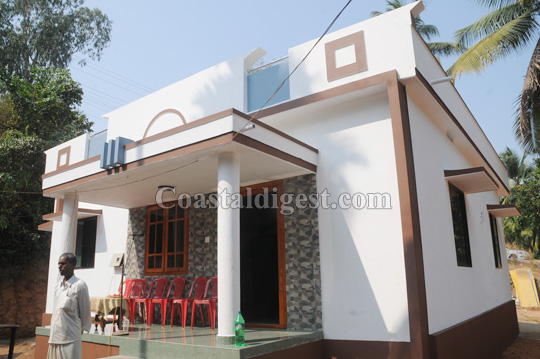
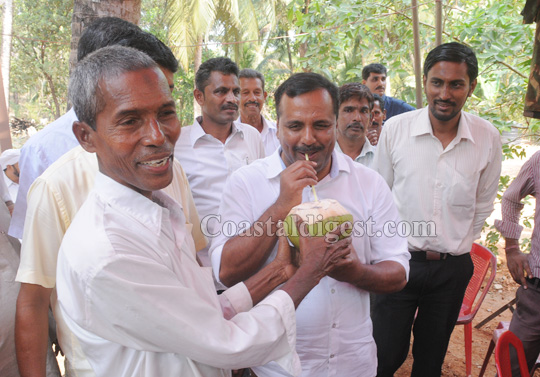
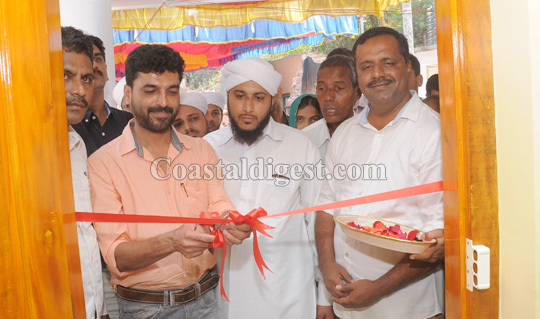
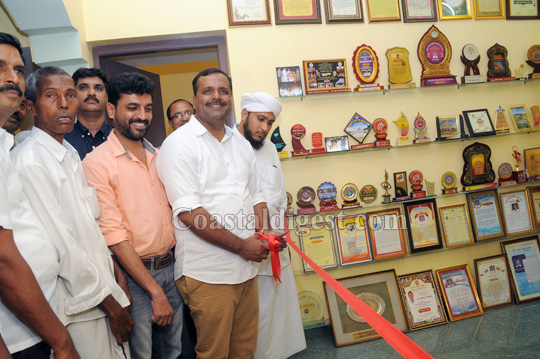
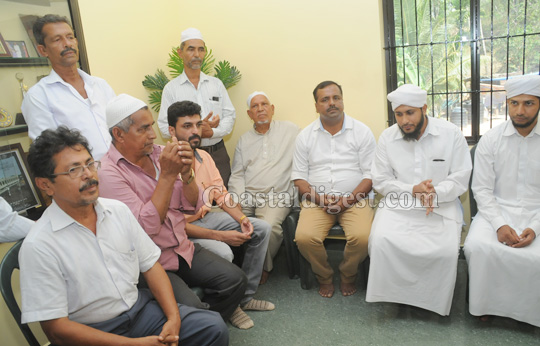
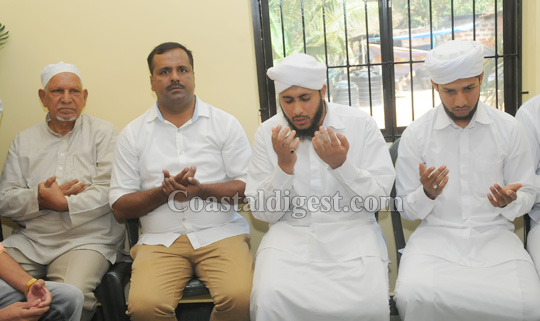
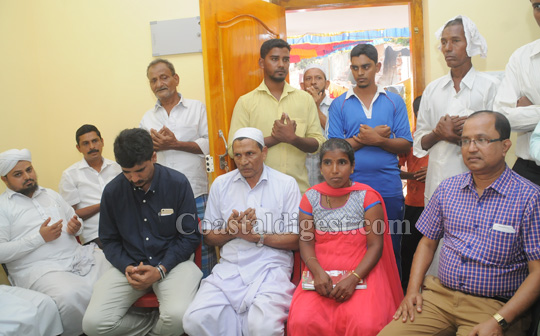
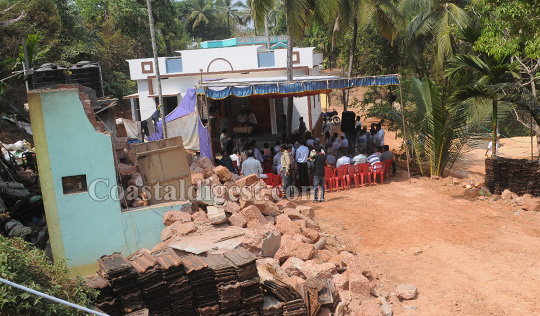
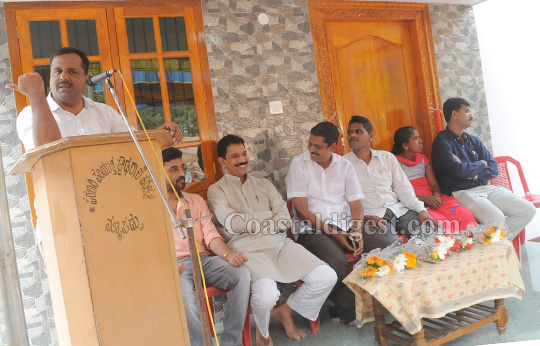
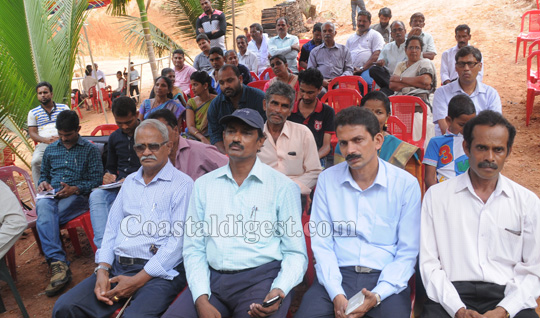
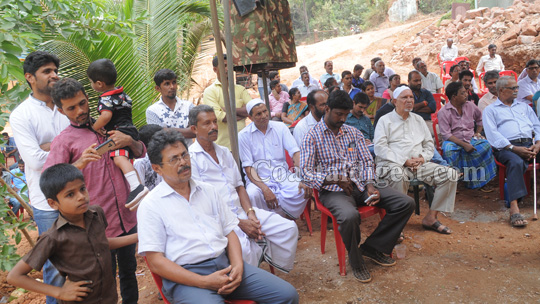
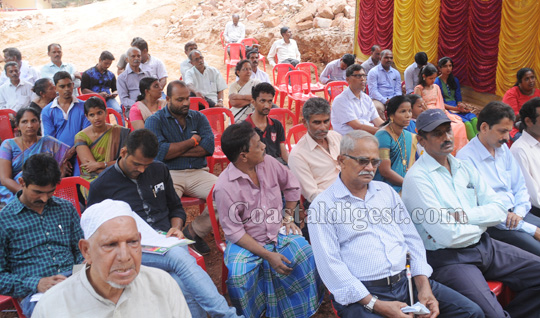
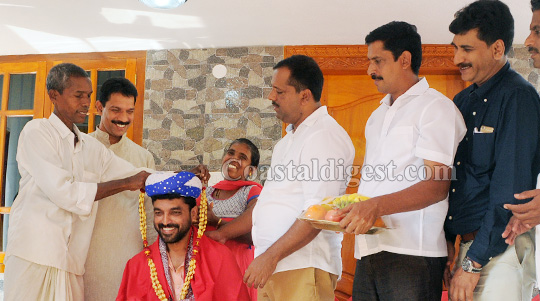
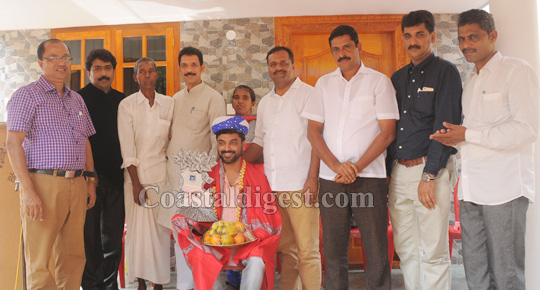
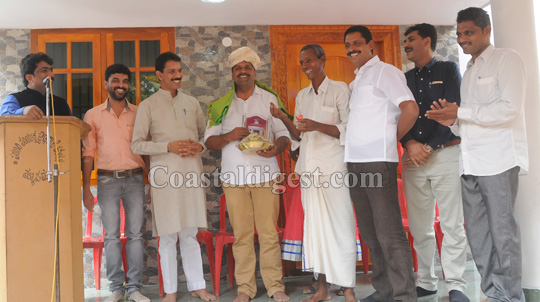
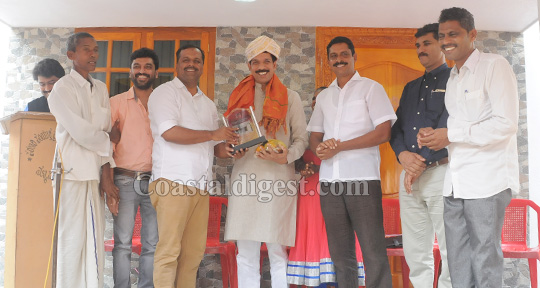
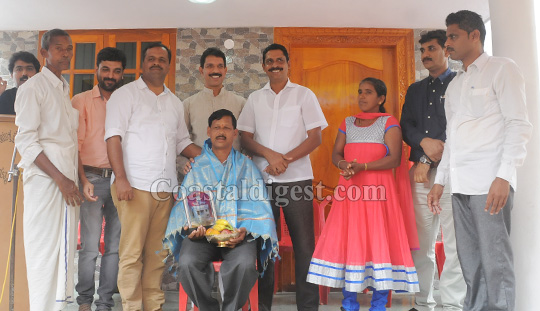
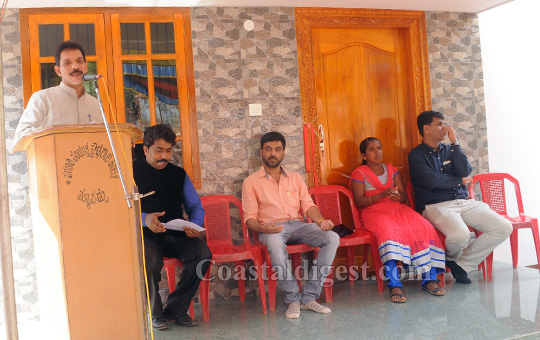
Despite being an uneducated, Hajabba fought tirelessly to build built a government school at Newpadpu in Harekala about 20 kms here by pooling money he earned and by seeking donors help. However, he had forgotten to build a house for his wife and three children. Hajabba was worried about his family very much, but he never showed it to others. At this juncture, the United Christian Association (UCA) has come forward to build 760 sqft house at a cost of Rs 15 lakh for Hajabba. On Sunday, a house warming ceremony was held in the presence of Muslim clergies, UCA president Alban Menezes, Dakshina Kannada MP Nalin Kumar Kateel and minister for health and family welfare U T Khader.

"I am an ordinary man and I have not earned a single rupee for myself. On September 13, 2004, there were no chairs in my house when four journalists came to talk to me about my struggle for a school in my village. Now I own this houses only because of media persons and organisations like United Christian Association," said Hajabba, who left no stones unturned to start a government school in his village and later to construct a new block for it.

Hajabba, who has been selling orange near State Bank bus stand, was literally struggling to meet both ends at his partially damaged tiled roof house, where five member family with ailing wife were living. In fact, it is the initiative of UCA president Alban Menezes, a young builder in the city, that led to construction of a two bed room RCC house for Hajabba.

"I understood the problems of Hajabba when he was admitted to hospital. Doctors, who treated Hajabba, told me that he was suffering from anxiety due to poverty. I felt really sad when I saw a great achiever suffering from poverty and living in a dilapidated house. Hence, I decided to construct a house for him through UCA. While nearly 1.5 lakh was collected through UCA members, I spent nearly Rs 13.5 lakh. Very soon, I will provide compound wall and gate for his house spending additional Rs 2 lakh," said Alban Menezes, who had donated many houses and did several charity works earlier.

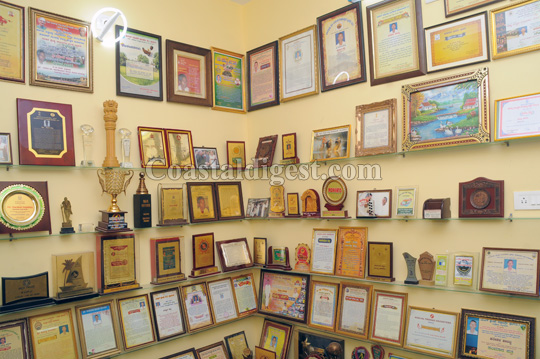
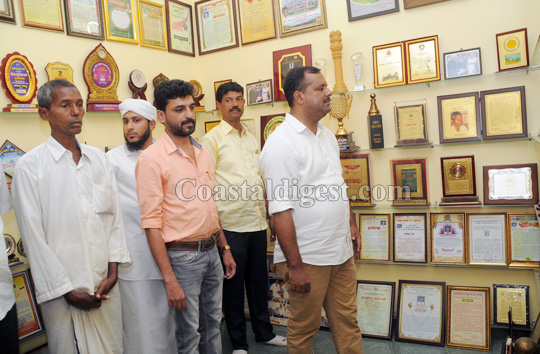
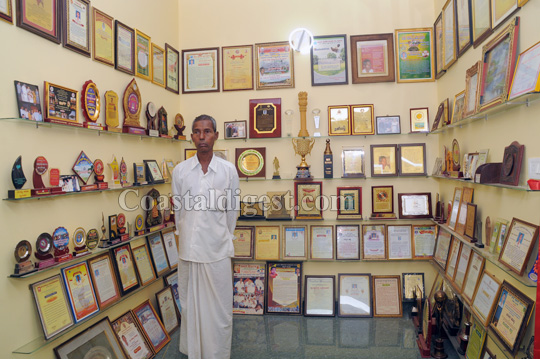
Menezes said that a separate space has been provided in the new house for Hajabba to display all awards, citations and mementos he received during his journey as a crusader of education.

harekala hajabba  1

harekala hajabba  2

harekala hajabba  3

harekala hajabba  5

harekala hajabba  6

harekala hajabba  7

harekala hajabba  8

harekala hajabba  9

harekala hajabba  10

harekala hajabba  11

harekala hajabba  12

harekala hajabba  13

harekala hajabba  14

harekala hajabba  15

harekala hajabba  16

harekala hajabba  17

harekala hajabba  18

harekala hajabba  19

harekala hajabba  20

harekala hajabba  21

harekala hajabba  22

harekala hajabba  23

Comments

Ahmed Bava
 - 
Tuesday, 9 Feb 2016

Congratulations UCA President Mr. Alban Menezes and Members really great work done by you for a Great person Mr.HAJABBA. HUMANBEING

A.Ullal
 - 
Tuesday, 9 Feb 2016

We admire you. sir.. I am proud that my fellow countryman have done great contribution towards education. Where he built school for kids when kids reach of school was far at site.
He is a role model for us.

A.Ullal
 - 
Tuesday, 9 Feb 2016

We admire you. sir.. I proud that my fellow countryman done grate contribution towards education. Were he build school for kids when kids reach of school is far at site.
He is role model for us.

rikaz
 - 
Monday, 8 Feb 2016

I hope because of this house he can keep up his health and serve more and better to poorer section of the society.

Government should think of giving him pension monthly basis...and I think it's not right time for him to go in the heat of sun and work and bring money for his social work as well his family...

Sherief
 - 
Monday, 8 Feb 2016

Mr.Alban Menezes and UCA's generous contribution in the form of donating new built home to Akshara Santha Janab Hajabba is truly appreciable. Your donation of a house is an inspiration to all of us. I hat's off for your generosity and commitment for helping the society is sincerely appreciated.

ABUL
 - 
Monday, 8 Feb 2016

Great job and highly praisable noble work by UCA. Bieng a muslim community memeber Janab Hajabba never recognised by his own community people where he stays with many muslim millionaires surroundings.
Hats off once again UCA.Keep it up

Muzaffar Ali
 - 
Monday, 8 Feb 2016

Congratulations ... UCA
Very Good deed by UCA

IBRAHIM.HUSSAIN
 - 
Monday, 8 Feb 2016

It is praise worthy that UCA and Alban understood the pain of Hajabba and built a house for this Akshara Santha. At the same time it is unfortunate, millionaire Muslim people, charity institutions around his area neither understood this Akshara Santha, nor his pitiful life in a lapidated house where he was living. Politician throng on the opening day, but never thought of his need.

Once again salute to Mr. Alban and UCA for this noble work.

Add new comment

  • Coastaldigest.com reserves the right to delete or block any comments.
  • Coastaldigset.com is not responsible for its readers’ comments.
  • Comments that are abusive, incendiary or irrelevant are strictly prohibited.
  • Please use a genuine email ID and provide your name to avoid reject.
Ram Puniyani
February 4,2020

As democracy is seeping in slowly all over the world, there is an organization which is monitoring the degree of democracy in the individual countries, The Economist Intelligence Unit. As such in each country there are diverse factors which on one hand work to deepen it, while others weaken it. Overall there is a march from theoretical democracy to substantive one. The substantive democracy will herald not just the formal equality, freedom and community feeling in the country but will be founded on the substantive quality of these values. In India while the introduction of modern education, transport, communication laid the backdrop of beginning of the process, the direction towards deepening of the process begins with Mahatma Gandhi when he led the non-cooperation movement in 1920, in which average people participated. The movement of freedom for India went on to become the ‘greatest ever mass movement’ in the World.

The approval and standards for democracy were enshrined in Indian Constitution, which begins ‘We the people of India’, and was adopted on 26th January 1950. With this Constitution and the policies adopted by Nehru the process of democratization started seeping further, the dreaded Emergency in 1975, which was lifted later restored democratic freedoms in some degree. This process of democratisation is facing an opposition since the decade of 1990s after the launch of Ram Temple agitation, and has seen the further erosion with BJP led Government coming to power in 2014. The state has been proactively attacking civil liberties, pluralism and participative political culture with democracy becoming flawed in a serious way. And this is what got reflected in the slipping of India by ten places, to 51st, in 2019. On the index of democracy India slipped down from the score of 7.23 to 6.90. The impact of sectarian BJP politics is writ on the state of the nation, country.

Ironically this lowering of score has come at a time when the popular protests, the deepening of democracy has been given a boost and is picking up with the Shaheen Bagh protests. The protest which began in Shaheen Bagh, Delhi in the backdrop of this Government getting the Citizenship amendment Bill getting converted into an act and mercilessly attacking the students of Jamia Milia Islamia, Aligarh Muslim University along with high handed approach in Jamia Nagar and neighbouring areas.  From 15th December 2019, the laudable protest is on.

It is interesting to note that the lead in this protest has been taken by the Muslim women, from the Burqa-Hijab clad to ‘not looking Muslim’ women and was joined by students and youth from all the communities, and later by the people from all the communities. Interestingly this time around this Muslim women initiated protest has contrast from all the protests which earlier had begun by Muslims. The protests opposing Shah Bano Judgment, the protests opposing entry of women in Haji Ali, the protests opposing the Government move to abolish triple Talaq. So far the maulanas from top were initiating the protests, with beard and skull cap dominating the marches and protests. The protests were by and large for protecting Sharia, Islam and were restricted to Muslim community participating.

This time around while Narendra Modi pronounced that ‘protesters can be identified by their clothes’, those who can be identified by their external appearance are greatly outnumbered by all those identified or not identified by their appearance.

The protests are not to save Islam or any other religion but to protect Indian Constitution. The slogans are structured around ‘Defence of democracy and Indian Constitution’. The theme slogans are not Allahu Akbar’ or Nara-E-Tadbeer’ but around preamble of Indian Constitution. The lead songs have come to be Faiz Ahmad Faiz’s ‘Hum Dekhenge’, a protest against Zia Ul Haq’s attempts to crush democracy in the name of religion. Another leading protest song is from Varun Grover, ‘Tanashah Aayenge…Hum Kagaz nahin Dikhayenge’, a call to civil disobedience against the CAA-NRC exercise and characterising the dictatorial nature of the current ruling regime.

While BJP was telling us that primary problem of Muslim women is Triple talaq, the Muslim women led movements has articulated that primary problem is the very threat to Muslim community. All other communities, cutting across religious lines, those below poverty line, those landless and shelter less people also see that if the citizenship of Muslims can be threatened because of lack of some papers, they will be not far behind in the victimization process being unleashed by this Government.

While CAA-NRC has acted as the precipitating factor, the policies of Modi regime, starting from failure to fulfil the tall promises of bringing back black money, the cruel impact of demonetisation, the rising process of commodities, the rising unemployment, the divisive policies of the ruling dispensation are the base on which these protest movements are standing. The spread of the protest movement, spontaneous but having similar message is remarkable. Shaheen Bagh is no more just a physical space; it’s a symbol of resistance against the divisive policies, against the policies which are increasing the sufferings of poor workers, the farmers and the average sections of society.

What is clear is that as identity issues, emotive issues like Ram Temple, Cow Beef, Love Jihad and Ghar Wapasi aimed to divide the society, Shaheen Bagh is uniting the society like never before. The democratisation process which faced erosion is getting a boost through people coming together around the Preamble of Indian Constitution, singing of Jan Gan Man, waving of tricolour and upholding the national icons like Gandhi, Bhagat Singh, Ambedkar and Maulana Azad. One can feel the sentiments which built India; one can see the courage of people to protect what India’s freedom movement and Indian Constitution gave them.

Surely the communal forces are spreading canards and falsehood against the protests. As such these protests which is a solid foundation of our democracy. The spontaneity of the movement is a strength which needs to be channelized to uphold Indian Constitution and democratic ethos of our beloved country.

Comments

Add new comment

  • Coastaldigest.com reserves the right to delete or block any comments.
  • Coastaldigset.com is not responsible for its readers’ comments.
  • Comments that are abusive, incendiary or irrelevant are strictly prohibited.
  • Please use a genuine email ID and provide your name to avoid reject.
News Network
June 2,2020

Bengaluru, Jun 2: Karnataka recorded a biggest single day spike of 388 COVID-19 cases, with returnees from neighboring Maharashtra continuing to add to the state's tally, taking the total number of infections in the state to 3,796, the health department said on Tuesday.

With 367 out of 388 new cases being returnees from other states, mostly from neighboring Maharashtra (357), the Karnataka government said it was mulling over increasing institutional quarantine for those returning from the western state. Meanwhile, achieving a milestone in the battle against the coronavirus,the Karnataka Institute of Medical Sciences at Hubballi has successfully treated a COVID-19 patient through plasma therapy.

"Maharashtra (returnees) is a major worry for us, already 15,000-20,000 people have come from Maharashtra, still 2000 odd people may come to each district, as we have allowed so many people already, we have decided to allow them also, Revenue Minister R Ahoka said.

Speaking to reporters here, he said ".....cases coming from Bombay and Pune are turning out to be positive, we have to take extra caution, seven days quarantine (institutional) is of no use, we want to increase it specifically for those returning from Maharashtra.

We will take a decision soon and issue order." Chief Minister B S Yediyurappa earlier directed district authorities including the Deputy Commissioners and Superintendents of Police to camp at taluk centres and work towards curbing the spread of COVID-19. Pointing out that COVID-19 cases were increasing in the state because of returnees from Maharashtra, he asked officials to take all necessary measures to check it, his office said in a release. The previous biggest single-day spike was recorded on May 31 with 299 cases. As of June 2 evening, cumulatively 3,796 COVID-19 positive cases have been confirmed in the state, which includes 52 deaths and 1,403 discharges, the health department said in its bulletin.

It said out of 2,339 active cases, 2,325 patients are in isolation at designated hospitals and are stable, while 14 are in ICU.

According to the bulletin,75 patients have been discharged today.

Medical Education Minister K Sudhakar said Karnataka Institute of Medical Sciences in Hubballi has successfully treated a COVID-19 patient through Plasma Therapy.

"Karnataka achieves yet another milestone in battle against #COVID19.

KIMS Hubli has successfully treated a Covid19 patient through Plasma Therapy & is the first institute in the state to accomplish this. Congrats to KIMS doctors & staff for this feat!" the Minister tweeted.

Among the districts where the new cases were reported, Udupi accounted for 150 cases, followed by Kalaburagi 100, Belagavi 51, Raichur 16, Bengaluru urban 12, Bidar 10, nine each from Bagalkote and Hassan, Davangere seven, Yadgiri five, four each from Mandya and Vijayapura, Bengaluru rural three, two each from Chikkaballapura, Dharwad and Tumakuru, and one each from Kolar and Haveri.

Udupi district tops the list of positive cases with 410 infections, followed by Kalaburagi 405 and Bengaluru urban 397.

Among discharges too Bengaluru urban tops the list with 237 discharges, followed by Kalaburagi 128 and Davangere 121.

A total of 3,19,628 samples have been tested so far, out of which 14,812 were tested on Tuesday alone.

According to the bulletin, 3,10,967 samples have reported as negative, 13,915 on Tuesday alone.

Comments

Add new comment

  • Coastaldigest.com reserves the right to delete or block any comments.
  • Coastaldigset.com is not responsible for its readers’ comments.
  • Comments that are abusive, incendiary or irrelevant are strictly prohibited.
  • Please use a genuine email ID and provide your name to avoid reject.
Agencies
July 8,2020

The Central Board of Secondary Education (CBSE) has rationalised by up to 30 per cent the syllabus for classes 9 to 12 for the academic year 2020-21 to reduce course load on students amid the COVID-19 crisis, Union HRD Minister Ramesh Pokhriyal 'Nishank' announced on Tuesday.

The curriculum has been rationalised while retaining the core elements, the Human Resource Development said.

Among the chapters dropped after the rationalisation exercise are lessons on democracy and diversity, demonetisation, nationalism, secularism, India's relations with its neighbours and growth of local governments in India, among others.

"Looking at the extraordinary situation prevailing in the country and the world, CBSE was advised to revise the curriculum and reduce course load for the students of classes 9 to 12.

"To aid the decision, a few weeks back I also invited suggestions from all educationists on the reduction of syllabus for students and I am glad to share that we received more than 1.5K suggestions. Thank you, everyone, for the overwhelming response," Nishank tweeted.

"Considering the importance of learning achievement, it has been decided to rationalise syllabus up to 30 per cent by retaining the core concepts," he added.

The Union minister said the changes made in the syllabi have been finalised by the respective course committees with the approval of the curriculum committee and the Governing Body of the Board.

"The heads of schools and teachers have been advised by the board to ensure that the topics that have been reduced are also explained to the students to the extent required to connect different topics. However, the reduced syllabus will not be part of the topics for internal assessment and year-end board examination.

"Alternative academic calendar and inputs from the NCERT on transacting the curriculum using different strategies shall also be part of the teaching pedagogy in the affiliated schools," a senior official of the HRD ministry said.

For classes 1 to 8, the National Council of Education Research and Training (NCERT) has already notified an alternative calendar and learning outcomes.

According to the updated curriculum, among the chapters deleted from class 10 syllabus are-- democracy and diversity, gender, religion and caste, popular struggles and movement, challenges to democracy

For class 11, the deleted portions included chapters on federalism, citizenship, nationalism, secularism, growth of local governments in India.

Similarly, class 12 students will not be required to study chapters on India's relations with its neighbours, changing nature of India's economic development, social movements in India and demonetisation, among others.

Universities and schools across the country have been closed since March 16 when the central government announced a nationwide classroom shutdown as one of the measures to contain the COVID-19 outbreak.

A nationwide lockdown was announced on March 24, which came into effect the next day. While the government has eased several restrictions, schools and colleges continue to remain closed.

Comments

Add new comment

  • Coastaldigest.com reserves the right to delete or block any comments.
  • Coastaldigset.com is not responsible for its readers’ comments.
  • Comments that are abusive, incendiary or irrelevant are strictly prohibited.
  • Please use a genuine email ID and provide your name to avoid reject.