



Thousands bid tearful adieu to Gopinath Munde

June 4, 2014

Parli, June 4: Tens of thousands of mourning supporters and distraught family members on Wednesday bid a tearful farewell to Gopinath Munde, Maharashtra BJP's tallest mass leader and architect of its impressive victory in the Lok Sabha elections, who was killed in a car crash on Tuesday.munde funeral 4
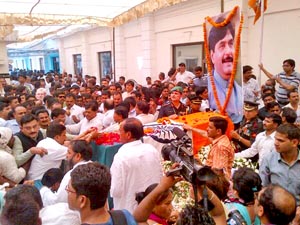
A sea of humanity converged at his home town to pay last respects to the towering leader from the backward Marathwada region as her eldest daughter Pankaja lit the funeral pyre amid roars of "Gopinath Munde amar rahe" and "Munde Saheb parat ya (Munde Sir, come again)".

Munde, 64, Union rural development minister, was on Tuesday killed in a road accident in Delhi while he was on way to Parli for a felicitation following his own and BJP's resounding victory in the Lok Sabha elections, which saw him re-elected for a second time from Beed.

However, in a cruel twist of fate, he could not reach there alive and only his mortal remains were brought to the Baidyanath Sugar Factory compound for performing the last rites, a few kilometres away from 'Totla Maidan', the venue of the felicitation that never happened.

The BJP veteran is survived by his wife Pradnya and three daughters including Pankaja, BJP MLA from Parli and heir to his political legacy.

Pankaja lighting her father's funeral pyre marked a departure from the Hindu tradition of a male member of the family doing duty and signalled her taking over the leader's political mantle.

Several senior BJP leaders including Union minister Prakash Javadekar, a close associate of Munde since his days as a student leader in Pune, party general secretary Rajeev Pratap Rudy, Goa chief minister Manohar Parrikar, Shiv Sena chief Uddhav Thackeray, MNS boss Raj Thackeray, RPI's Ramdas Athavale and several state ministers and legislators were in attendance.

Munde, a backward class leader, who started his political career as a student leader and rose to become the deputy chief minister of Maharashtra in 1995, when BJP-Shiv Sena came to power in the state for the first time, was to lead his party's assembly campaign.

He was also seen by many as a formidable contender for the chief minister's post in the event of the alliance forming its government after the assembly elections four months from now.

But fate willed otherwise and Munde died in a crash a week after being sworn in as Union minister but before he could take oath as MP.

With his brother-in-law Pramod Mahajan, another towering BJP leader from Maharashtra whose promising political career was snuffed out in May 2003 after he was shot by his younger brother, Munde was an architect of the BJP-Sena alliance which has stood the test of time.

He was considered the glue that still binds the two saffron allies.

As Narendra Modi launched a spirited Lok Sabha campaign and was looking for new allies, Munde's political astuteness and acceptability across the political spectrum came in handy as he brought Ramdas Athavale's RPI, Raju Shetty's Swabhimani Shetkari Sanghatana and Mahadeo Jankar's Rashtriya Samaj Party into the 'Mahayuti' (Grand Alliance), which contested Lok Sabha polls together, winning 42 of state's 48 seats.

His departure from Maharashtra's political scene has left BJP bereft of a charismatic leader months before the crucial electoral battle for control of the key western state. Operations were conducted under the supervision of Shri Pravin Vinod, Assistant commissioner of customs, Mangalore International Airport. Further investigation is under progress.

Comments

Add new comment

  • Coastaldigest.com reserves the right to delete or block any comments.
  • Coastaldigset.com is not responsible for its readers’ comments.
  • Comments that are abusive, incendiary or irrelevant are strictly prohibited.
  • Please use a genuine email ID and provide your name to avoid reject.
News Network
May 28,2020

May 28: Abdul Kareem was forced out of school and into a life of odd jobs like repairing bicycles before he finally managed to pull his family out of abject poverty transporting goods across Delhi in a mini truck.

The job, and the slim financial security that came with it, was the first stepping stone to a better life.

All that is now gone as India reels under the economic impact of its protracted coronavirus lockdown. Mr Kareem's out of a job and stranded in his village in Uttar Pradesh with his wife and two children. Their minuscule savings from his Rs 9,000 a month job have been exhausted, and the money he saved for books and school uniforms is spent.

"I don't know what the job situation will be in Delhi once we go back," Mr Kareem said. "We can't stay hungry so I will do whatever I find."

At least 49 million people across the world are expected to plunge into "extreme poverty" -- those living on less than $1.90 per day -- as a direct result of the pandemic's economic destruction and India leads that projection, with the World Bank estimating some 12 million of its citizens will be pushed to the very margins this year.

Some 122 million Indians were forced out of jobs last month alone, according to estimates from the Center for Monitoring Indian Economy, a private sector think tank. Daily wage workers and those employed by small businesses have taken the worst hit. These include hawkers, roadside vendors, workers employed in the construction industry and many who eke out a living by pushing handcarts and rickshaws.

For Prime Minister Narendra Modi, who came to power in 2014 promising to lift the poorest citizens out of poverty, the fallout from the lockdown brings with it significant political risk. He won an even larger second term majority last year on the strength of his government's popular social programs that directly targeted the poor, such as the provision of cooking gas cylinders, power and public housing. The breadth and depth of this renewed economic pain will only increase the pressure on his government as it works to steer the country's economy back on track.

"Much of the Indian government's efforts to mitigate poverty over the years could be negated in a matter of just a few months," said Ashwajit Singh, managing director of IPE Global, a development sector consultancy that advises several multinational aid agencies. Noting that he did not expect unemployment rates to improve this year, Singh said: "More people could die from hunger than the virus."

Desperate Times

Mr Singh points to a United Nations University study estimating 104 million Indians could fall below the World Bank-determined poverty line of $3.2 a day for lower-middle-income countries. This will take the proportion of people living in poverty from 60% -- or 812 million currently, to 68% or 920 million -- a situation last seen in the country more than a decade ago, he said.

A World Bank report found the country had been making significant progress and was close to losing its status as the country with the most poor citizens. The impact of PM Modi's lockdown risks reversing those gains.

The World Bank and the CMIE estimates were published in late April and early May respectively. Since then the situation has only become grimmer, with harrowing images of people making desperate attempts to reach their villages, on crowded buses, the flatbeds of trucks and even on foot or on bicycles dominating media coverage.

The Rustandy Center for Social Sector Innovation at the University of Chicago Booth School of Business analyzed the unemployment data from the CMIE, collected through surveys covering about 5,800 homes across 27 states in April.

Researchers found rural areas were the hardest hit, and the economic misery was the result of the lockdown, rather than the spread of infections in the hinterland. More than 80% of households had experienced a drop income and many won't survive much longer without aid, they wrote in a report.

The government has promised cheap credit to farmers, direct transfer of money to the poor and eased access to food security programs -- but these help people who have some documentation, which many of the poorest don't. With millions of impoverished people now in transit across the country, the food security situation is dire -- news reports are emerging of people foraging through piles of rotting fruit or eating leaves.

Shattered Economy

The economy was already growing at its slowest pace in over a decade when the virus struck. The lockdown, which came into effect on March 25, has hammered it, stalling business activity and putting a lid on consumption, pushing the economy to what may be its first full-year contraction in more than four decades.

It's dire enough to warrant the country exiting its lockdown, as it has been doing incrementally since May 4, even as its infections are surging. India is now Asia's virus hotspot with infections crossing 151,000 according to data from Johns Hopkins University.

PM Modi, who has come under criticism for the pain inflicted on the poor, has said his government will spend $265 billion or about 10% of its GDP to help Asia's third-largest economy weather the pandemic's fallout. But experts say only a part of it is direct fiscal stimulus, and probably smaller than the total damage done to the economy during the lockdown period.

"What is especially worrying is the government's response," said Reetika Khera, an economics professor at the Indian Institute of Technology in Delhi. "The epidemic will magnify existing -- and already high -- inequalities in India."

Still, the economic measures aren't going to kick in for some time and industry will likely struggle to restart because of the flight of labour from industrial hubs.

And as the harsh summer unfolds more pain lies in store in the villages now dealing with returning migrant workers.

"There are no factories or industries here, there are just hills," said Surendra Hadia Damor, who had walked nearly 100 km from Ahmedabad, Gujarat, before a voluntary organisation drove him to his village in the neighboring state of Rajasthan. "We can survive for a month or two and then try and find a job nearby -- we will see what happens."

Comments

Add new comment

  • Coastaldigest.com reserves the right to delete or block any comments.
  • Coastaldigset.com is not responsible for its readers’ comments.
  • Comments that are abusive, incendiary or irrelevant are strictly prohibited.
  • Please use a genuine email ID and provide your name to avoid reject.
News Network
March 12,2020

New Delhi, Mar 12: The coronavirus pandemic could deal a crippling blow to the Indian travel and tourism industry, specially with the government suspending all visas, with the economic impact being assessed to run into thousands of crores of rupees. According to industry chamber CII, this is the one of the worst crises ever to hit the Indian tourism industry impacting all its geographical segments - inbound, outbound and domestic, almost all tourism verticals - leisure , adventure, heritage, MICE, cruise, corporate and niche segments.

The whole tourism value chain across hotels, travel agents, tour operations, destinations, restaurants, family entertainment venues and air, land and sea transportation have been hit.

In an impact assessment of the coronavirus pandemic, CII Tourism Committee said inbound foreign tourism of over USD 28 billion in value terms accounts for an average 60-65 per cent between October to March.

"As the news of the virus started picking up from November, the percentage of cancellations started going up in this segment exponentially and is reaching a peak of almost 80 per cent now in March in many Indian locations. The value at risk from this segment will be in multiples of tens of thousands of crores," the CII assessment report said.

With India cancelling all visas, the chamber said the impact "will be worse".

It further said,"The forward bookings for the inbound season of October 2020-March 2021 which should have started picking are all muted. These are showing highly discouraging signs with cancellations of important global travel marts which are marketplaces for contracting for the next season."

It further said there are reports of large scale forward cancellations from NRI segment from developed markets, which account for over 60 per cent during April to September inbound visits.

"Unless the progression of the virus stops, almost the entire value for the remainder of 2020 season is at risk," the report added.

ANAROCK Property Consultants Chairman Anuj Puri said India's hospitality sector will definitely be impacted by the announcement of a global pandemic, and the mounting numbers of confirmed coronavirus cases in the country.

"The cancellation of visas for foreigners as well as the strong advice issued to Indians to refrain from unnecessary travel will have a marked effect. This is the most unsettling healthcare crisis in recent times and hotel bookings will go south," he added.

On Indians being advised to refrain from unnecessary travel, as per the CII report almost 28 million plus Indians are estimated to have travelled outside in 2019 and there were almost 1.8 billion domestic tourist footfalls.

The holiday season of Indians -- those travelling within the country and outside -- is heavy in April-July, October and December.

"The December holiday season of 2019 took an estimated hit of almost 40-50 per cent, the holiday season of April to July 2020 is likely to take a humongous hit which could be as high as 80-100 per cent, unless there is positive news of the progression of virus decreasing," the CII assessment report said.

There are advanced cancellations and highly reduced forward booking pipelines for the holiday season. Only corporates are flying and that too only on highly essential same day travel. Most of the MNCs are advising work from home, stifling travel, it added.

On suspension of visas, MakeMyTrip Group CEO Rajesh Magow told ,"The period between February till the end of March is typically a lean period because of exam season but we are seeing a demand slowdown for the upcoming summer holiday season especially for international travel. The situation remains dynamic making it hard to quantify the actual impact on our business and industry at large."

He further said,"The decision by the government will have an impact on inbound and outbound international travel. So far there are no restrictions or advisories issued for domestic travel."

VFS Global Regional Group COO - South Asia, Middle East and North Africa, Americas Vinay Malhotra said,"While it is too early to comment on the impact of coronavirus on visa application trends, so far, our visa application processes in India continue on schedule as per the mandates of our client governments."

He also said the company is exploring steps to assuage concerns of people about visiting busy public areas due to the nature of the virus by considering discounted rates on courier return services for visa customers who want to avoid returning to the visa centres to pick up their passports.

Besides, he said,"We are also contemplating lower fees for our Visa at your doorstep service, for those customers who are requesting an alternative to visiting the centres to submit visa applications."

Comments

Add new comment

  • Coastaldigest.com reserves the right to delete or block any comments.
  • Coastaldigset.com is not responsible for its readers’ comments.
  • Comments that are abusive, incendiary or irrelevant are strictly prohibited.
  • Please use a genuine email ID and provide your name to avoid reject.
News Network
April 23,2020

Washington, Apr 23: Air pollution over northern India has plummeted to a 20-year-low for this time of the year, according to satellite data published by US space agency National Aeronautics and Space Administration (NASA).
The US space agency's satellite sensors observed aerosol levels at a 20-year low post the countrywide lockdown, implemented to slow the spread of the novel coronavirus.

"We knew we would see changes in atmospheric composition in many places during the lockdown," said Pawan Gupta, a Universities Space Research Association (USRA) scientist at NASA''s Marshall Space Flight Center. "But I have never seen aerosol values so low in the Indo-Gangetic Plain at this time of year," added Mr Gupta.

Acting Assistant Secretary of State for South and Central Asia Alice G Wells tweeted, "These images from NASA were taken each spring starting in 2016 and show a 20-year low in airborne particle levels over India. When India and the world are ready to work and travel again, let's not forget that collaborative action can result in cleaner air."

The data published with maps show aerosol optical depth (AOD) in 2020 compared to the average for 2016-2019. Aerosol optical depth is a measure of how light is absorbed or reflected by airborne particles as it travels through the atmosphere.

If aerosols are concentrated near the surface, an optical depth of 1 or above indicates very hazy conditions. An optical depth, or thickness, of less than 0.1 over the entire atmospheric vertical column is considered "clean." The data were retrieved by the Moderate Resolution Imaging Spectroradiometer (MODIS) on NASA's Terra satellite.

In the first few days of the lockdown, it was difficult to observe a change in the pollution signature. "We saw an aerosol decrease in the first week of the shutdown, but that was due to a combination of rain and the lockdown," said Mr Gupta.

Around March 27, heavy rain poured over vast areas of northern India and helped clear the air of aerosols. Aerosol concentrations usually increase again after such heavy precipitation.

"After the rainfall, I was really impressed that aerosol levels did not go up and return to normal. We saw a gradual decrease and things have been staying at the level we might expect without anthropogenic emissions," Mr Gupta said.

On March 25, the Indian government placed its 1.3 billion citizens under a strict lockdown to reduce the spread of COVID-19. The countrywide mandate decreased activity at factories and severely reduced car, bus, truck and airplane traffic. Every year, aerosols from anthropogenic (human-made) sources contribute to unhealthy levels of air pollution in many Indian cities.

Aerosols are tiny solid and liquid particles suspended in the air that reduce visibility and can damage the human lungs and heart.

In southern India though, the story is a little hazier. Satellite data show aerosol levels have not yet decreased to the same extent. In fact, levels seem to be slightly higher than in the past four years. The reasons are unclear but could be related to recent weather patterns, agricultural fires, winds or other factors.

"This a model scientific experiment," Robert Levy, program leader for NASA's MODIS aerosol products, said about the lockdown and its effects on pollution.

"We have a unique opportunity to learn how the atmosphere reacts to sharp and sudden reductions in emissions from certain sectors. This can help us separate how natural and human sources of aerosols affect the atmosphere," Mr Levy added.

Comments

Add new comment

  • Coastaldigest.com reserves the right to delete or block any comments.
  • Coastaldigset.com is not responsible for its readers’ comments.
  • Comments that are abusive, incendiary or irrelevant are strictly prohibited.
  • Please use a genuine email ID and provide your name to avoid reject.