



Thousands take to streets across US to protest Trump victory

November 10, 2016

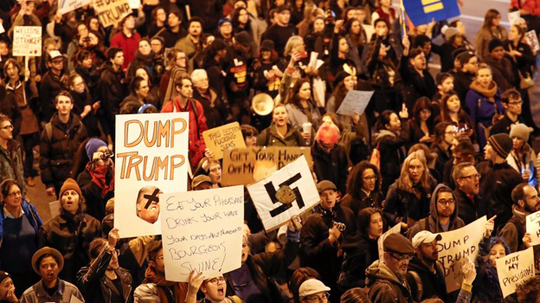
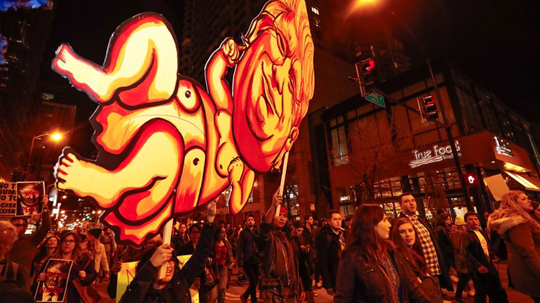
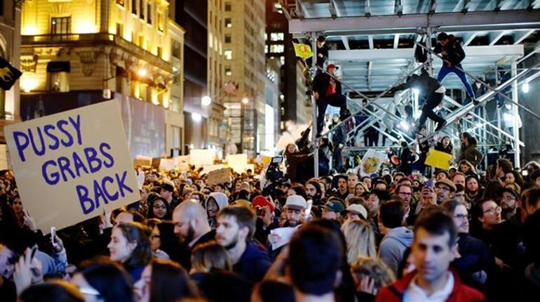
New York, Nov 10: Hundreds of thousands of people took to the streets across the US to protest against Donald Trump's victory in the presidential polls, slamming him for his bigotry and racism, as they demonstrated against his electoral pronouncements on immigration and Muslims.
Trump1

People from all ages, faiths and nationalities assembled at landmark locations in New York, Chicago, Philadelphia, Boston, California, Colorado, Seattle and other cities protesting against Trump, barely a day after he registered a stunning presidential victory against Hillary Clinton.

The protesters were seen walking on roads and highways between moving traffic, holding a multitude of placards and expressing their resentment for Trump through slogans such as 'No more Hate' and 'Trump is not our President'.

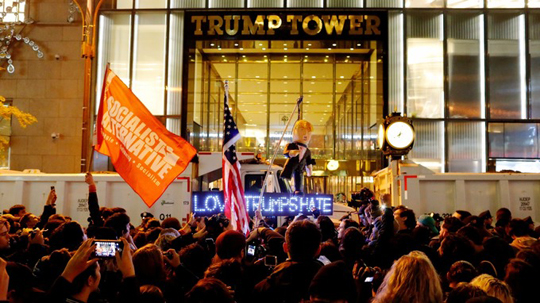
In New York, protesters walked about 40 streets from 14th Street to Fifth Avenue, where Trump's campaign headquarters The Trump Towers is located. Streets surrounding the towers were completely shut off due to the protests.

Kelly Lopez, a young Latino said, she has been upset since morning when it was clear that Trump will be the next US President. She said a person who throughout his campaign has resorted to racism, bigotry, fascism and insulting women and minorities, cannot change overnight and say that he will work for all American people.

"You have bases your entire electoral race on bringing down people, you cannot suddenly change that," she said.

John Jacob, referring to Trump's victory speech, said he does not trust Trump when he said he will "bind the wounds of division".
trump

"How does he take back everything he said in his campaign and the debates," Jacob said, adding that Trump does not have the experience or the intelligence of Clinton.

A young African American student Elaz Iben said Trump will be president of the country for the next four years and "while I will respect the institution of the presidency, I will also respect my right to protest."

The protests in the city as well as across other parts of the country were organised by a group called Socialist Alternative.

"The victory of Donald Trump is being met with shock, fear, and anger. Especially for immigrants, Muslims, people of color, women, and other oppressed people who Trump has singled out for attack, the question of how to defend themselves against the coming attacks is sharply posed," the group said.

It urged people to come together and demonstrate their "mass opposition" to Trump. "Build a wall around Trump's bigoted agenda," the group said on its Facebook page.

The group said the protests must be the beginning of "coordinated nationwide mobilisations to organise millions into a massive grassroots movement."
trump3

trump4

Comments

Add new comment

  • Coastaldigest.com reserves the right to delete or block any comments.
  • Coastaldigset.com is not responsible for its readers’ comments.
  • Comments that are abusive, incendiary or irrelevant are strictly prohibited.
  • Please use a genuine email ID and provide your name to avoid reject.
Agencies
June 24,2020

Seoul, Jun 24: North Korea on Wednesday said leader Kim Jong Un suspended a planned military retaliation against South Korea, possibly slowing the pressure campaign it has waged against its rival amid stalled nuclear negotiations with the Trump administration.

Last week, the North had declared relations with the South as fully ruptured, destroyed an inter-Korean liaison office in its territory and threatened unspecified military action to censure Seoul for a lack of progress in bilateral cooperation and for activists floating anti-Pyongyang leaflets across the border.

Analysts say North Korea, after weeks deliberately raising tensions, may be pulling away just enough to make room for South Korean concessions.

Pyongyang's official Korean Central News Agency said Kim presided by video conference over a meeting Tuesday of the ruling Workers' Party's Central Military Commission, which decided to postpone plans for military action against the South brought up by the North's military leaders.

KCNA didn't specify why the decision was made. It said other discussions included bolstering the country's "war deterrent".

Yoh Sang-key, spokesman of South Korea's Unification Ministry, said Seoul was "closely reviewing" the North's report but didn't further elaborate.

Yoh also said it was the first report in state media of Kim holding a video conferencing meeting, but he didn't provide a specific answer when asked whether that would have something to do with the coronavirus.

The North says there hasn't been a single COVID-19 case on its territory, but the claim is questioned by outside experts.

Kim Dong-yub, an analyst from Seoul's Institute for Far Eastern Studies, said it's likely that the North is waiting for further action from the South to salvage ties from what it sees as a position of strength, rather than softening its stance on its rival.

"What's clear is that the North said (the military action) was postponed, not cancelled," said Kim, a former South Korean military official who participated in inter-Korean military negotiations.

Other experts say the North would be seeking something major from the South, possibly a commitment to resume operations at a shuttered joint factory park in Kaesong, which was where the liaison office was located, or restart South Korean tours to the North's Diamond Mountain resort.

Those steps are prohibited by the international sanctions against the North over its nuclear weapons programme.

The public face of the North's recent bashing of the South has been Kim Yo Jong, the powerful sister of leader Kim Jong Un, who has been confirmed as his top official on inter-Korean affairs.

Issuing harsh statements through state media, she had said the North's demolishing of the liaison office would be just the first in a series of retaliatory action against the enemy South and that she would leave it to the North's military to come up with the next steps.

The General Staff of the North's military has said it would send troops to the mothballed inter-Korean cooperation sites in Kaesong and Diamond Mountain and restart military drills in frontline areas.

Such steps would nullify a set of deals the Koreas reached during a flurry of diplomacy in 2018 that prohibited them from taking hostile action against each other.

Also condemning the South over North Korean refugees floating anti-Pyongyang leaflets across the border, the North said Monday it printed 12 million of its own propaganda leaflets to be dropped over the South in what would be its largest ever anti-Seoul leafleting campaign.

It wasn't immediately clear whether Kim's decision to hold back military action would affect the country's plans for leafleting. The North's military had said it would open border areas on land and sea and provide protection for civilians involved in the leafleting campaigns.

The North has a history of dialling up pressure against the South when it fails to get what it wants from the United States. The North's recent steps came after months of frustration over Seoul's unwillingness to defy US-led sanctions and restart the inter-Korean economic projects that would breathe life into its broken economy.

Nuclear negotiations between Pyongyang and Washington largely stalled after Kim's second summit with President Donald Trump last year in Vietnam, where the Americans rejected North Korea's demands for major sanctions relief in exchange for a partial surrender of its nuclear capabilities.

Comments

Add new comment

  • Coastaldigest.com reserves the right to delete or block any comments.
  • Coastaldigset.com is not responsible for its readers’ comments.
  • Comments that are abusive, incendiary or irrelevant are strictly prohibited.
  • Please use a genuine email ID and provide your name to avoid reject.
News Network
May 29,2020

Washington, May 29: US President Donald Trump while speaking with reporters at the White House on Thursday said that he is more liked in India than the media in his own country --the United States.

"I know. And they like me in India. I think they like me in India certainly more than the media likes me in this country, " Trump told reporters at his Oval office.

"And I like Modi (Prime Minister Narendra Modi). I like your prime minister a lot. He's a great gentleman. A great gentleman," he added further while briefing the reporters.

But when asked over ties between India and China, the US President said, "They have a big conflict going with India and China. Two countries with 1.4 billion people. Two countries with very powerful militaries. And India is not happy, and probably China is not happy."

Reiterating his offer to mediate between India and China on the border issue, Trump said that he spoke to Prime Minister Narendra Modi, who is not in "good mood" about the ongoing situation with Beijing.

However, informed sources from the Ministry of External Affairs told ANI on Friday that there has been no recent contact between Prime Minister Modi and the US President. The last conversation between them took place on April 4, 2020, on the subject of hydroxychloroquine.

Asked about his Wednesday's tweet regarding his offer to mediate between India and China, Trump said, "I would do that. If they (China and India) thought it would help." However, Trump did not clarify when did he speak to Modi.

Trump on Wednesday tweeted that he is "ready, willing and able to mediate" between India and China."We have informed both India and China that the United States is ready, willing and able to mediate or arbitrate their now raging border dispute," the US President said.

In response to Trump's mediation offer, India said on Thursday that it is engaged with the Chinese side to resolve the border issue peacefully.

India's Ministry of External Affairs spokesperson Anurag Srivastava said that the two sides have established mechanisms both at military and diplomatic levels to resolve situations that may arise in border areas peacefully through dialogue and "continue to remain engaged through these channels."

Indian and Chinese field commanders have been holding talks on de-escalating the tensions.

China has also struck a conciliatory tone on the border issue with India, saying the two countries pose no threat to each other and should resolve their differences through communication, while not allowing them to overshadow bilateral relations.

"We should never let differences overshadow our relations. We should resolve differences through communication. China and India should be good neighbours of harmonious coexistence and good partners to move forward hand in hand," said Chinese Ambassador to India, Sun Weidong, on Wednesday.

The tensions escalated between India and China following a number of confrontations between soldiers of both armies.

Troops of India and China were engaged in two face-offs in Eastern Ladakh and North Sikkim along the disputed Line of Actual Control (LAC), where troops from both sides suffered injuries early this month.

Studies over the anti-malarial drug, which is believed to cure the highly contagious coronavirus, have shown side-effects, according to the Centers for Disease Control and Prevention and the World Health Organisation. But Trump continues to defend his decision to take hydroxychloroquine saying he believes that it gives an additional level of safety.

Comments

Add new comment

  • Coastaldigest.com reserves the right to delete or block any comments.
  • Coastaldigset.com is not responsible for its readers’ comments.
  • Comments that are abusive, incendiary or irrelevant are strictly prohibited.
  • Please use a genuine email ID and provide your name to avoid reject.
News Network
June 4,2020

Jun 4: A malaria drug President Donald Trump took to try to prevent COVID-19 proved ineffective for that in the first large, high-quality study to test it in people in close contact with someone with the disease.

Results published Wednesday by the New England Journal of Medicine show that hydroxychloroquine was no better than placebo pills at preventing illness from the coronavirus.

The drug did not seem to cause serious harm, though -- about 40% on it had side effects, mostly mild stomach problems.

 “We were disappointed. We would have liked for this to work,” said the study leader, Dr. David Boulware, an infectious disease specialist at the University of Minnesota.

“But our objective was to answer the question and to conduct a high-quality study,” because the evidence on the drug so far has been inconclusive, he said.

Hydroxychloroquine and a similar drug, chloroquine, have been the subject of much debate since Trump started promoting them in March.

Hydroxychloroquine has long been used for malaria, lupus, and rheumatoid arthritis, but no large studies have shown it or chloroquine to be safe or effective for much sicker patients with coronavirus, and some studies have suggested the drugs may do harm.

Trump took a two-week course of hydroxychloroquine, along with zinc and Vitamin D, after two staffers tested positive for COVID-19, and had no ill effects, according to results of his latest physical released by his doctor Wednesday.

Federal regulators have warned against hydroxychloroquine's use except in hospitals and formal studies because of the risk of side effects, especially heart rhythm problems.

Boulware's study involved 821 people in the United States and Canada living with someone diagnosed with COVID-19 or at high risk of getting it because of their job -- doctors, nurses, ambulance workers who had significant exposure to a sick patient while not wearing full protective gear.

They were randomly assigned to get either the nutrient folate as a placebo or hydroxychloroquine for five days, starting within four days of their exposure. Neither they nor others involved in the research knew who was getting which pills.

After 14 days in the study, 12 per cent on the drug developed COVID-19 symptoms versus 14 per cent in the placebo group, but the difference is so small it could have occurred by chance, Boulware said.

“There's basically no effect. It does not prevent infection,” he said of the drug. Even if it were to give some slim advantage, “we'd want a much larger effect” to justify its use and risk of side effects for preventing illness, he said.

Results were no different among a subgroup of participants who were taking zinc or vitamin C, which some people believe might help make hydroxychloroquine more effective or fight the coronavirus.

There are some big caveats: The study enrolled people through the Internet and social media, relying on them to report their own symptoms rather than having them tracked in a formal way by doctors.

Participants were not all tested for the coronavirus but were diagnosed as COVID-19 cases based on symptoms in many cases. And not all took their medicines as directed.

The results “are more provocative than definitive,” and the drug may yet have prevention benefits if tried sooner or in a different way, Dr. Myron Cohen of the University of North Carolina at Chapel Hill wrote in a commentary in the journal.

Others were glad to see a study that had a comparison group and good scientific methods after so many weaker reports on hydroxychloroquine.

“This fits with everything else we've seen so far which suggests that it's not beneficial," said Dr. Peter Bach, director of a health policy center at Memorial Sloan Kettering Cancer Center in New York.

This study was in younger relatively healthy people, but the results “would make me very discouraged about trying to use this in older people” who are most vulnerable to serious illness from the coronavirus, Bach said.

“If it does work, it doesn't work very well.” Dr. Dan Culver, a lung specialist at the Cleveland Clinic, said there's still a chance that giving the drug sooner than four days after someone's exposure to the virus may help prevent illness.

But the study “takes 'home run' off the table” as far as hopes for the drug, he said.

The study was mostly funded by David Baszucki, founder of Roblox, a California-based game software company, and other private donors and the Minnesota university.

Boulware also is leading a study testing hydroxychloroquine for treating COVID-19. The study is finished and results are being analyzed now.

On Tuesday, the journal Lancet posted an “expression of concern” about a study it published earlier this month of nearly 15,000 COVID-19 patients on the malaria drugs that tied their use to a higher risk of dying in the hospital or developing a heartbeat problem.

Scientists have raised serious questions about the database used for that study, and its authors have launched an independent audit.

That work had a big impact: the World Health Organization suspended use of hydroxychloroquine in a study it is leading, and French officials stopped the drug's use in hospitals. On Wednesday, the WHO said experts who reviewed safety information decided that its study could resume.

Comments

Add new comment

  • Coastaldigest.com reserves the right to delete or block any comments.
  • Coastaldigset.com is not responsible for its readers’ comments.
  • Comments that are abusive, incendiary or irrelevant are strictly prohibited.
  • Please use a genuine email ID and provide your name to avoid reject.
