



Tillerson says China warned North Korea to stop nuclear tests

April 28, 2017

Washington, Apr 28: U.S. Secretary of State Rex Tillerson said Thursday that China has threatened to impose sanctions on North Korea if it conducts further nuclear tests.
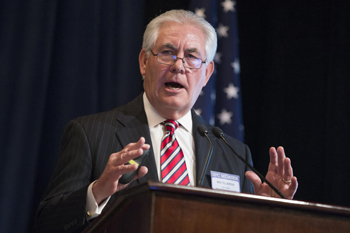
TillersonTillerson said China also told the U.S. that it had informed North Korea "that if they did conduct further nuclear tests, China would be taking sanctions actions on their own."

Earlier Thursday, the senior U.S. Navy officer overseeing military operations in the Pacific said the crisis with North Korea is at the worst point he's ever seen, but he declined to compare the situation to the Cuban missile crisis decades ago.

"It's real," Adm. Harry Harris Jr., commander of U.S. Pacific Command, said during testimony before the Senate Armed Services Committee.

Harris said he has no doubt that North Korean leader Kim Jong Un intends to fulfill his pursuit of a nuclear-tipped missile capable of striking the United States. The admiral acknowledged there's uncertainty within U.S. intelligence agencies over how far along North Korea's nuclear and missile programs are. But Harris said it's not a matter of if but when.

"There is no doubt in my mind," Harris said.

The Trump administration has declared that all options, including a targeted military strike, are on the table to block North Korea from carrying out threats against the United States and its allies in the region. But a pre-emptive attack isn't likely, U.S. officials have said, and the administration is pursuing a strategy of putting pressure on Pyongyang with assistance from China, North Korea's main trading partner and the country's economic lifeline.

With international support, the Trump administration said Thursday it wants to exert a "burst" of economic and diplomatic pressure on North Korea that yields results within months to push the communist government to change course from developing nuclear weapons.

Susan Thornton, the acting top U.S. diplomat for East Asia, said there's debate about whether Pyongyang is willing to give up its weapons programs. She said the U.S. wants "to test that hypothesis to the maximum extent we can" for a peaceful resolution.

But signaling that military action remains possible, Thornton told an event hosted by the Foundation for Defense of Democracies — the Washington think tank has advocated tougher U.S. policies on Iran and North Korea — that the administration treats North Korea as its primary security challenge and is serious that "all options are on the table."

"We are not seeking regime change and our preference is to resolve this problem peacefully," Thornton said, "but we are not leaving anything off the table."

Tillerson took a similar stand in the Fox News interview Thursday, saying: "We do not seek regime change in North Korea. ... What we are seeking is the same thing China has said they seek — a full denuclearization of the Korean peninsula."

In a separate interview with National Public Radio, Tillerson said the U.S. remains open to holding direct negotiations with North Korea.

"But North Korea has to decide they're ready to talk to us about the about the right agenda, and the right agenda is not simply stopping where they are for a few more months or a few more years and then resuming things," he said, according to excerpts of an interview that will air Friday morning. "That's been the agenda for the last 20 years."

Multi-nation negotiations with North Korea on its nuclear program stalled in 2008. The Obama administration attempted to resurrect them in 2012, but a deal to provide food aid in exchange for a nuclear freeze soon collapsed.

Harris told the committee that the financial sanctions imposed against the North Korean regime by the U.S. and other countries have done nothing to slow North Korea's quest for weapons of mass destruction. He also said he's been skeptical of China's willingness to exert its influence over Pyongyang. But Harris said he's become "cautiously optimistic" following recent talks between Trump and Chinese President Xi Jinping.

"It's only been a month or so and it's too early to tell," Harris said. "I wouldn't bet my farm on it."

The House GOP leadership announced late Thursday that it would vote next week on new sanctions against North Korea that would target its shipping industry and those who employ North Korean slave labor abroad.

"The time for waiting on North Korea to get its act together is over. Congress has led the effort to institute tough and far-reaching sanctions against Pyongyang," said House Majority Leader Kevin McCarthy, R-Calif.

In a show of military might, the U.S. has sent a massive amount of American weaponry to the region. A group of American warships led by the aircraft carrier USS Carl Vinson is in striking range of North Korea "if the president were to call on it," Harris told the committee. A U.S. missile defense system called Terminal High-Altitude Area Defense is being installed in South Korea.

Harris said he has adequate forces to "fight tonight" against North Korea if that were to become necessary. But the admiral also said he lacks all the attack submarines he needs and has no capable defense against the thousands of artillery pieces North Korea has assembled near the Demilitarized Zone separating North and South Korea. There are about 28,500 U.S. military personnel serving in South Korea.

Comments

Add new comment

  • Coastaldigest.com reserves the right to delete or block any comments.
  • Coastaldigset.com is not responsible for its readers’ comments.
  • Comments that are abusive, incendiary or irrelevant are strictly prohibited.
  • Please use a genuine email ID and provide your name to avoid reject.
News Network
May 8,2020

May 8: Thousands of migrants have been stranded “all over the world” where they face a heightened risk of COVID-19 infection, the head of the UN migration agency International Organization for Migration (IOM) has said.

IOM Director-General António Vitorino said that more onerous health-related travel restrictions might discriminate disproportionately against migrant workers in future.

“Health is the new wealth,” Vitorino said, citing proposals by some countries to introduce the so-called immunity passports and use mobile phone apps designed to prevent the spread of the new coronavirus.

“In lots of countries in the world, we already have a system of screening checks to identify the health of migrants, above all malaria, tuberculosis… HIV-AIDS, and now I believe that there will be increased demands in health controls for regular migrants,” he said on Thursday.

Travel restrictions to try to limit the spread of the pandemic has left people on the move more vulnerable than ever and unable to work to support themselves, Vitorino told journalists via videoconference.

“There are thousands of stranded migrants all over the world.

 “In South-East Asia, in East Africa, in Latin America, because of the closing of the borders and with the travel restrictions, lots of migrants who were on the move; some of them wanted to return precisely because of the pandemic,” he said.

They are blocked, some in large groups, some in small, in the border areas, in very difficult conditions without access to minimal care, especially health screening, Vitorino said.

“We have been asking the governments to allow the humanitarian workers and the health workers to have access to (them),” he said.

Turning to Venezuelan migrants, who are believed to number around five million amidst a worsening economic crisis in the country, the IOM chief said “thousands… have lost their jobs in countries like Ecuador and Colombia and are returning back to Venezuela in large crowds without any health screening and being quarantined when they go back”.

In a statement, the IOM highlighted the plight of migrants left stranded in the desert in west, central and eastern Africa, either after having been deported without the due process, or abandoned by the smugglers.

The IOM’s immediate priorities for migrants include ensuring that they have access to healthcare and other basic social welfare assistance in their host country.

Among the UN agency’s other immediate concerns is preventing the spread of new coronavirus infection in more than 1,100 camps that it manages across the world.

They include the Cox’s Bazar complex in Bangladesh, home to around one million mainly ethnic Rohingya from Myanmar, the majority having fled persecution.

So far, no cases of infection have been reported there, the IOM chief said, adding that preventative measures have been communicated to the hundreds of thousands of camp residents, while medical capacity has been boosted.

Beyond the immediate health threat of COVID-19 infection, migrants also face growing stigmatization from which they need protection, Vitorino said.

Allowing hate speech and xenophobic narratives to thrive unchallenged also threatens to undermine the public health response to COVID-19, he said, before noting that migrant workers make up a significant percentage of the health sector in many developed countries including the UK, the US and Switzerland.

Populist narratives targeting migrants as carriers of disease could also destabilise national security through social upheaval and countries’ post-COVID economic recovery by removing critical workers in agriculture and service industries, he said.

Remittances have already seen a 30 per cent drop during the pandemic, Vitorino said, citing the World Bank data, meaning that some USD 20 billion has not been sent home to families in countries where up to 15 per cent of their gross domestic product comes from pay packets earned abroad.

Vitorino, in a plea, urged to give the health of migrants as much attention as that of the host populations in all countries.

“It is quite clear that health is the new wealth and that health concerns will be introduced in the mobility systems - not just for migration - but as a whole; where travelling for business or professional reasons, health will be the new gamechanger in town.

“If the current pandemic leads to a two or even three-tier mobility system, then we will have to try to solve the problem – the problem of the pandemic - but at the same time we have created a new problem of deepening the inequalities,” he said.

Comments

Add new comment

  • Coastaldigest.com reserves the right to delete or block any comments.
  • Coastaldigset.com is not responsible for its readers’ comments.
  • Comments that are abusive, incendiary or irrelevant are strictly prohibited.
  • Please use a genuine email ID and provide your name to avoid reject.
News Network
March 23,2020

Singapore, Mar 23: Oil prices fell at the open in Asia on Monday after a trillion-dollar Senate proposal to help the coronavirus-hit American economy was defeated and death tolls soared across Europe and the US.

US benchmark West Texas Intermediate initially tumbled more than three percent but then pulled back some ground to trade 1.5 percent lower, at $22 a barrel.

Brent crude, the international benchmark, fell 4.9 percent to $25 a barrel.

Prices have fallen to multi-year lows in recent weeks as lockdowns and travel restrictions to fight the virus hit demand, and top producers Saudi Arabia and Russia engage in a price war.

The latest drop came after a trillion-dollar Senate proposal to rescue the US economy was defeated after receiving zero support from Democrats, and with five Republicans absent from the chamber because of virus-related quarantines.

The bill had proposed funding for American families, thousands of shuttered or suffering businesses and the nation's critically under-equipped hospitals.

Coronavirus deaths soared across Europe and the United States at the weekend despite heightened restrictions.

The death toll from the virus -- which has upended lives and closed businesses and schools across the planet -- surged to more than 14,300 Sunday, according to an AFP tally.

AxiCorp chief markets strategist Stephen Innes said that "total demand devastation" had set it.

"Oil markets collapsed out of the gate this morning as prices react... to stringent containment lockdown measures," he said.

Comments

Add new comment

  • Coastaldigest.com reserves the right to delete or block any comments.
  • Coastaldigset.com is not responsible for its readers’ comments.
  • Comments that are abusive, incendiary or irrelevant are strictly prohibited.
  • Please use a genuine email ID and provide your name to avoid reject.
Agencies
July 2,2020

Ramallah, Jul 2: Several world countries renew a call for Israel to halt contentious plans to annex parts of the occupied Palestinian territory after the regime delayed the implementation of the land garb bid in the face of a series of stumbling blocks, including internal rifts, global criticisms and the US’s failure to give Tel Aviv the go-ahead for the move.

Israel's ruling coalition, led by Prime Minister Benjamin Netanyahu, had announced July 1 as the date to begin moving forward with the plan to impose Tel Aviv’s “sovereignty” over about a third of the West Bank, including settlements and the fertile Jordan Valley.

Without clarifications, the regime, however, failed to launch the scheme on the set date amid widening differences between Netanyahu and his coalition partner, minister of military affairs Benny Gantz.

Meanwhile, there are signs that the administration of US President Donald Trump, a staunch Israel supporter, has cooled its backing for the Israeli move amid what is believed to be troubles at home and fears that it might hurt the president’s chances of re-election besides international pressure.

On Wednesday, Netanyahu's office said in a statement that he would continue to discuss a possible West bank annexation with the US administration.

“In the coming days there will be additional discussions,” the statement said.

Labor, Social Affairs and Social Services Minister Ofir Akunis said the Israel would annex portions of the West Bank in July but only after the US president issued a declaration on the matter.

The annexation “will only happen after a declaration by Trump,” he told Israeli Army Radio.

Trump had already given Tel Aviv the green light for the land grab in his self-proclaimed “deal of the century,” which was unveiled in January with the aim of re-drawing the Middle East map.

However, the Trump administration has so far refrained from offering official support for the annexation sought by Netanyahu and his right-wing allies.

Unlike the US, several countries, including some of Israel’s allies, have expressed their opposition to Israel’s planned push to consolidate its occupation of Palestine.

Germany passes anti-annexation resolution

On Wednesday, the German parliament approved a resolution calling on the government to dissuade Israel from annexing the West Bank.

The motion, which was brought in the German legislature by the three parties in Chancellor Angela Merkel's coalition, was approved without opposing votes. 

Berlin should use its “special relations and contacts [with Tel Aviv] to express to the Israeli government our concerns and our urgent demand to refrain from an annexation of parts of the West Bank and from the continued expansion of settlements, both of which contradict international law,” read the resolution.

Speaking at the parliamentary debate before the vote, German Foreign Minister Heiko Maas said, “We reject unilateral changes of borders, and we won’t recognize them.”

He also stressed that peace “cannot be achieved through unilateral steps but only through serious negotiations.”

France warns of consequences

Similarly, French Foreign Minister, Jean-Yves Le Drian warned that any Israeli annexation would be a violation of international law and would bring about consequences.

“Annexation of Palestinian territories, whatever the perimeters, would seriously throw into question the parameters to resolve the conflict,” he told a parliamentary hearing. 

The top diplomat added, “An annexation decision could not be left without consequences and we are examining different options at a national level and also in coordination with our main European partners.”

Australia raises concerns

Additionally, Australian Foreign Minister Marise Payne voiced worries about the Israeli scheme, saying she had directly expressed this view to Israeli Foreign Minister Gabi Ashkenazi.

“We are following with concern possible moves towards the unilateral annexation or change in status of territory on the West Bank,” she said in a statement.

“The focus needs to be on a return to direct and genuine negotiations between Israel and the Palestinians for a durable and resilient peace arrangement, as soon as possible,” Payne added.

Vatican summons US, Israeli envoys

Meanwhile, the Vatican announced on Wednesday that it had summoned the American and Israeli ambassadors to protest Israel’s annexation bid.

In separate meetings, Vatican Secretary of State Cardinal Pietro Parolin told Israeli Ambassador Oren David and US Ambassador Callista Gingrich of concerns “regarding possible unilateral actions that may further jeopardize the search for peace between Israelis and Palestinians, as well as the delicate situation in the Middle East,”

“As already declared … the Holy See reiterates that ... Israel and the State of Palestine have the right to exist and to live in peace and security, within internationally recognized borders,” the Vatican said in a statement.

“It thus appeals to the parties to do everything possible to reopen the process of direct negotiation, on the basis of the relevant Resolutions of the United Nations,” it added.

Amnesty urges firm action

Amnesty International called on the international community to take firm action against Israel’s annexation plan and its “law of the jungle” mentality.

“Members of the international community must enforce international law and restate that annexation of any part of the occupied West Bank is null and void,” said Saleh Higazi, deputy regional director for Amnesty Middle East and North Africa.

“They must also work to immediately stop the construction or expansion of illegal Israeli settlements and related infrastructure in the Occupied Palestinian Territories as a first step towards removing Israeli civilians living in such settlements,” he added.

Palestinians mark ‘Day of Rage'

Also on Wednesday, Palestinians held “Day of Rage” rallies both in the West Bank and the Gaza Strip against the Israeli expansionism.

In Gaza city, several thousand protesters gathered, some brandishing Palestinian national flags and placards condemning Trump.

Some demonstrators carried signs in English reading, “We Can’t Breathe Since 1948” and “Palestinian Lives Matter,” in reference to the American Black Lives Matter movement.

“The occupation has killed us and killed our children and deprived us of a good life. May God grant the Resistance victory,” a protester told the al-Aqsa TV.

“The resistance must be revived,” Gaza protester Rafeeq Inaiah told media persons. “Israel is afraid of force.”

Similar demonstrations also took place in the West Bank cities of Ramallah and Jericho.

Comments

Add new comment

  • Coastaldigest.com reserves the right to delete or block any comments.
  • Coastaldigset.com is not responsible for its readers’ comments.
  • Comments that are abusive, incendiary or irrelevant are strictly prohibited.
  • Please use a genuine email ID and provide your name to avoid reject.