



Tillerson says China warned North Korea to stop nuclear tests

April 28, 2017

Washington, Apr 28: U.S. Secretary of State Rex Tillerson said Thursday that China has threatened to impose sanctions on North Korea if it conducts further nuclear tests.
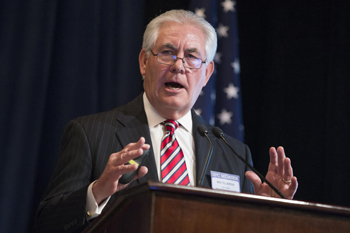
TillersonTillerson said China also told the U.S. that it had informed North Korea "that if they did conduct further nuclear tests, China would be taking sanctions actions on their own."

Earlier Thursday, the senior U.S. Navy officer overseeing military operations in the Pacific said the crisis with North Korea is at the worst point he's ever seen, but he declined to compare the situation to the Cuban missile crisis decades ago.

"It's real," Adm. Harry Harris Jr., commander of U.S. Pacific Command, said during testimony before the Senate Armed Services Committee.

Harris said he has no doubt that North Korean leader Kim Jong Un intends to fulfill his pursuit of a nuclear-tipped missile capable of striking the United States. The admiral acknowledged there's uncertainty within U.S. intelligence agencies over how far along North Korea's nuclear and missile programs are. But Harris said it's not a matter of if but when.

"There is no doubt in my mind," Harris said.

The Trump administration has declared that all options, including a targeted military strike, are on the table to block North Korea from carrying out threats against the United States and its allies in the region. But a pre-emptive attack isn't likely, U.S. officials have said, and the administration is pursuing a strategy of putting pressure on Pyongyang with assistance from China, North Korea's main trading partner and the country's economic lifeline.

With international support, the Trump administration said Thursday it wants to exert a "burst" of economic and diplomatic pressure on North Korea that yields results within months to push the communist government to change course from developing nuclear weapons.

Susan Thornton, the acting top U.S. diplomat for East Asia, said there's debate about whether Pyongyang is willing to give up its weapons programs. She said the U.S. wants "to test that hypothesis to the maximum extent we can" for a peaceful resolution.

But signaling that military action remains possible, Thornton told an event hosted by the Foundation for Defense of Democracies — the Washington think tank has advocated tougher U.S. policies on Iran and North Korea — that the administration treats North Korea as its primary security challenge and is serious that "all options are on the table."

"We are not seeking regime change and our preference is to resolve this problem peacefully," Thornton said, "but we are not leaving anything off the table."

Tillerson took a similar stand in the Fox News interview Thursday, saying: "We do not seek regime change in North Korea. ... What we are seeking is the same thing China has said they seek — a full denuclearization of the Korean peninsula."

In a separate interview with National Public Radio, Tillerson said the U.S. remains open to holding direct negotiations with North Korea.

"But North Korea has to decide they're ready to talk to us about the about the right agenda, and the right agenda is not simply stopping where they are for a few more months or a few more years and then resuming things," he said, according to excerpts of an interview that will air Friday morning. "That's been the agenda for the last 20 years."

Multi-nation negotiations with North Korea on its nuclear program stalled in 2008. The Obama administration attempted to resurrect them in 2012, but a deal to provide food aid in exchange for a nuclear freeze soon collapsed.

Harris told the committee that the financial sanctions imposed against the North Korean regime by the U.S. and other countries have done nothing to slow North Korea's quest for weapons of mass destruction. He also said he's been skeptical of China's willingness to exert its influence over Pyongyang. But Harris said he's become "cautiously optimistic" following recent talks between Trump and Chinese President Xi Jinping.

"It's only been a month or so and it's too early to tell," Harris said. "I wouldn't bet my farm on it."

The House GOP leadership announced late Thursday that it would vote next week on new sanctions against North Korea that would target its shipping industry and those who employ North Korean slave labor abroad.

"The time for waiting on North Korea to get its act together is over. Congress has led the effort to institute tough and far-reaching sanctions against Pyongyang," said House Majority Leader Kevin McCarthy, R-Calif.

In a show of military might, the U.S. has sent a massive amount of American weaponry to the region. A group of American warships led by the aircraft carrier USS Carl Vinson is in striking range of North Korea "if the president were to call on it," Harris told the committee. A U.S. missile defense system called Terminal High-Altitude Area Defense is being installed in South Korea.

Harris said he has adequate forces to "fight tonight" against North Korea if that were to become necessary. But the admiral also said he lacks all the attack submarines he needs and has no capable defense against the thousands of artillery pieces North Korea has assembled near the Demilitarized Zone separating North and South Korea. There are about 28,500 U.S. military personnel serving in South Korea.

Comments

Add new comment

  • Coastaldigest.com reserves the right to delete or block any comments.
  • Coastaldigset.com is not responsible for its readers’ comments.
  • Comments that are abusive, incendiary or irrelevant are strictly prohibited.
  • Please use a genuine email ID and provide your name to avoid reject.
Agencies
July 13,2020

New Delhi, Jul 13: Google CEO Sundar Pichai on Monday announced an investment of Rs 75,000 crore or approximately US$10 billion into India over the next five to seven years through 'Google for India Digistation Fund'.

This move is significant as it comes in the middle of the COVID-19 pandemic and as multinational companies across the world look at alternative investment destinations.

"Excited to announce Google for India Digitisation Fund. Through it, we will invest Rs 75,000 crore or approx US$10 Billon into India over the next 5-7 yrs. We'll do this through a mix of equity investments, partnerships and operational infrastructure in ecosystem investments," said Pichai.

Pichai along with Union Minister Ravi Shankar Prasad virtually attended the sixth annual edition of Google for India.

"This is a reflection of our confidence in the future of India and its digital economy," said Pichai.
He added that the investments will focus on four areas important to India's digitisation.

Listing out the areas, Pichai elaborated, "First enabling affordable access and information to every Indian in their own language. Second, building new products and services that are deeply relevant to India's unique needs. Third, empowering businesses as they continue or embark on the digital transformation. Fourth, leveraging technology in AI for social good in areas like health, education and agriculture."

"When I was young, every piece of technology brought new opportunities to learn and grow but I always had to wait for it to arrive from some places. Today people in India no more have to wait for technology to come to you. A whole new generation of technologies is happening in India first," said Pichai.

Earlier today Prime Minister Narendra Modi interacted with Pichai and discussed a range of subjects like a new work culture in coronavirus times, data security and cyber safety.

Comments

Add new comment

  • Coastaldigest.com reserves the right to delete or block any comments.
  • Coastaldigset.com is not responsible for its readers’ comments.
  • Comments that are abusive, incendiary or irrelevant are strictly prohibited.
  • Please use a genuine email ID and provide your name to avoid reject.
News Network
May 6,2020

Singapore, May 6: Oil prices slipped back Wednesday after two days of gains, although Brent crude remained above $30 a barrel, as renewed US-China tensions offset optimism about the easing of coronavirus lockdowns.

Brent, the international benchmark, fell 1.1 per cent to $30.63 a barrel in early Asian trade. On Tuesday, the contract surged 14 per cent and rose above $30 for the first time since mid-April.

US marker West Texas Intermediate slipped 1.9 per cent and was changing hands for $24.13 a barrel.

Oil markets have been battered as the virus strangled demand due to business closures and travel restrictions, with US crude falling into negative territory last month for the first time.

They started rallying strongly this week as countries from Europe to Asia ease curbs and economies start shuddering back to life.

But gains were capped Wednesday as dealers follow a brewing US-China row after Donald Trump hit out at Beijing over its handling of the outbreak, saying it began in a Wuhan lab, but so far offering no evidence.

"Traders are incredibly cautious this morning, weighing all the possible China responses," said Stephen Innes, chief global market strategist at AxiCorp.

"And the one that would hurt the most would be for China to reduce imports of US oil."

This week's rally was in part driven by a deal agreed between top producers to reduce output by almost 10 million barrels a day, which came into effect on May 1.

There have also been signs that the massive oversupply in the market is starting to ease as demand slowly comes back.

Energy data provider Genscape said earlier this week that stockpiles at the main US oil depot in Cushing, Oklahoma had increased by only 1.8 million barrels last week following weeks of major rises.

Comments

Add new comment

  • Coastaldigest.com reserves the right to delete or block any comments.
  • Coastaldigset.com is not responsible for its readers’ comments.
  • Comments that are abusive, incendiary or irrelevant are strictly prohibited.
  • Please use a genuine email ID and provide your name to avoid reject.
News Network
January 28,2020

Jan 28: China said on Tuesday that 106 people had died from a new coronavirus that is spreading across the country, up from the previous toll of 81.

The number of total confirmed cases in China rose to 4,515 as of Jan. 27, the National Health Commission said in a statement, up from 2,835 reported a day earlier.

The United States warned against travel to China on Monday and Canada issued a more narrow travel warning as the death toll from the spreading coronavirus passed 100, with tens of millions stranded during the biggest holiday of the year and global markets rattled.

Global stocks fell, oil prices hit three-month lows, and China's yuan dipped to its weakest level in 2020 as investors fretted about damage to the world's second-biggest economy from travel bans and the Lunar New Year holiday, which China extended in a bid to keep people at home.

The health commission of China's Hubei province said on Tuesday that 100 people had died from the virus as of Jan. 27, according to an online statement, up from the previous toll of 76, with the number of confirmed cases in the province rose to 2,714.

Other fatalities have been reported elsewhere in China, including the first in Beijing, bringing the deal toll to 106 so far, according to the People's Daily. The state newspaper put the total number of confirmed cases in China at 4,193, though some experts suspect a much higher number.

On Monday, US President Donald Trump offered China whatever help it needed, while the State Department said Americans should "reconsider" visiting all of China due to the virus.

Canada, which has two confirmed cases of the virus and is investigating 19 more potential cases, warned its citizens to avoid travel to China's Hubei province, at the heart of the outbreak.

Authorities in Hubei province are taking increasing flak from the public over their initial response to the virus. Chinese Premier Li Keqiang visited the city of Wuhan, epicentre of the outbreak, to encourage medical workers and promise reinforcements.

Visiting Wuhan in blue protective suit and mask, Li praised medics, said 2,500 more workers would join them in the next two days, and visited the site of a new hospital to be built in days.

The most senior leader to visit Wuhan since the outbreak, Li was shown on state TV leading medical workers in chants of "Wuhan jiayou!" - an exhortation to keep their strength up.

China's ambassador to the United Nations, following a meeting with UN Secretary-General António Guterres on Monday, said "the Chinese government attaches paramount importance to prevention and control of the epidemic, and President Xi Jinping has given important instructions. ...

"China has been working with the international community in the spirit of openness, transparency and scientific coordination," he said.

Guterres said in a statement, "The UN appreciates China's effort, has full confidence in China's ability of controlling the outbreak, and stands ready to provide any support and assistance."

MOUNTING ANGER

On China's heavily censored social media, officials have faced mounting anger over the virus, which is thought to have originated from a market where wildlife was sold illegally.

Some criticised the governor of Hubei province, of which Wuhan is the capital, after he corrected himself twice during a news conference over the number of face masks being produced.

"If he can mess up the data multiple times, no wonder the disease has spread so severely," said one user of the Weibo social media platform.

In rare public self-criticism, Wuhan Mayor Zhou Xianwang said the city's management of the crisis was "not good enough" and indicated he was willing to resign.

The central Chinese city of 11 million people is in virtual lockdown and much of Hubei, home to nearly 60 million people, is under travel curbs.

Elsewhere in China, people from the region faced questioning about their movements. "Hubei people are getting discriminated against," a Wuhan resident complained on Weibo.

Cases linked to people who travelled from Wuhan have been confirmed in a dozen countries, from Japan to the United States, where authorities said they had 110 people under investigation in 26 states. Sri Lanka was the latest to confirm a case.

INVESTORS WORRIED

Investors are worried about the impact. The consensus is that in the short term, economic output will be hit as authorities limit travel and extend the week-long New Year holiday — when millions traditionally travel by rail, road and plane - by three days to limit spread of the virus.

Asian and European shares tumbled, with Japan's Nikkei average sliding 2%, its biggest one-day fall in five months. Demand spiked for safe-haven assets such as the Japanese yen and Treasury notes. European stocks fell more than 2%.

The US S&P 500 closed down nearly 1.6%.

"China is the biggest driver of global growth so this couldn't have started in a worse place," said Alec Young, FTSE Russell's managing director of global markets research.

During the 2002-2003 outbreak of Severe Acute Respiratory Syndrome (SARS), which originated in China and killed nearly 800 people globally, air passenger demand in Asia plunged 45%. The travel industry is more reliant on Chinese travellers now.

Chinese-ruled Hong Kong, which has had eight cases, banned entry to people who had visited Hubei recently.

Some European tour operators cancelled trips to China, while governments around the world worked on repatriating nationals.

Officially known as 2019-nCoV, the newly identified coronavirus can cause pneumonia, but it is still too early to know just how dangerous it is and how easily it spreads.

"What we know about this virus it that transmission occurs through human contact but we are speaking of close contact, i.e. less than a meter," said Jerome Salomon, a senior official with France's health ministry.

"Crossing someone (infected) in the street poses no threat," he said. "The risk is low when you spend a little time near that person and becomes higher when you spend a lot of time near that person."

Comments

Add new comment

  • Coastaldigest.com reserves the right to delete or block any comments.
  • Coastaldigset.com is not responsible for its readers’ comments.
  • Comments that are abusive, incendiary or irrelevant are strictly prohibited.
  • Please use a genuine email ID and provide your name to avoid reject.