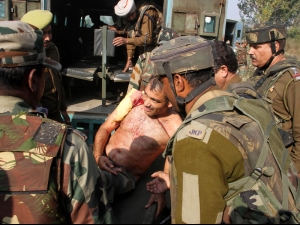
Toll in Jammu gunfight rises to 11

November 28, 2014

jammu kasJammu, Nov 28: The toll in the gunfight between the security forces and infiltrators that restarted Friday after a lull has risen to 11. Heavy firing is on in Jammu district ahead of the prime minister's election rallies in the state.

A senior police officer said another body was recovered Friday morning during searches in Arnia area of Jammu district, the site of the gunbattle that started Thursday and resumed Friday.

"Searches in the area had to be stopped after heavy firing exchanges started again at the site this morning," a senior army officer said here.

"Another dead body has been recovered during Friday's searches." "The toll has risen to 11... So far, four civilians, three soldiers and four militants have been killed," the officer added.

A group of heavily-armed militants infiltrated into the Indian side of the border at Arnia in Jammu district Thursday. The security forces took them on and four militants were killed.

Sources said the lone surviving militant is presumed to be firing Friday from an abandoned army bunker in Pind Khote village of the R.S. Pura area.

Prime Minister Narendra Modi is scheduled to arrive here Friday to address election rallies in Udhampur and Poonch before the second phase of assembly elections Dec 2.

Comments

Add new comment

  • Coastaldigest.com reserves the right to delete or block any comments.
  • Coastaldigset.com is not responsible for its readers’ comments.
  • Comments that are abusive, incendiary or irrelevant are strictly prohibited.
  • Please use a genuine email ID and provide your name to avoid reject.
News Network
June 9,2020

Jun 9: Prime Minister Narendra Modi wants all 1.3 billion Indians to be “vocal for local” — meaning, to not just use domestically made products but also to promote them. As an overseas citizen living in Hong Kong, I’m doing my bit by very vocally demanding Indian mangoes on every trip to the grocery. But half the summer is gone, and not a single slice so far.

My loss is due to India’s COVID-19 lockdown, which has severely pinched logistics, a perennial challenge in the huge, infrastructure-starved country. But more worrying than the disruption is the fruity political response to it. Rather than being a wake-up call for fixing supply chains, the pandemic seems to be putting India on an isolationist course. Why?

Granted that the liberal view that trade is good and autarky bad isn’t exactly fashionable anywhere right now. What makes India’s lurch troublesome is that the pace and direction of economic nationalism may be set by domestic business interests. The Indian liberals, many of whom are Western-trained academics, authors and — at least until a few years ago — policy makers, want a more competitive economy. They will be powerless to prevent the slide.

Modi’s call for a self-reliant India has been echoed by Home Minister Amit Shah, the cabinet’s unofficial No. 2, in a television interview. If Indians don’t buy foreign-made goods, the economy will see a jump, he said. The strategy — although it’s too nebulous yet to call it that — has a geopolitical element. A military standoff with China is under way, apparently triggered by India’s completion of a road and bridge near the common border in the tense Himalayan region of Ladakh. It’s very expensive to fight even a limited war there. With India’s economy flattened by COVID, New Delhi may be looking for ways to restore the status quo and send Beijing a signal.

Economic boycotts, such as Chinese consumers’ rejection of Japanese goods over territorial disputes in the East China Sea, are well understood as statecraft. In these times, it’s not even necessary to name an enemy. An undercurrent of popular anger against China, the source of both the virus and India’s biggest bilateral trade deficit, is supposed to do the job. But is it ever that easy?

A hastily introduced policy to stock only local goods in police and paramilitary canteens became a farcical exercise after the list of banned items ended up including products by the local units of Colgate-Palmolive Co., Nestle SA, and Unilever NV, which have had significant Indian operations for between 60 and 90 years, as well as Dabur India Ltd., a New Delhi-based maker of Ayurveda brands. The since-withdrawn list demonstrates the practical difficulty of bureaucrats trying to find things in a globalized world that are 100% indigenous.

Free-trade champions fret that the prime minister, whom they saw as being on their side six years ago, is acting against their advice to dismantle statist controls on land, labor and capital to help make the country more competitive. Engage with the world more, not less, they caution. But Modi also has to satisfy the Rashtriya Swayamsevak Sangh, the umbrella Hindu organisation that gets him votes. Its backbone of small traders, builders and businessmen — the RSS admits only men — was losing patience with the anemic economy even before the pandemic. Now, they’re in deep trouble, because India’s broken financial system won’t deliver even state-guaranteed loans to them.

The U.S.-China tensions — over trade, intellectual property, COVID responsibility and Hong Kong’s autonomy — offer a perfect backdrop. A dire domestic economy and trouble at the border provide the foreground. Big business will dial economic nationalism up and down to hit a trifecta of goals: Block competition from the People's Republic; make Western rivals fall in line and do joint ventures; and tap deep overseas capital markets. The first goal is being achieved with newly placed restrictions on investment from any country that shares a land border with India. The second aim is to be realized by corporate lobbying to influence India's whimsical economic policies. As for the third objective, with the regulatory environment becoming tougher for U.S.-listed Chinese companies like Alibaba Group Holding Ltd., an opportunity may open up for Indian firms.

All this may bring India Shenzhen-style enclaves of manufacturing and trade, but it will concentrate economic power in fewer hands, something that worries liberals. They’re moved by the suffering of India’s low-wage workers, who have borne the brunt of the COVID shutdown. But when their vision of a more just society and fairer income distribution prompts them to make common cause with the ideological Left, they’re quickly repelled by the Marxist voodoo that all cash, property, bonds and real estate held by citizens or within the nation “must be treated as national resources available during this crisis.” Who will invest in a country that does that instead of just printing money?

At the same time, when liberals look to the business class, they see a sudden swelling of support for ideas like a universal basic income. They wonder if this isn’t a ploy by industry to outsource part of the cost of labor to the taxpayer. Slogans like Modi’s vocal-for-local stir the pot and thicken the confusion. The value-conscious Indian consumer couldn’t give two hoots for calls to buy Indian, but large firms will know how to exploit economic nationalism. One day soon, I’ll get my mangoes — from them.

Comments

Add new comment

  • Coastaldigest.com reserves the right to delete or block any comments.
  • Coastaldigset.com is not responsible for its readers’ comments.
  • Comments that are abusive, incendiary or irrelevant are strictly prohibited.
  • Please use a genuine email ID and provide your name to avoid reject.
News Network
February 14,2020

Washington, Feb 14: The United States has called for making Jamaat-ud-Dawa (JuD) chief Hafiz Saeed accountable for his involvement in the planning of "numerous acts of terrorism, including 2008 Mumbai attacks". "We continue to call for Hafiz Saeed to be held accountable for his involvement in the planning of numerous acts of terrorism, including 2008 Mumbai attacks that killed 166 innocent people, including 6 Americans," US State Department spokesperson said on Thursday (February 13, 2020).

US State Department spokesperson said this while commenting on the Saeed`s conviction in terror financing cases.

The spokesperson said Hafiz Saeed`s conviction on terror financing is a step towards curtailing the operation of a terrorist group that threatens peace and stability in South Asia.

"We urge Pakistan to continue to take appropriate legal action against individuals who commit acts of terrorism, raise funds for, or advocate for terrorism," the official said.

On Wednesday, Alice Wells, Principal Deputy Assistant Secretary of US for South and Central Asian Affairs had termed the conviction of 26/11 Mumbai terror attack mastermind Hafiz Saeed as an "important step forward" towards holding terrorist organisation LeT "accountable for its crimes".

"Today`s conviction of Hafiz Saeed and his associate is an important step forward - both toward holding LeT accountable for its crimes and for #Pakistan in meeting its international commitments to combat terrorist financing," she tweeted.

"And as @ImranKhanPTI has said, it is in the interest of #Pakistan`s future that it not allow non-state actors to operate from its soil," she said in another tweet.

An anti-terrorism court in Lahore, Pakistan on Wednesday sentenced Mumbai terror attack mastermind and chief of the banned Jamaat-ud -Dawa (JuD) Hafiz Saeed to five-and-a-half years in prison each in two terror financing cases.

Pakistan based Dawn reported that he was slapped with a prison sentence of five-and-a-half years and a fine of Rs15,000 in each case and the sentences of both cases will run concurrently.

Comments

Add new comment

  • Coastaldigest.com reserves the right to delete or block any comments.
  • Coastaldigset.com is not responsible for its readers’ comments.
  • Comments that are abusive, incendiary or irrelevant are strictly prohibited.
  • Please use a genuine email ID and provide your name to avoid reject.
News Network
March 6,2020

New Delhi, Mar 6: As panicky depositors rushed to withdraw money from Yes Bank whose control was seized by the RBI in a dramatic late-night move, Finance Minister Nirmala Sitharaman on Friday assured depositors that their money is safe and said the central bank was working for an early resolution of the crisis.

The Reserve Bank of India (RBI) on Thursday evening capped withdrawals at Rs 50,000 for the next one month and imposed strict limits on operations at the country's fourth-largest private lender that faced "regular outflow of liquidity" after an effort to raise new capital failed.

"I am in continuous interaction with the RBI. The RBI is fully seized of the matter and has assured they will give a quick resolution," Sitharaman said here.

She said no depositor will lose his or her money and insisted that the immediate priority is to ensure Yes Bank customers are able to withdraw money within the stipulated cap.

"I want to assure every depositor that their money shall be safe. Their monies are safe," she said. "I am constantly in contact with the RBI and the steps that are taken are taken in the interest of depositors, banks and economy. We are fully seized of the development."

She was talking to reporters after meeting State Bank of India (SBI) Chairman Rajnish Kumar. On Thursday, the SBI board gave its "in-principle" approval to exploring investment opportunities in Yes Bank.

"So I repeat, the depositors can be assured that their money is safe," she said.

Soon after the RBI takeover, depositors thronged Yes Bank ATMs to withdraw money and police had to be deployed in some places to control the crowds.

Yes Bank has 1,000 branches across the country.

Refusing to elaborate on her meeting with the SBI chairman, the minister said that "was on a completely different matter".

"RBI governor has given me assurance that there will be an appropriate resolution soon. No depositor will lose (money)," she said. "Reserve Bank has taken cognizance of the problem."

The central bank, she said, has gone through the "process over and over again to find out an amicable solution".

"And that has been over the last couple of months. So it is not as if they have come in suddenly now. We have been monitoring the situation," she said adding the RBI has appointed an administrator who previously was with the SBI.

"Both the RBI and the government are looking at this with all the details before them, not just today. I have personally monitored the situation over the last couple of months with the RBI. Therefore we have taken a course which will be in everybody's interest," she added.

Yes Bank had been seeking new capital since last year to bolster its ratios and quell questions about its stability due to its exposure to the non-banking finance industry entangled in a prolonged crunch in the local credit market.

The SBI chairman said the resolution to the Yes Bank crisis will come "very shortly".

"This is not a sectoral problem. It is a bank-specific problem," he said. "The RBI will take all steps to ensure financial stability."

On SBI picking up a stake in Yes Bank, he said the lender already has an in-principle approval for doing so.

"If SBI has to pick up a stake in Yes Bank, we have an in-principle approval for that," he said.

Commenting on the crisis at Yes Bank, Alka Anbarasu, Vice President – Senior Credit Officer, Financial Institutions, Moody's Investors Service, said: "RBI's moratorium on Yes Bank is credit negative as it affects timely repayment of bank depositors and creditors."

"While Moody's expects Indian authorities will take steps to prevent the weakness in the bank's viability from significantly impacting its depositors and senior creditors, the lack of a coordinated and timely action highlights continued uncertainty around bank resolutions in India," she said.


Comments

Add new comment

  • Coastaldigest.com reserves the right to delete or block any comments.
  • Coastaldigset.com is not responsible for its readers’ comments.
  • Comments that are abusive, incendiary or irrelevant are strictly prohibited.
  • Please use a genuine email ID and provide your name to avoid reject.