



Trouble for Modi govt: Coal strike stops output at over 60% mines; unions refuse to budge

January 7, 2015

Modi govt

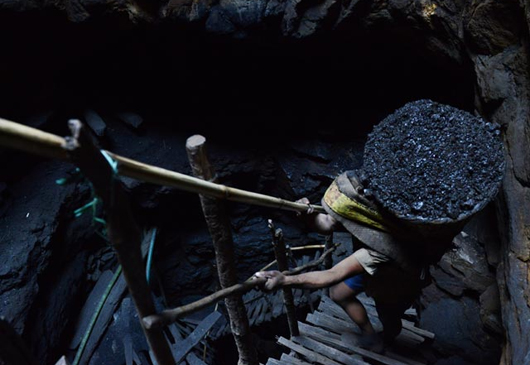
Kolkata/New Delhi, Jan 7: Coal industry employees across the country yesterday went on a five-day strike, halting production at over 60 percent of state-run Coal India units that may also severely hit fuel supply to power plants, while talks failed late tonight to end the industrial action.

The government officials held hours-long negotiations with union representatives, but failed to convince them to call off the strike, which is being billed as the biggest industrial action since 1977.

Claiming that over 5 lakh coal industry workers across the country have gone off-work, the union leaders said they are open to negotiations at 'political' level, including with Prime Minister Narendra Modi and Coal Minister Piyush Goyal.

On its first day itself, the strike is estimated to have caused production losses to the tune of Rs 70 crore in first two shifts yesterday, officials said.

The strike call has been given by all five leading trade unions of the country, including the BJP-backed Bharatiya Mazdoor Sangh (BMS).

The industrial action is in protest against 'disinvestment and restructuring of state-run Coal India' and to press for demands including the roll-back of what they call as "process of denationalising of coal sector".

The Labour Ministry said in a statement that the strike has affected the working of CIL and its subsidiaries, as also the mines of Singareni Collieries Co Ltd.

The strike, joined by all five major trade unions - BMS, INTUC, AITUC, CITU and HMS -- is likely to affect production of up to 1.5 million tonnes (MT) of the dry-fuel per day besides fuel supply to power plants which are already grappling with fuel shortages.

Coming out of late-night talks, INTUC Secretary General S Q Zama said, "Negotiations at the secretary-level have failed, but we are open for discussions at political level, at the level of Prime Minister or Coal Minister.

"We did our best to arrive at an amicable solution, but the (Coal) Secretary has his own limitations. Around five lakh workers, including 3.5 lakh from CIL, are on strike."

CIL Chairman Sutirtha Bhattacharya, who assumed charge yesterday itself, said that he was hopeful that the situation would be resolved in an amicable manner.

According to a senior official, "Out of 438 units of CIL, 271 have been completely impacted by the strike. There is only partial production from 57 units. The PSU had suffered losses to the tune of Rs 35 crore in the first shift itself."

According to union leaders, the strike was being observed by almost all employees of CIL and around 70-80 percent of SCCL (Singareni Collieries Company Ltd) workers, while 5-10 percent of staff engaged in essential services like water supply were working at some CIL subsidiaries.

All India Coal Workers Federation leader Jibon Roy claimed that about 7 lakh workers have joined the strike.

CIL, which accounts for over 80 per cent of domestic coal production, itself has a workforce of about 3.5 lakh.

The trade unions had boycotted the earlier two meetings called by the government.

To face emergency situation, CIL has sought 20 additional rakes from Railways for supply of coal, while normally about 200 rakes are supplied a day on an average.

The company has stepped up supplies to power plants to tide over the likely disruption of supplies due to the strike.

All five major trade unions of the coal PSU had boycotted a meeting called by Coal Minister Piyush Goyal last week.

Meanwhile, electricity workers' union EEFI has also extended its support to the strike call.

Separately, employee unions had called for a one-day strike at public sector banks tomorrow, to be followed by another four-day strike later this month but deferred their action after talks between employee and management representatives earlier this evening.

Besides, petrol pump owners in Rajasthan will go on a single-day strike tomorrow to press for rollback of recent hike in VAT on petrol.

Comments

Add new comment

  • Coastaldigest.com reserves the right to delete or block any comments.
  • Coastaldigset.com is not responsible for its readers’ comments.
  • Comments that are abusive, incendiary or irrelevant are strictly prohibited.
  • Please use a genuine email ID and provide your name to avoid reject.
Agencies
January 25,2020

Patna, Jan 25: JD Women's College in Patna has issued a direction to the students to follow the prescribed dress code on the campus while stating that wearing a 'burqa' in college is prohibited.

"All students have to come to college in the prescribed dress code, every day except on Saturday. Students are prohibited from wearing 'burqa' in college", reads a notice signed by the Principal and Proctor of the college.

The college administration has also imposed a fine of Rs. 250 for violation of the norm.

Comments

Abdullah
 - 
Sunday, 26 Jan 2020

I think this college management will allow girl students to wear tight jeans + t-shair and miniskirts but is not allowing a girl to cover her body.    Are we in ancient days where humans had no dress to cover themselves or in the time of Nair kings in kerala who restricted ladies of low caste from covering their chest.     

Add new comment

  • Coastaldigest.com reserves the right to delete or block any comments.
  • Coastaldigset.com is not responsible for its readers’ comments.
  • Comments that are abusive, incendiary or irrelevant are strictly prohibited.
  • Please use a genuine email ID and provide your name to avoid reject.
News Network
May 15,2020

New Delhi, May 15: With an increase of 3,967 COVID-19 cases in the last 24 hours, India's tally of coronavirus cases reached 81,970 cases, according to the Union Ministry of Health and Family Welfare on Friday.

According to the latest figures, 51,401 patients are active coronavirus cases while 27,919 patients have been cured/discharged and one patient has been migrated.

With a rise in 100 deaths due to COVID-19 in the last 24 hours, the number of deaths now stands at 2,649.

According to the Health Ministry, Maharashtra is the worst-hit state with regard to the number of COVID-19 cases with 27,524 cases of which, 6,059 patients have been cured/discharged and 1,019 succumbing to the virus.

Tamil Nadu has a tally of 9,674 cases inclusive of 2,240 patients cured/discharged and 66 fatalities.

Gujarat has a total of 9,591 cases which include 3,753 patients cured/discharged while 586 have lost their lives due to coronavirus.

Delhi has a tally of 8,470 cases of which 3,045 patients cured/discharged and 115 fatalities.

Comments

Add new comment

  • Coastaldigest.com reserves the right to delete or block any comments.
  • Coastaldigset.com is not responsible for its readers’ comments.
  • Comments that are abusive, incendiary or irrelevant are strictly prohibited.
  • Please use a genuine email ID and provide your name to avoid reject.
News Network
June 20,2020

New Delhi, Jun 20: Diesel price on Saturday hit a record high after rates were hiked by 61 paise per litre while petrol price was up 51 paise, taking the cumulative increase in rates in two weeks to Rs 8.28 and Rs 7.62 respectively.

Petrol price in Delhi was hiked to Rs 78.88 per litre from Rs 78.37, while diesel rates were increased to Rs 77.67 a litre from Rs 77.06, according to a price notification of state oil marketing companies.

Rates have been increased across the country and vary from state to state depending on the incidence of local sales tax or VAT.

The 14th daily increase in rates since oil companies on June 7 restarted revising prices in line with costs after ending an 82-day hiatus in rate revision, has taken diesel prices to new high. Petrol price too is at a two-year high.

Prior to the current rally, diesel rate had touched a peak of Rs 75.69 per litre in Delhi on October 16, 2018.

The highest-ever petrol price was on October 4, 2018, when rates soared to Rs 84 a litre in Delhi.

When rates had peaked in October 2018, the government had cut excise duty on petrol and diesel by Rs 1.50 per litre each. State-owned oil companies were asked to absorb another Re 1 a litre to help cut retail rates by Rs 2.50 a litre.

Oil companies had quickly recouped the Re 1 and the government in July 2019 raised excise duty by Rs 2 a litre.

The 82-day freeze in rates this year was imposed in mid-March soon after the government hiked excise duty on petrol and diesel to shore up additional finances.

The government on March 14 hiked excise duty on petrol and diesel by Rs 3 per litre each and then again on May 5 by a record Rs 10 per litre in case of petrol and Rs 13 on diesel. The two hikes gave the government Rs 2 lakh crore in additional tax revenues.

Oil PSUs Indian Oil Corp (IOC), Bharat Petroleum Corp Ltd (BPCL) and Hindustan Petroleum Corp Ltd (HPCL), instead of passing on the excise duty hikes to customers, adjusted them against the fall in retail rates that was warranted because of a decline in international oil prices to two-decade lows.

International oil prices have since rebounded and oil firms are now adjusting retail rates in line with them.

In 14 hikes, petrol price has gone up by Rs 7.62 per litre and diesel by Rs 8.28 a litre.

Comments

Add new comment

  • Coastaldigest.com reserves the right to delete or block any comments.
  • Coastaldigset.com is not responsible for its readers’ comments.
  • Comments that are abusive, incendiary or irrelevant are strictly prohibited.
  • Please use a genuine email ID and provide your name to avoid reject.