



New York, Jan 12: President-elect Donald Trump acknowledged for the first time here Wednesday that Russia was responsible for hacking the Democratic Party during last year's election, but denied that the leaks were intended to boost him and argued that Moscow would cease cyber attacks on the United States once he is sworn in.
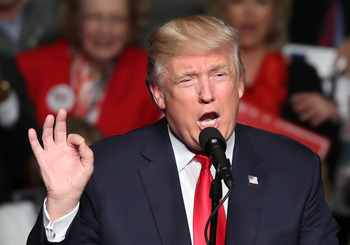 In a rollicking hour-long news conference, Trump furiously denounced as "fake news" the reports that Russia had obtained salacious intelligence that could compromise him. He suggested that any damaging information collected by Russian President Vladimir Putin's administration would already have been released - and he celebrated what had leaked out about Democratic nominee Hillary Clinton.
"As far as hacking, I think it was Russia," Trump said. "Hacking's bad and it shouldn't be done. But look at the things that were hacked, look at what was learned from that hacking."
Allowing his hostility and contempt toward the U.S. intelligence community to again burst into public view, Trump also reaffirmed his belief - first expressed in a tweet earlier Wednesday morning - that intelligence officials were behaving as though they were in "Nazi Germany" with what he termed "disgraceful" leaks to the media. The Anti-Defamation League asked Trump to apologize for trivializing the Holocaust.
Trump made a series of promises but provided little specific evidence on how he would deliver them. He vowed to repeal and replace President Barack Obama's Affordable Care Act quickly and nearly simultaneously ("could be the same hour"); to start building a wall along the U.S. border with Mexico before convincing the Mexican government to pay for it ("that will happen, whether it's a tax or whether it's a payment"); and unveiled how he is disentangling himself from management of his massive business empire while still refusing to divest himself of his financial interests.
Trump also said he planned to announce a nominee fill the Supreme Court vacancy left by the late justice Antonin Scalia within two weeks of his Jan. 20 inauguration, having already reviewed a list of about 20 candidates recommended by conservatives at the Federalist Society and Heritage Foundation. And he promised to bring jobs to the states that supported him in November, calling himself "the greatest jobs producer that God ever created."
In a performance that was by turns considered, combative, and carnivalesque, Trump also definitively confirmed that winning the presidency has not changed his public presentation to that of a more traditional statesman.
Instead, he repeatedly lashed out at the news media. He shushed correspondents from CNN - "You are fake news," he hissed at them - which broke the news late Tuesday that Trump and Obama had been briefed on allegations that Russian intelligence services have compromising material and information on Trump's personal life and finances.
He also went after Buzzfeed, which published a document Tuesday outlining some of the unverified allegations, which were based on research done by an outside entity engaged in political consulting work and led by a former high-ranking British intelligence official. Trump called Buzzfeed a "failing pile of garbage" and warned it would "suffer the consequences" for publishing the dossier.
Some 300 journalists packed into the marble lobby of Trump Tower for the president-elect's first full-fledged news conference since July 27, when among other pronouncements Trump urged the Russian government to find and release tens of thousands of Clinton's private emails.
Six months later, the subject of Russian hacking still clouds Trump's transition to power and questions about the hacking attacks dominated Wednesday's press conference. At first, Trump refused to say whether he or anyone on his campaign had been in contact with Russia, but he clarified as he left the press conference, telling reporters near the elevators that neither he nor his team had any contact with Russia about his campaign.
Trump also insisted that the warm relationship he has cultivated with Putin is beneficial to the United States.
"If Putin likes Donald Trump, guess what, folks? That's called an asset, not a liability," he said. "Now, I don't know that I'm gonna get along with Vladimir Putin. I hope I do. But there's a good chance I won't. And if I don't, do you honestly believe that Hillary would be tougher on Putin than me?"
At times, Trump also seemed eager to both reminisce about and relitigate his unlikely campaign. He recounted his crowds of thousands that "would go crazy" when he urged them to cheer that Mexico would pay for a border wall. And he poked fun at Sen. Lindsey Graham, R-S.C., a longtime critic who ran unsuccessfully in the 2016 Republican primary, when asked about a bill Graham is co-sponsoring that would increase sanctions on Russia.
"I've been competing with him for a long time," Trump said, nodding to Graham's poor showing in the primaries. "He is going to crack that 1 percent barrier one day."
On cyber attacks, he said his administration will produce within 90 days a major report on how to stop the hacking "phenomena."
He also argued that Russia hacked the Democrats because "the Democratic National Committee was totally open to be hacked."
Trump claimed credit for instructing Republican National Committee Chairman Reince Priebus, his incoming White House chief of staff, to invest in ordering "a very, very strong hacking defense," and said the Russians had tried to hack his party's internal systems but "were unable to break through."
FBI Director James Comey said at a hearing Tuesday that none of the RNC's current computer networks were hacked but that old email servers that were no longer being used were penetrated. The fact that none of that information was released by the Russians factored into the intelligence community's conclusion that Moscow aimed to help Trump win, Comey said.
He noted that the Russian hackers "got far deeper and wider into the DNC than the RNC." Officials have previously said that the DNC's cybersecurity was not as strong as the RNC's.
Like many Trump productions, Wednesday's press conference was strategically staged and cast. Aides carried out heaps of papers in manila folders, which Trump claimed were the legal documents transferring management of his many business interests over to his two adult sons, Donald Jr. and Eric.
Sean Spicer, the incoming White House press secretary, emerged first at the lectern to play the role of outraged disciplinarian, setting the tone for a press conference that was both offensive and defensive. He half-read, half-shouted a strongly worded statement castigating some media organizations for "highly salacious and flat-out false" reports Tuesday night about Trump and Russia that he said were intended to undermine the new administration.
"The fact that BuzzFeed and CNN made the decision to run with this unsubstantiated claim is a sad and pathetic attempt to get clicks," Spicer said, as his boss looked on proudly.
Spicer's admonishment seemed intended to free Trump to rise above the fray - and Trump's initial remarks were measured and largely magnanimous. But a few questions into the news conference, the president-elect delved directly into the topic of Russia.
Asked whether he engaged in behavior during his Russia trip for the Miss Universe pageant that he now regrets and that makes him now vulnerable to blackmail, Trump said he is "extremely careful" when traveling abroad. He said he tells his bodyguards to beware hidden cameras in foreign hotels.
"You have cameras in the strangest places - cameras that are so small with modern technology you can't see them and you won't know," Trump said. "You better be careful or you'll be watching yourself on nightly television. I tell this to people all the time."
Trump added, "I'm also very much of a germaphobe, by the way. Believe me."
Trump's post-election news conference, where he had planned to formally announce how he would restructure his businesses to avoid conflicts of interest, was delayed for weeks as he and his lawyers worked to disentangle the president-elect.
Midway through, Trump turned over the lectern to Sheri Dillon, a tax adviser at the Morgan Lewis law firm, who read a lengthy statement explaining that Trump was giving up management of the Trump Organization and shifting his assets into a trust managed by Donald Jr. and Eric Trump while he serves as president.
However, Trump will not sell his business or his stake. He also said he would continue continued to refuse to release his tax returns for public review. "The only ones that care about my tax returns are the reporters," Trump said.
Trump's company, which has a vast array of licensing deals, buildings, golf courses and other properties around the globe, will make no new foreign deals while he is in office, Dillon said. Any new domestic deals would undergo vigorous review and require approval by an independent ethics adviser.
As Dillon explained the nuances of the new arrangement, Trump stood off to the side appearing restless and perhaps bored. He shifted his stance, whispered back and forth with Vice President-elect Mike Pence, and at one point ducked out of camera view to take a sip of water.
Yet Trump soon returned to his spot at center stage, parrying questions on a range of subjects before drawing the cameras to focus on the display of papers and folders at the table next to him. He said they were "just a piece of the many, many companies" being put into a trust to be run by his sons.
"I hope at the end of eight years I'll come back and say, 'Oh, you did a good job,' " Trump said, as his two older sons looked on admiringly.
But Trump couldn't resist a final flourish, underscoring his ongoing struggle to shift from reality television host to leader of the free world. "Otherwise, if they do a bad job," Trump continued, "I'll say, 'You're fired!' "

Comments
Add new comment