


Trump blasts courts for blocking travel ban, warns of 'peril'

February 6, 2017

Palm Beach(US), Feb 6: President Donald Trump blasted the federal courts for a second day in a row after his efforts to implement a travel ban were suspended and warned that the judiciary could be placing Americans in "peril."
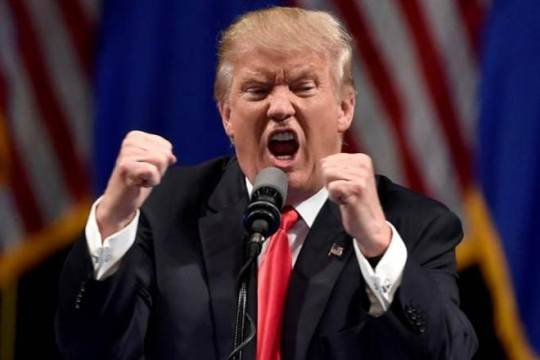
trump-R

"Just cannot believe a judge would put our country in such peril. If something happens blame him and court system. People pouring in. Bad!" the president tweeted yesterday, after uncharacteristically taking a nearly day-long break from Twitter.

"I have instructed Homeland Security to check people coming into our country VERY CAREFULLY. The courts are making the job very difficult!"

The saga began on January 27 when Trump issued a blanket ban on all refugees, as well as on travellers from Iran, Iraq, Libya, Somalia, Sudan, Syria and Yemen.

That sparked a worldwide furor, prompting protest marches and demonstrations in cities and at airports across the United States.

On Friday, a federal judge in Seattle, James Robart, blocked the ban nationwide pending a wider legal review.

On Saturday Trump angrily fired off multiple tweets on the matter, stating that the "so-called judge" was "ridiculous" -- and drawing criticism from Democrats and others who said the president was dangerously close to interfering with the judicial branch of government.

A leading Democratic senator, Patrick Leahy of Vermont, said Trump seemed "intent on precipitating a constitutional crisis."

Then early yesterday, a US appeals court rejected an urgent government request to reinstate Trump's controversial ban.

Comments

shaji
 - 
Monday, 6 Feb 2017

He is a hate monger and hope american public will discard him soon. I hope there will be more demonstration in US and other nations against inappropriae/unjust policy of this hate monger

Add new comment

  • Coastaldigest.com reserves the right to delete or block any comments.
  • Coastaldigset.com is not responsible for its readers’ comments.
  • Comments that are abusive, incendiary or irrelevant are strictly prohibited.
  • Please use a genuine email ID and provide your name to avoid reject.
News Network
February 14,2020

London, Feb 14: Five years ago Britain’s new finance minister Rishi Sunak wasn’t even a member of parliament and now he is running the world's fifth largest economy.

The 39-year-old former Goldman Sachs banker was appointed in dramatic fashion on Thursday when incumbent Sajid Javid unexpectedly quit — in a row over advisers — during what Downing Street had cast as a routine ministerial reshuffle.

Sunak is married to the daughter of Infosys co-founder NR Narayana Murthy, and was hand-picked to take over an ultra-safe seat in northern England, previously represented by former Conservative Party leader William Hague. The Murthy family was not reachable for comment.

In July, when he was promoted chief secretary to the Treasury, Murthy had said: “Our advice to our children, including Rishi, has been to work hard, be honest, and do good for society…We wish him well.”

After Thursday’s announcement, Sunak said: “Delighted to be appointed... Lots to get on with.”

Tipped for Promotion

As Boris Johnson moves to increase control of the finance ministry, one of the youngest chancellors in history will face a prime minister who wants to increase government spending on everything from infrastructure and police to health and education.

Sunak, seen as a rising star in the ruling Conservative Party since he entered Parliament in 2015, had been tipped for promotion to a senior post in the ministerial rejig as Johnson put together his post-Brexit cabinet.

But, despite an already rapid ascent through the ranks of government, few expected the Oxford University Politics, Philosophy and Economics graduate to ascend to one of the highest offices in the land.

Sunak had been serving as Javid’s deputy in the finance ministry since Johnson promoted him upon taking office in July 2019. Prior to that he had served as a junior housing minister.

“From working in my mum’s tiny chemist shop to my experience building large businesses, I have seen first-hand how politicians should support free enterprise and innovation to ensure our future prosperity,” Sunak says on his website.

Smooth and loyal

Seen as a smooth media performer and ultra-loyal member of the Conservative Party, Sunak has been used by the government to present and defend their policies in television interviews — a sign of trust from Johnson, who has a fraught relationship with Britain’s media.

Sunak takes control at a critical juncture for Britain’s $2.7 trillion economy. He will have to steer the economy through the turbulence of leaving the European Union and the forging of new trade links that will define Britain’s new relationship with the world.

However, the power struggle that forced his predecessor Javid to quit hints at a more diminished role for what is the second most powerful position in the government — with Johnson’s office wanting to centralise control and minimise dissent.

Sunak is one of the three ministers of Indian origin in Johnson’s cabinet, the other two being Priti Patel and Alok Sharma. Patel remains the interior minister after the cabinet reshuffle while Sharma, a former minister for international development, was appointed the new minister for business. Sunak’s father was a doctor and his mother ran a chemist shop. Before entering politics he worked for Goldman Sachs and a hedge fund, then co-founded an investment firm. He also has an MBA from Stanford University.

Comments

Add new comment

  • Coastaldigest.com reserves the right to delete or block any comments.
  • Coastaldigset.com is not responsible for its readers’ comments.
  • Comments that are abusive, incendiary or irrelevant are strictly prohibited.
  • Please use a genuine email ID and provide your name to avoid reject.
News Network
May 20,2020

London, May 20: The current physical distancing guidelines of 6 feet may be insufficient to prevent COVID-19 transmission, according to a study which says a mild cough in low wind speeds can propel saliva droplets by as much as 18 feet.

Researchers, including those from the University of Nicosia in Cyprus, said a good baseline for studying the airborne transmission of viruses, like the one behind the COVID-19 pandemic, is a deeper understanding of how particles travel through the air when people cough.

In the study, published in the journal Physics of Fluids, they said even with a slight breeze of about four kilometres per hour (kph), saliva travels 18 feet in 5 seconds.

"The droplet cloud will affect both adults and children of different heights," said study co-author Dimitris Drikakis from the University of Nicosia.

According to the scientists, shorter adults and children could be at higher risk if they are located within the trajectory of the saliva droplets.

They said saliva is a complex fluid, which travels suspended in a bulk of surrounding air released by a cough, adding that many factors affect how saliva droplets travel in the air.

These factors, the study noted, include the size and number of droplets, how they interact with one another and the surrounding air as they disperse and evaporate, how heat and mass are transferred, and the humidity and temperature of the surrounding air.

In the study, the scientists created a computer simulation to examine the state of every saliva droplet moving through the air in front of a coughing person.

The model considered the effects of humidity, dispersion force, interactions of molecules of saliva and air, and how the droplets change from liquid to vapour and evaporate, along with a grid representing the space in front of a coughing person.

Each grid, the scientists said, holds information about variables like pressure, fluid velocity, temperature, droplet mass, and droplet position.

The study analysed the fates of nearly 1,008 simulated saliva droplets, and solved as many as 3.7 million equations.

"The purpose of the mathematical modelling and simulation is to take into account all the real coupling or interaction mechanisms that may take place between the main bulk fluid flow and the saliva droplets, and between the saliva droplets themselves," explained Talib Dbouk, another co-author of the study.

However, the researchers added that further studies are needed to determine the effect of ground surface temperature on the behaviour of saliva in air.

They also believe that indoor environments, especially ones with air conditioning, may significantly affect the particle movement through air.

This work is important since it concerns safety distance guidelines, and advances the understanding of the transmission of airborne diseases, Drikakis said.

Comments

Add new comment

  • Coastaldigest.com reserves the right to delete or block any comments.
  • Coastaldigset.com is not responsible for its readers’ comments.
  • Comments that are abusive, incendiary or irrelevant are strictly prohibited.
  • Please use a genuine email ID and provide your name to avoid reject.
News Network
May 21,2020

Canberra, May 21: Australian Prime Minister Scott Morrison and his Indian counterpart, Narendra Modi, are looking forward to deepening the countries' strategic relationship, with both sides expected to sign a range of pacts from defence to trade in strategic sectors amid heightened tensions with China over Beijing's response to coronavirus pandemic.

During a virtual summit, scheduled to take place on June 4, both leaders are expected to ramp up efforts to diversify Australia's export markets and find trusted suppliers of vital products and components, a local newspaper, The Australian reported on Tuesday.

The new agreements will focus on reliable supply chains in key strategic sectors, including medical goods, technology and critical minerals, amid heightened tensions with China over Beijing's response to coronavirus pandemic.

The leaders will seal a new defence agreement allowing reciprocal access to bases and co-operation on military technology projects, while a new education partnership will be on the table to help overcome Australian university reliance on Chinese students.

The talks in terms of strategic convergence, now have greater significance as COVID-19 exacerbates the strategic contest between the US and China, and forces like-minded countries to seek out reliable partners.

Australian farmers could also benefit, with talks underway on expanding agricultural exports to India, including barley, as China throws up new trade barriers, media reports stated.

The virtual summit follows the cancellation of Morrison's planned state visit to India in January due to the bushfires.

Morrison said last year, ahead of his planned visit, that India was "a natural partner for Australia", referring to the countries' "shared values" -- a point of differentiation with China.

Former Department of Foreign Affairs and Trade secretary Peter Varghese, who wrote a landmark report on the bilateral relationship in 2018, was quoted by the newspaper as saying that India would be even more important to Australia in the post-COVID world. "If one of the lessons from COVID is that countries need to spread their risk, then finding new markets or building up existing markets is a crucial part of that," he added.

Varghese noted that India, a member of the Quadrilateral Security Dialogue along with Australia, Japan and the US, was a vital strategic partner to Australia in helping "constrain China's ambitions to be the predominant power".

"That shared objective between Australia and India of not wanting to see the region dominated by China is a key component of building up our geopolitical relationship," he told The Australian.

The summit also follows recent talks between Australian Foreign Minister Marise Payne and Indian counterpart Subrahmanyam Jaishankar on the pandemic response and Australia's call for an independent inquiry, which was overwhelmingly backed at the World Health Assembly on Tuesday.

Australia wants to support India to develop a domestic critical minerals processing industry, which would provide Western nations with an alternative to sourcing the materials from China.

Meanwhile, India has strong expertise as a manufacturer of drugs and medical equipment, while Australia is a centre of biomedical research, opening the possibility for closer co-operation in the key sector, the media reported further.

Comments

Add new comment

  • Coastaldigest.com reserves the right to delete or block any comments.
  • Coastaldigset.com is not responsible for its readers’ comments.
  • Comments that are abusive, incendiary or irrelevant are strictly prohibited.
  • Please use a genuine email ID and provide your name to avoid reject.