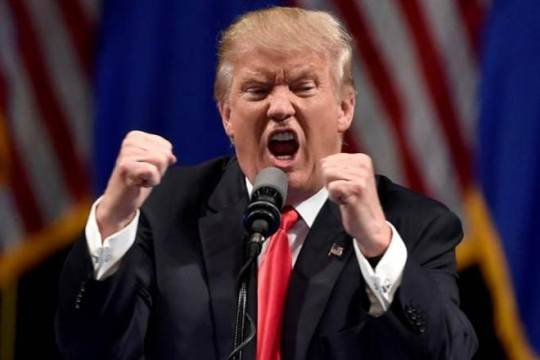
Trump blasts courts for blocking travel ban, warns of 'peril'

February 6, 2017

Palm Beach(US), Feb 6: President Donald Trump blasted the federal courts for a second day in a row after his efforts to implement a travel ban were suspended and warned that the judiciary could be placing Americans in "peril."

trump-R

"Just cannot believe a judge would put our country in such peril. If something happens blame him and court system. People pouring in. Bad!" the president tweeted yesterday, after uncharacteristically taking a nearly day-long break from Twitter.

"I have instructed Homeland Security to check people coming into our country VERY CAREFULLY. The courts are making the job very difficult!"

The saga began on January 27 when Trump issued a blanket ban on all refugees, as well as on travellers from Iran, Iraq, Libya, Somalia, Sudan, Syria and Yemen.

That sparked a worldwide furor, prompting protest marches and demonstrations in cities and at airports across the United States.

On Friday, a federal judge in Seattle, James Robart, blocked the ban nationwide pending a wider legal review.

On Saturday Trump angrily fired off multiple tweets on the matter, stating that the "so-called judge" was "ridiculous" -- and drawing criticism from Democrats and others who said the president was dangerously close to interfering with the judicial branch of government.

A leading Democratic senator, Patrick Leahy of Vermont, said Trump seemed "intent on precipitating a constitutional crisis."

Then early yesterday, a US appeals court rejected an urgent government request to reinstate Trump's controversial ban.

Comments

shaji
 - 
Monday, 6 Feb 2017

He is a hate monger and hope american public will discard him soon. I hope there will be more demonstration in US and other nations against inappropriae/unjust policy of this hate monger

Add new comment

  • Coastaldigest.com reserves the right to delete or block any comments.
  • Coastaldigset.com is not responsible for its readers’ comments.
  • Comments that are abusive, incendiary or irrelevant are strictly prohibited.
  • Please use a genuine email ID and provide your name to avoid reject.
News Network
February 17,2020

Feb 17: Chinese authorities on Monday reported a slight upturn in new virus cases and 105 more deaths for a total of 1,770 since the outbreak began two months ago.

The 2,048 new cases followed three days of declines but was up by just 39 cases from the previous day’s figure. Another 10,844 people have recovered from COVID-19, a disease caused by the new coronavirus, and have been discharged from hospitals, according to Monday’s figures.

The update followed the publication late Saturday in China’s official media of a recent speech by President Xi Jinping in which he indicated for the first time that he had led the response to the outbreak from early in the crisis. While the reports were an apparent attempt to demonstrate the Communist Party leadership acted decisively from the start, it also opened Xi up to criticism over why the public was not alerted sooner.

In his speech, Xi said he gave instructions on fighting the virus on Jan. 7 and ordered the shutdown of the most-affected cities that began on Jan. 23.

The disclosure of his speech indicates top leaders knew about the outbreak’s potential severity at least two weeks before such dangers were made known to the public. It was not until late January that officials said the virus can spread between humans and public alarm began to rise.

New cases in other countries are raising growing concerns about containment of the virus.

Taiwan on Sunday reported its first death from COVID-19, the fifth fatality outside of mainland China. Taiwan’s Central News Agency, citing health minister Chen Shih-chung, said the man who died was in his 60s and had not traveled overseas recently and had no known contact with virus patients.

Japanese Prime Minister Shinzo Abe convened an experts meeting to discuss containment measures in his country, where more than a dozen cases have emerged in the past few days without any obvious link to China.

“The situation surrounding this virus is changing by the minute,” Abe said.

Japanese Health Minister Katsunobu Kato said the country is “entering into a phase that is different from before,” requiring new steps to stop the spread of the virus.

Japan now has 413 confirmed cases, including 355 from a quarantined cruise ship, and one death from the virus. Its total is the highest number of cases among about two dozen countries outside of China where the illness has spread.

Hundreds of Americans from the cruise ship took charter flights home, as Japan announced another 70 infections had been confirmed on the Diamond Princess. Canada, Hong Kong and Italy were planning similar flights.

The 300 or so Americans flying on U.S.-government chartered aircraft back to the U.S. will face another 14-day quarantine at Travis Air Force Base in California and Lackland Air Force Base in Texas. The U.S. Embassy said the departure was offered because people on the ship were at a high risk of exposure to the virus. People with symptoms were banned from the flights.

About 255 Canadians and 330 Hong Kong residents are on board the ship or undergoing treatment in Japanese hospitals. There are also 35 Italians, of which 25 are crew members, including the captain.

In China’s Hubei province, where the outbreak began in December, all vehicle traffic will be banned in another containment measure. It expands a vehicle ban in the provincial capital, Wuhan, where public transportation, trains and planes have been halted for weeks.

Exceptions were being made for vehicles involved in epidemic prevention and transporting daily necessities.

Hubei has built new hospitals with thousands of patient beds and China has sent thousands of military medical personnel to staff the new facilities and help the overburdened health care system.

Last Thursday, Hubei changed how it recognized COVID-19 cases, accepting a doctor’s diagnosis rather than waiting for confirmed laboratory test results, in order to treat patients faster. The tally spiked by more than 15,000 cases under the new method.


Comments

Add new comment

  • Coastaldigest.com reserves the right to delete or block any comments.
  • Coastaldigset.com is not responsible for its readers’ comments.
  • Comments that are abusive, incendiary or irrelevant are strictly prohibited.
  • Please use a genuine email ID and provide your name to avoid reject.
News Network
April 13,2020

Manila, Apr 13: The Asian Development Bank (ADB) on Monday tripled the size of its response to novel coronavirus disease (COVID-19) pandemic to 20 billion dollars and approved measures to streamline its operations for quicker and more flexible delivery of assistance.

The package expands ADB's 6.5 billion dollars initial response announced on March 18, adding 13.5 billion dollars in resources to help ADB's developing member countries counter the severe macroeconomic and health impacts caused by COVID-19.

The 20 billion dollar package includes about 2.5 billion dollars in concessional and grant resources.

"This pandemic threatens to severely set back economic, social, and development gains in Asia and the Pacific, reverse progress on poverty reduction and throw economies into recession," said ADB President Masatsugu Asakawa.

"Our expanded and comprehensive package of assistance, made possible with the strong support of our board, will be delivered more quickly, flexibly and forcefully to the governments and the private sector in our developing member countries to help them address the urgent challenges in tackling the pandemic and economic downturn," he said in a statement.

ADB's most recent assessment released on April 3 estimates the global impact of the pandemic at between 2.3 and 4.8 per cent of gross domestic product. Regional growth is forecast to decline from 5.2 per cent last year to 2.2 per cent in 2020.

The new package includes the establishment of a COVID-19 pandemic response option under ADB's countercyclical support facility.

Up to 13 billion dollars will be provided through this new option to help governments of developing member countries implement effective countercyclical expenditure programs to mitigate impacts of the COVID-19 pandemic, with a particular focus on the poor and the vulnerable.

Grant resources will continue to be deployed quickly for providing medical and personal protective equipment and supplies from expanded procurement sources.

Some 2 billion dollars from the 20 billion dollar package will be made available for the private sector. Loans and guarantees will be provided to financial institutions to rejuvenate trade and supply chains.

Enhanced microfinance loan and guarantee support and a facility to help liquidity-starved small and medium-sized enterprises, including those run by female entrepreneurs, will be implemented alongside direct financing of companies responding to or impacted by COVID-19.

The response package includes a number of adjustments to policies and business processes that will allow ADB to respond more rapidly and flexibly to the crisis. These include measures to streamline internal business processes, widen the eligibility and scope of various support facilities and make the terms and conditions of lending more tailored.

All support under the expanded package will be provided in close collaboration with international organisations, including the International Monetary Fund, World Bank Group, World Health Organisation, UNICEF, other UN agencies and the broader global community.

Comments

Add new comment

  • Coastaldigest.com reserves the right to delete or block any comments.
  • Coastaldigset.com is not responsible for its readers’ comments.
  • Comments that are abusive, incendiary or irrelevant are strictly prohibited.
  • Please use a genuine email ID and provide your name to avoid reject.
News Network
February 16,2020

Munich, Feb 16: Iran's foreign minister said Saturday that US President Donald Trump is receiving bad advice if he believes an American "maximum pressure" campaign against his country will cause the government in Tehran to collapse.

Foreign Minister Mohammad Javad Zarif told a group of top defense officials and diplomats at the Munich Security Conference that the information provided to the president has dissuaded Trump from accepting offers from other leaders to mediate between Washington and Tehran.

"President Trump has been convinced that we are about to collapse so he doesn't want to talk to a collapsing regime," Zarif said.

To support his argument, the Iranian minister cited Trump's decision to pull out unilaterally in 2018 from Iran's nuclear deal with the US and other world powers. Trump said the landmark 2015 accord didn't address Iran's ballistic missile program or regional activities and needed to be renegotiated.

Since then, the Trump administration's re-imposition of US sanctions in a campaign of so-called "maximum pressure" have taken a severe toll on the Iranian economy and sent Iran's currency plunging.

"I believe President Trump, unfortunately, does not have good advisers," Zarif said. "He's been wanting for Iran to collapse since he withdrew from the nuclear deal." Zarif also said the killing of Iranian Gen. Qassem Soleimani in a US drone strike in Iraq on January 3 was a miscalculation by Washington that has galvanized support for Iran instead of increasing pressure on the regime.

The Iran nuclear deal, known as the Joint Comprehensive Plan of Action or JCPOA, promised Iran economic incentives in exchange for curbs on its nuclear program. It was intended to prevent Tehran from developing a nuclear bomb, which Iran insists it does not want to do.

Since the US withdrawal, the deal's other signatories - Germany, France, Britain, Russia and China - have unsuccessfully struggled to come up with ways to offset the effects of the new American sanctions.

Washington has pressured the other countries - so far without success - to abandon the deal entirely US Secretary of State Mike Pompeo said at the Munich Security Conference earlier Saturday that while there may be disagreements on what to do with the JCPOA, "when I talk to my counterparts here in Europe, everybody gets it."

"Everyone understands that these are folks who continue to build out their nuclear program," Pompeo said. "So there's a common understanding about the threat; we have tactical differences on how to proceed."

In recent months, Iran has steadily violated the limitations the deal placed on the amount of enriched uranium and heavy water it can stockpile, the number and type of centrifuges it can operate, and the purity of the uranium it enriches.

Iranian officials insist the moves are intended only to put pressure on the countries that remain part of the deal to provide economic help to Iran and that all the measures taken are fully reversible.

Zarif rejected Trump's suggestion of negotiating a new deal, saying the one negotiated during the Obama administration was the only vehicle for talks on Iran's nuclear program.

"There is no point in talking over something you already talked about. You don't buy a horse twice," he said.

"It's not about opening talks with the United States. It's about bringing the United States to the negotiating table that's already there," Zarif said.

Comments

Add new comment

  • Coastaldigest.com reserves the right to delete or block any comments.
  • Coastaldigset.com is not responsible for its readers’ comments.
  • Comments that are abusive, incendiary or irrelevant are strictly prohibited.
  • Please use a genuine email ID and provide your name to avoid reject.