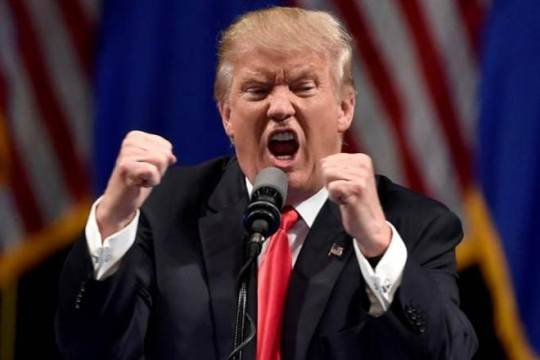
Trump blasts courts for blocking travel ban, warns of 'peril'

February 6, 2017

Palm Beach(US), Feb 6: President Donald Trump blasted the federal courts for a second day in a row after his efforts to implement a travel ban were suspended and warned that the judiciary could be placing Americans in "peril."

trump-R

"Just cannot believe a judge would put our country in such peril. If something happens blame him and court system. People pouring in. Bad!" the president tweeted yesterday, after uncharacteristically taking a nearly day-long break from Twitter.

"I have instructed Homeland Security to check people coming into our country VERY CAREFULLY. The courts are making the job very difficult!"

The saga began on January 27 when Trump issued a blanket ban on all refugees, as well as on travellers from Iran, Iraq, Libya, Somalia, Sudan, Syria and Yemen.

That sparked a worldwide furor, prompting protest marches and demonstrations in cities and at airports across the United States.

On Friday, a federal judge in Seattle, James Robart, blocked the ban nationwide pending a wider legal review.

On Saturday Trump angrily fired off multiple tweets on the matter, stating that the "so-called judge" was "ridiculous" -- and drawing criticism from Democrats and others who said the president was dangerously close to interfering with the judicial branch of government.

A leading Democratic senator, Patrick Leahy of Vermont, said Trump seemed "intent on precipitating a constitutional crisis."

Then early yesterday, a US appeals court rejected an urgent government request to reinstate Trump's controversial ban.

Comments

shaji
 - 
Monday, 6 Feb 2017

He is a hate monger and hope american public will discard him soon. I hope there will be more demonstration in US and other nations against inappropriae/unjust policy of this hate monger

Add new comment

  • Coastaldigest.com reserves the right to delete or block any comments.
  • Coastaldigset.com is not responsible for its readers’ comments.
  • Comments that are abusive, incendiary or irrelevant are strictly prohibited.
  • Please use a genuine email ID and provide your name to avoid reject.
News Network
February 5,2020

Feb 5: Pakistan will buy more palm oil from Malaysia, Prime Minister Imran Khan said on Tuesday, aiming to help offset lost sales after top buyer India put curbs on Malaysian imports last month amid a diplomatic row.

India imposed restrictions on refined palm oil imports and informally asked traders to stop buying from Malaysia, the world's biggest producer of the edible oil. Sources said the move was in retaliation for Malaysia's criticism of India's policy on Kashmir.

Malaysian Prime Minister Mahathir Mohamad said on Tuesday that he discussed palm oil with Khan who was on a visit to Malaysia and that Pakistan had indicated it would import more from Malaysia.

"That's right, especially since we noticed India threatened Malaysia for supporting the Kashmir cause, threatened to cut palm oil imports," Khan told a joint news conference, referring to India's Muslim-majority region of Kashmir.

"Pakistan will do its best to compensate for that."

India is a Hindu-majority country while Malaysia and Pakistan are mainly Muslim. India and Pakistan have been mostly hostile to each other since the partition of British India in 1947, and have fought two of their three wars over competing territorial claims in Kashmir.

Pakistan may have bought around 135,000 tonnes of Malaysian palm oil last month, a record high, India-based dealers who track such shipments told Reuters on condition of anonymity.

The figure is close to estimates of 141,500 tonnes from Refinitiv, which show sales to India in January may have plunged 80% from a year earlier to 40,400 tonnes.

Malaysia will release official export data on Monday.

Pakistan bought 1.1 million tonnes of palm oil from Malaysia last year, while India bought 4.4 million tonnes, according to the Malaysian Palm Oil Council.

Malaysian palm oil futures rose on Tuesday after Khan's comments and on expectations of a steep drop in production in January.

STRONG TIES

India has repeatedly objected to Mahathir speaking out against its move last year to strip Kashmir's autonomy and make it easier for non-Muslims from neighbouring Muslim-majority Bangladesh, Pakistan and Afghanistan to gain citizenship.

At the news conference, Mahathir did not refer to Kashmir but Khan did.

"The way you, PM, have stood with us and spoken about this injustice going on, on behalf of Pakistan I really want to thank you," Khan said.

He also said he was sad he had been unable to attend a summit of Muslim leaders in Malaysia in December. Saudi Arabia did not attend the summit, saying it was the wrong forum to discuss matters affecting the world's Muslims and Khan belatedly pulled out.

Some Pakistani officials, unnamed because they were not authorised to speak to the media, said at the time that Khan pulled out under pressure from Saudi Arabia, a close ally, although local media reported his officials denied that was the reason for his absence.

"Unfortunately our friends, who are very close to Pakistan as well, felt that somehow the conference was going to divide the ummah," Khan said, using the Arabic word for the Muslim community but not mentioning Saudi Arabia by name.

"It is clearly a misconception, as that was not the purpose of the conference."

Comments

Add new comment

  • Coastaldigest.com reserves the right to delete or block any comments.
  • Coastaldigset.com is not responsible for its readers’ comments.
  • Comments that are abusive, incendiary or irrelevant are strictly prohibited.
  • Please use a genuine email ID and provide your name to avoid reject.
Agencies
May 28,2020

Washington, May 28: US President Donald Trump has warned social media giants that his government could "strongly regulate" or "close them down" after Twitter fact-checked one of his tweets for the first time.

"Republicans feel that Social Media Platforms totally silence conservatives voices," Xinhua news agency reported citing Trump as saying in a tweet to his 80 million followers on Wednesday.

"We will strongly regulate, or close them down, before we can ever allow this to happen."

Later in the day, he said that Twitter "has now shown everything we have been saying about them... is correct" and vowed "big action to follow".

The President's remarks came after Twitter slapped a warning label on one of his tweets on Tuesday, cautioning readers "Trump makes unsubstantiated claim that mail-in ballots will lead to voter fraud".

It was in response to Trump's tweet, without providing evidence, said: "There is NO WAY (ZERO!) that Mail-In Ballots will be anything less than substantially fraudulent."

Also Read: Obama was ‘grossly incompetent president’, says Donald Trump
It is unclear what regulatory steps the president could take without new laws passed by Congress, the BBC reported.

The White House is yet to offer further details.

Earlier, Trump has accused Twitter of interfering in this year's US presidential election scheduled for November, saying the company was "completely stifling free speech, and I, as president, will not allow it to happen".

With more than 52,000 tweets currently to his name, Trump is a prolific tweeter and relies on the platform to disseminate his views to millions of people.

He has used Twitter to launch attacks on opponents, with targets ranging from North Korean leader Kim Jong-un to his political rivals in the US.

In 2017 he used anti-Muslim tweets aimed at London Mayor Sadiq Khan to serve a domestic political purpose of warning about immigration.

Comments

Add new comment

  • Coastaldigest.com reserves the right to delete or block any comments.
  • Coastaldigset.com is not responsible for its readers’ comments.
  • Comments that are abusive, incendiary or irrelevant are strictly prohibited.
  • Please use a genuine email ID and provide your name to avoid reject.
Agencies
July 1,2020

The ILO has warned that if another Covid-19 wave hits in the second half of 2020, there would be global working-hour loss of 11.9 percent - equivalent to the loss of 340 million full-time jobs.

According to the 5th edition of International Labour Organisation (ILO) Monitor: Covid-19 and the world of work, the recovery in the global labour market for the rest of the year will be uncertain and incomplete.

The report said that there was a 14 percent drop in global working hours during the second quarter of 2020, equivalent to the loss of 400 million full-time jobs.

The number of working hours lost across the world in the first half of 2020 was significantly worse than previously estimated. The highly uncertain recovery in the second half of the year will not be enough to go back to pre-pandemic levels even in the best scenario, the agency warned.

The baseline model – which assumes a rebound in economic activity in line with existing forecasts, the lifting of workplace restrictions and a recovery in consumption and investment – projects a decrease in working hours of 4.9 percent (equivalent to 140 million full-time jobs) compared to last quarter of 2019.

It says that in the pessimistic scenario, the situation in the second half of 2020 would remain almost as challenging as in the second quarter.

“Even if one assumes better-tailored policy responses – thanks to the lessons learned throughout the first half of the year – there would still be a global working-hour loss of 11.9 per cent at the end of 2020, or 340 million full-time jobs, relative to the fourth quarter of 2019,” it said.

The pessimistic scenario assumes a second pandemic wave and the return of restrictions that would significantly slow recovery. The optimistic scenario assumes that workers’ activities resume quickly, significantly boosting aggregate demand and job creation. With this exceptionally fast recovery, the global loss of working hours would fall to 1.2 per cent (34 million full-time jobs).

The agency said that under the three possible scenarios for recovery in the next six months, “none” sees the global job situation in better shape than it was before lockdown measures began.

“This is why we talk of an uncertain but incomplete recovery even in the best of scenarios for the second half of this year. So there is not going to be a simple or quick recovery,” ILO Director-General Guy Ryder said.

The new figures reflect the worsening situation in many regions over the past weeks, especially in developing economies. Regionally, working time losses for the second quarter were: Americas (18.3 percent), Europe and Central Asia (13.9 percent), Asia and the Pacific (13.5 percent), Arab States (13.2 percent), and Africa (12.1 percent).

The vast majority of the world’s workers (93 per cent) continue to live in countries with some sort of workplace closures, with the Americas experiencing the greatest restrictions.

During the first quarter of the year, an estimated 5.4 percent of global working hours (equivalent to 155 million full-time jobs) were lost relative to the fourth quarter of 2019. Working- hour losses for the second quarter of 2020 relative to the last quarter of 2019 are estimated to reach 14 per cent worldwide (equivalent to 400 million full-time jobs), with the largest reduction (18.3 per cent) occurring in the Americas.

The ILO Monitor also found that women workers have been disproportionately affected by the pandemic, creating a risk that some of the modest progress on gender equality made in recent decades will be lost, and that work-related gender inequality will be exacerbated.

The severe impact of Covid-19 on women workers relates to their over-representation in some of the economic sectors worst affected by the crisis, such as accommodation, food, sales and manufacturing.

Globally, almost 510 million or 40 percent of all employed women work in the four most affected sectors, compared to 36.6 percent of men, it said.

The report said that women also dominate in the domestic work and health and social care work sectors, where they are at greater risk of losing their income and of infection and transmission and are also less likely to have social protection.

The pre-pandemic unequal distribution of unpaid care work has also worsened during the crisis, exacerbated by the closure of schools and care services.

Even as countries have adopted policy measures with unprecedented speed and scope, the ILO Monitor highlights some key challenges ahead, including finding the right balance and sequencing of health, economic and social and policy interventions to produce optimal sustainable labour market outcomes; implementing and sustaining policy interventions at the necessary scale when resources are likely to be increasingly constrained and protecting and promoting the conditions of vulnerable, disadvantaged and hard-hit groups to make labour markets fairer and more equitable.

“The decisions we adopt now will echo in the years to come and beyond 2030. Although countries are at different stages of the pandemic and a lot has been done, we need to redouble our efforts if we want to come out of this crisis in a better shape than when it started,” Ryder said. 

Comments

Add new comment

  • Coastaldigest.com reserves the right to delete or block any comments.
  • Coastaldigset.com is not responsible for its readers’ comments.
  • Comments that are abusive, incendiary or irrelevant are strictly prohibited.
  • Please use a genuine email ID and provide your name to avoid reject.