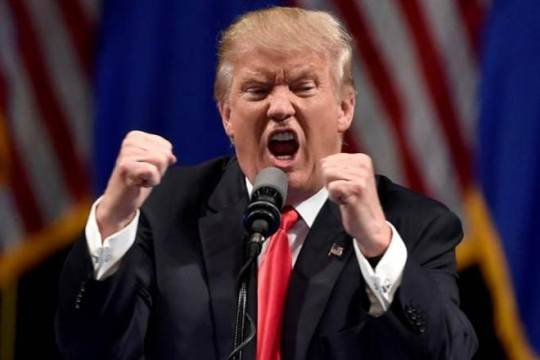
Trump blasts courts for blocking travel ban, warns of 'peril'

February 6, 2017

Palm Beach(US), Feb 6: President Donald Trump blasted the federal courts for a second day in a row after his efforts to implement a travel ban were suspended and warned that the judiciary could be placing Americans in "peril."

trump-R

"Just cannot believe a judge would put our country in such peril. If something happens blame him and court system. People pouring in. Bad!" the president tweeted yesterday, after uncharacteristically taking a nearly day-long break from Twitter.

"I have instructed Homeland Security to check people coming into our country VERY CAREFULLY. The courts are making the job very difficult!"

The saga began on January 27 when Trump issued a blanket ban on all refugees, as well as on travellers from Iran, Iraq, Libya, Somalia, Sudan, Syria and Yemen.

That sparked a worldwide furor, prompting protest marches and demonstrations in cities and at airports across the United States.

On Friday, a federal judge in Seattle, James Robart, blocked the ban nationwide pending a wider legal review.

On Saturday Trump angrily fired off multiple tweets on the matter, stating that the "so-called judge" was "ridiculous" -- and drawing criticism from Democrats and others who said the president was dangerously close to interfering with the judicial branch of government.

A leading Democratic senator, Patrick Leahy of Vermont, said Trump seemed "intent on precipitating a constitutional crisis."

Then early yesterday, a US appeals court rejected an urgent government request to reinstate Trump's controversial ban.

Comments

shaji
 - 
Monday, 6 Feb 2017

He is a hate monger and hope american public will discard him soon. I hope there will be more demonstration in US and other nations against inappropriae/unjust policy of this hate monger

Add new comment

  • Coastaldigest.com reserves the right to delete or block any comments.
  • Coastaldigset.com is not responsible for its readers’ comments.
  • Comments that are abusive, incendiary or irrelevant are strictly prohibited.
  • Please use a genuine email ID and provide your name to avoid reject.
News Network
March 28,2020

Washington, Mar 28: The world is in the face of a devastating impact due to the coronavirus pandemic and has clearly entered a recession, the International Monetary Fund said on Friday, but projected a recovery next year.

"We have reassessed the prospects for growth for 2020 and 2021. It is now clear that we have entered a recession as bad or worse than in 2009. We do project recovery in 2021," IMF Managing Director Kristalina Georgieva told reporters at a news conference.

Georgieva was addressing the press after a meeting of governing body of the IMF, the International Monetary and Financial Committee. Representing 189 members, the body met virtually to discuss the unprecedented challenge posed to the world by COVID-19.

The key to recovery in 2021, she said, is only if the international community succeeds in containing the virus everywhere and prevent liquidity problems from becoming a solvency issue.

"The US is in recession, as is the rest of the advanced economies of the world. And in a big chunk of developed and emerging markets in developing economies. How severe? We are working now on our projections for 2020, Georgieva said in response to a question.

The new projections are expected in the next few weeks.

Stressing that while containment is the main reason for the economy to stand still and get into a recession, she said containment is very necessary to come out of this period and step in to recovery. "Until the virus is not contained, it would be very difficult to go to the lives we love."

"A key concern about a long-lasting impact of the sudden stop of the world economy is the risk of a wave of bankruptcies and layoffs that not only can undermine the recovery. But can erode the fabric of our societies," the IMF chief said.

To avoid this from happening, many countries have taken far-reaching measures to address the health crisis and to cushion its impact on the economy, both on the monetary and on the fiscal side, she said.

The IMF chief said 81 emergency financing requests, including 50 from lower-income countries, have been received. She said current estimate for the overall financial needs of emerging markets is 2.5 trillion dollars.

"We believe this is on the lower end. We do know that their own reserves and domestic resources will not be sufficient," she added.

The G-20, a day earlier, reported fiscal measures totalling some 5 trillion dollars or over 6 per cent of the global GDP.

Responding to another question, Georgieva said the IMF is projecting recession for 2020.

"We do expect it to be quite deep and we are very much urging countries to step up containment measures aggressively so we can shorten the duration of this period of time when the economy is in standstill," she said.

"And also to apply well-targeted measures, primarily focusing on the health system to absorb that enormous stress that comes from coronavirus. And on people, businesses and the financial system, I am very pleased to say that when we went through countries' responses, that sense of targeted fiscal measures is there and are also very impressive to see the size of these measures," she added.

"Countries are doing all they can on the fiscal and on the monetary front. We have heard from our members' very impressive decisions taken over the last days," the IMF chief said.

"We also want to caution that as we are responding now, we want to make the recession as possibly short and not too deep. We also want to think about what is going to follow the recovery and make sure that we are putting forward measures that can be supportive in this regard," she said.


Comments

Add new comment

  • Coastaldigest.com reserves the right to delete or block any comments.
  • Coastaldigset.com is not responsible for its readers’ comments.
  • Comments that are abusive, incendiary or irrelevant are strictly prohibited.
  • Please use a genuine email ID and provide your name to avoid reject.
Agencies
March 29,2020

A shrimp seller at the wet market in the Chinese city of Wuhan believed to be the centre of the coronavirus pandemic, may be the first person to have tested positive for the disease, a media report said on Saturday.

The report by the London-based Metro newspaper said that 57-year-old woman, named by the Wall Street Journal as Wei Guixian, was selling shrimp at the Huanan Seafood Market when she developed what she thought was a cold last December.

Chinese digital news outlet, The Paper has said that she may be epatient zero'.

Wei was told by doctors her illness was "ruthless" and other workers at the market had come to the Wuhan Union Hospital with the same symptoms, the Metro newspaper report quoted the outlet as saying.

"Every winter, I suffer from the flu, so I thought it was the flu," the woman was quoted as saying by The Paper news outlet.

The shrimp seller added that she believed she contracted the coronavirus from the shared toilet in the market.

She said the fatal disease would have killed fewer people if the government had acted sooner.

Wuhan Municipal Health Commission has confirmed that Wei was among the first 27 people to test positive for the coronavirus.

It said she was one of 24 cases with direct links to the market, the Metro newspaper reported.

Though Wei may be "patient zero", it does not mean she is the first person to have contracted the virus, added the Metro report.

Chinese researchers have claimed that the first person diagnosed with the airborne virus had no contact with the seafood market and was identified on December 1, 2019.

Wei was later quarantined when a connection was made between the bug and the market before recovering in January.

As of Saturday, the global number of coronavirus cases stood at 104,837 with 27,862 deaths, according to the latest update by the Washington-based Johns Hopkins University.

The US has the highest number of cases at 104,837, followed by Italy 86,498 and China 81,948.

Italy has recorded the highest number of fatalities with 9,134 deaths, followed by Spain and China, at 5,138 and 3,299, respectively.

Comments

Add new comment

  • Coastaldigest.com reserves the right to delete or block any comments.
  • Coastaldigset.com is not responsible for its readers’ comments.
  • Comments that are abusive, incendiary or irrelevant are strictly prohibited.
  • Please use a genuine email ID and provide your name to avoid reject.
News Network
March 3,2020

Mar 3: Just hours after the ending of a week-long “reduction” in violence that was crucial for Donald Trump’s peace deal in Afghanistan, the Taliban struck again: On Monday, they killed three people and injured about a dozen at a football match in Khost province. This resumption of violence will not surprise anyone actually invested in peace for that troubled country. The point of the U.S.-Taliban deal was never peace. It was to try and cover up an ignominious exit for the U.S., driven by an election-bound president who feels no responsibility toward that country or to the broader region.

Seen from South Asia, every point we know about in the agreement is a concession by Trump to the Taliban. Most importantly, it completes a long-term effort by the U.S. to delegitimize the elected government in Kabul — and, by extension, Afghanistan’s constitution. Afghanistan’s president is already balking at releasing 5,000 Taliban prisoners before intra-Afghan talks can begin — a provision that his government did not approve.

One particularly cringe-worthy aspect: The agreement refers to the Taliban throughout  as “the Islamic Emirate of Afghanistan that is not recognized by the United States as a state and is known as the Taliban.” This unwieldy nomenclature validates the Taliban’s claim to be a government equivalent to the one in Kabul, just not the one recognised at the moment by the U.S. When read together with the second part of the agreement, which binds the U.S. to not “intervene in [Afghanistan’s] domestic affairs,” the point is obvious: The Taliban is not interested in peace, but in ensuring that support for its rivals is forbidden, and its path to Kabul is cleared.

All that the U.S. has effectively gotten in return is the Taliban’s assurance that it will not allow the soil of Afghanistan to be used against the “U.S. and its allies.” True, the U.S. under Trump has shown a disturbing willingness to trust solemn assurances from autocrats; but its apparent belief in promises made by a murderous theocratic movement is even more ridiculous. Especially as the Taliban made much the same promise to an Assistant Secretary of State about Osama bin Laden while he was in the country plotting 9/11.

Nobody in the region is pleased with this agreement except for the Taliban and their backers in the Pakistani military. India has consistently held that the legitimate government in Kabul must be the basic anchor of any peace plan. Ordinary Afghans, unsurprisingly, long for peace — but they are, by all accounts, deeply skeptical about how this deal will get them there. The brave activists of the Afghan Women’s Network are worried that intra-Afghan talks will take place without adequate representation of the country’s women — who have, after all, the most to lose from a return to Taliban rule.

But the Pakistani military establishment is not hiding its glee. One retired general tweeted: “Big victory for Afghan Taliban as historic accord signed… Forced Americans to negotiate an accord from the position of parity. Setback for India.” Pakistan’s army, the Taliban’s biggest backer, longs to re-install a friendly Islamist regime in Kabul — and it has correctly estimated that, after being abandoned by Trump, the Afghan government will have sharply reduced bargaining power in any intra-Afghan peace talks. A deal with the Taliban that fails also to include its backers in the Pakistani military is meaningless.

India, meanwhile, will not see this deal as a positive for regional peace or its relationship with the U.S. It comes barely a week after Trump’s India visit, which made it painfully clear that shared strategic concerns are the only thing keeping the countries together. New Delhi remembers that India is not, on paper, a U.S. “ally.” In that respect, an intensification of terrorism targeting India, as happened the last time the U.S. withdrew from the region, would not even be a violation of Trump’s agreement. One possible outcome: Over time the government in New Delhi, which has resolutely sought to keep its ties with Kabul primarily political, may have to step up security cooperation. Nobody knows where that would lead.

The irresponsible concessions made by the U.S. in this agreement will likely disrupt South Asia for years to come, and endanger its own relationship with India going forward. But worst of all, this deal abandons those in Afghanistan who, under the shadow of war, tried to develop, for the first time, institutions that work for all Afghans. No amount of sanctimony about “ending America’s longest war” should obscure the danger and immorality of this sort of exit.

Comments

Add new comment

  • Coastaldigest.com reserves the right to delete or block any comments.
  • Coastaldigset.com is not responsible for its readers’ comments.
  • Comments that are abusive, incendiary or irrelevant are strictly prohibited.
  • Please use a genuine email ID and provide your name to avoid reject.