


Trump dares Republican Party into high-stakes vote on troubled health bill

March 24, 2017

Washington, Mar 24: House GOP leaders are hurtling toward a vote on Friday on their embattled health-care bill without knowing for sure they have enough support to pass the measure, after yielding to Trump administration demands to act now.
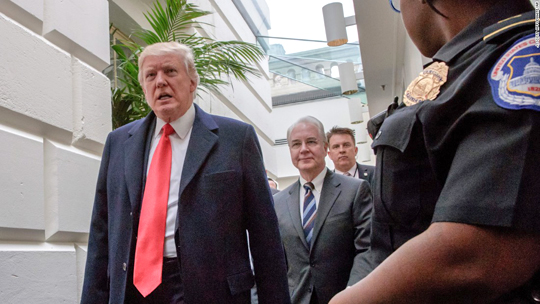
Trump1

If the high-stakes gamble works and the House manages to pass the Obamacare replacement bill, it will be an important win for President Donald Trump and House Speaker Paul Ryan who have formed an uneasy alliance to repeal the health care law.

But if the measure is blocked, it will be an embarrassing setback that casts doubt on the ability of Trump and Ryan to deliver on their ambitious agenda, including a sweeping tax overhaul and infrastructure package, both of which are being closely watched by Wall Street.

“For those who are on the fence one way or another, it's a long night of the soul for them,” Representative Tom Cole of Oklahoma said late Thursday. “It's very much an individual decision now.”

“Success breeds success; failure, you know, tends to compound itself,” he added. “So tomorrow is a very important moment for us and if you don't know that, you don't get it.”

The Trump administration made a last-minute deal with House conservatives to change the bill — by removing Obamacare's requirements that certain essential benefits be covered by insurance — in an effort to win over holdouts, who had forced GOP leaders to delay their vote, originally scheduled for Thursday.

Then Trump aides, including senior strategist Steve Bannon, went to Capitol Hill to deliver a message in person to House leaders and the Republican caucus that the president has run out of patience: Trump wanted a vote on Friday, win or lose, even if that means leaving Obamacare in place.

‘No more negotiations'

“We have to have a vote tomorrow. He expects it to pass,” Representative Chris Collins of New York said, speaking about Trump. “We are done negotiating, there are no more negotiations.”

“If it loses, we just move on to tax reform,” added Collins, a Trump ally.

House conservatives, including Freedom Caucus chairman Mark Meadows, emerged from the meeting saying they were still leaning against the bill, but were still evaluating the final package.

Meadows said late on Thursday “I'm a no” for now, but said members had been given “a binary choice” and that he will talk with other members before making a final decision.

GOP leaders didn't agree to a core demand of the Freedom Caucus to eliminate other insurance regulations, according to a senior Republican aide.

Representative Thomas Massie of Kentucky, who opposes the bill, said Republican leaders are taking a risky bet.

“If they bring this to the floor and it doesn't get to 216 quickly, the momentum could go in the other direction and they could come way short,” he said. “Because you don't want to be the person who fell on your sword and voted yes for a piece of legislation that never passes.”

‘Leaning the other way'

But other House conservatives said they were getting the sense that enough of their colleagues would end up backing it.

“I'm still a no, but it looks like it's leaning the other way,” Freedom Caucus member Ted Yoho said. Representative Mark Sanford of South Carolina agreed, saying he's picking up that it is the “sentiment” of most of the conference now to pass the bill.

The bill has struggled to win over far-right members who have demanded a more complete repeal of Obamacare, but it's also unnerved moderates concerned about projections that millions will lose coverage. A number of moderates came out against the bill this week, giving Republican leaders little room to negotiate changes.

Ryan put a brave face on the upcoming test of whether he and Trump can deliver the votes.

“For seven-and-a-half years, we have been promising the American people that we will repeal and replace this broken law because it is collapsing and hurting families,” he said. “Tomorrow we will see that.”

The GOP bill, H.R. 1628, would reverse massive gains in health coverage under the Affordable Care Act, which brought the uninsured rate to a record low. The proposal would pull hundreds of billions of dollars out of the health system by winding down Obamacare's expansion of Medicaid and limiting its subsidies, threatening revenues for hospitals, doctors and insurance companies.

Signs that the bill was in trouble on Thursday unnerved US markets, helping to erase gains, while sending hospital stocks higher.

Some changes

Meadows and other conservative Freedom Caucus members demanded a provision in the bill — agreed to by Trump and GOP leaders that would scrap the essential benefits portion of the Affordable Care Act, which requires insurers to cover 10 categories of services, for the individual market. Those services include hospitalization, ambulance services, maternitycare, pediatric services, mental health and substance abuse treatment, prescription drugs, rehabilitative care and laboratory services.

Other new provisions described by lawmakers Thursday night include a $15 billion boost to a new state flexibility fund and six more years of a 0.9% Medicare tax on high earners.

That last bit is needed to pay for what is expected to be a surge of people buying lower-cost insurance products, triggering tax credits that run from $2,000 to $4,000 per person for eligible people.

If the bill makes it to the Senate, it is expected to undergo significant changes there as well, including boosts to tax credits for people ages 50 to 64 who are hit with massive premium spikes under the bill.

Outdated CBO score

But the last-minute changes mean that Republicans will be voting on the measure without a final estimate from the Congressional Budget Office about how many millions of Americans will lose coverage or how much the measure will cost.

In another development that could unease conservatives, the CBO issued a new estimate Thursday to account for changes made to the bill earlier in the week. The nonpartisan agency cut its estimate of how much the bill would shrink the federal budget deficit, saying the updated measure would reduce the deficit by $150 billion over the next decade, $186 billion less than the initial forecast of $337 billion.

Of course, if the measure manages to pass the House, it still faces significant hurdles in the Senate.

Representative Kevin Cramer of North Dakota said he fears that even if the Freedom Caucus succeeds at getting its wish and delivers the votes for the bill to pass to the House, the provisions they demand won't pass muster under Senate rules.

“It seems that they want more inclusion on the essential benefits and some of those things that the speaker and others believe” will violate Senate rules, Cramer said. “And for some, I think they're spoiling for a fight. They want to challenge the Senate.”

Comments

Add new comment

  • Coastaldigest.com reserves the right to delete or block any comments.
  • Coastaldigset.com is not responsible for its readers’ comments.
  • Comments that are abusive, incendiary or irrelevant are strictly prohibited.
  • Please use a genuine email ID and provide your name to avoid reject.
News Network
February 26,2020

Feb 26: Looking out over the world’s largest cricket stadium, the seats jammed with more than 100,000 people, India’s prime minister heaped praise on his American visitor.

“The leadership of President Trump has served humanity,” Prime Minister Narendra Modi said Monday, highlighting Trump’s fight against terrorism and calling his 36-hour visit to India a watershed in India-U.S. relations.

The crowds cheered. Trump beamed.

“The ties between India and the U.S. are no longer just any other partnership,” Modi said. “It is a far greater and closer relationship.”

India, it seems, loves Donald Trump. It seemed obvious from the thousands who turned out to wave as his motorcade snaked through the city of Ahmedabad, and from the tens of thousands who filled the city’s new stadium. It seemed obvious from the hug that Modi gave Trump after he descended from Air Force One, and from the hundreds of billboards proclaiming Trump’s visit.

But it’s not so simple.

Because while Trump is genuinely popular in India, his clamorous and carefully choreographed welcome was also about Asian geopolitics, China’s growing power and a masterful Indian politician who gave his American visitor exactly what he wanted.

Modi “is doing this not necessarily because he loves Trump,” said Tanvi Madan, the director of the India Project at the Brookings Institution in Washington, D.C. “It’s very much about Trump as the leader of the U.S. and recognizing what it is that Trump himself likes.”

Trump likes crowds — big crowds — and the foot soldiers of India’s political parties have long known how to corral enough people to make any politician look popular. In a city like Ahmedabad, the capital of Modi’s home state of Gujarat and the center of his power base, it wouldn’t take much effort to fill a cavernous sports stadium. It was more surprising that a handful of seats remained empty, and that some in the stands had left even before Trump had finished his speech.

For India, good relations with the U.S. are deeply important: They signal that India is a serious global player, an issue that has long been important to New Delhi, and help cement an alliance that both nations see as a counterweight to China’s rise.

“For both countries, their biggest rival is China,” said John Echeverri-Gent, a professor at the University of Virginia whose research often focuses on India. “China is rapidly expanding its presence in the Indian Ocean, which India has long considered its backyard and its exclusive realm for security concerns.”

“It’s very clearly a major concern for both India and the United States,” he said.

Trump isn’t the first U.S. president that Modi has courted. In 2015, then-President Barack Obama was the first American chief guest at India’s Republic Day parade, a powerful symbolic gesture. Obama also got a Modi hug, and the media in both countries were soon writing about the two leaders’ “bromance.”

Trump is popular in India, even if some of that is simply because he’s the U.S. president. A 2019 Pew Research Center poll showed that 56% of Indians had confidence in Trump’s abilities in world affairs, one of only a handful of countries where he has that level of approval. But Obama was also popular: Before he left office, he had 58% approval in world affairs among Indians.

The Pew poll also indicated that Trump’s support was higher among supporters of Modi’s Hindu nationalist party.

That’s not surprising. Both men have fired up their nationalist bases with anti-Muslim rhetoric and government policies, from Trump’s travel bans to Modi’s crackdown in Kashmir, India’s only Muslim-majority state.

And Trump’s Indian support is far from universal. Protests against his trip roiled cities from New Delhi to Hyderabad to the far northeastern city of Gauhati, although those demonstrations were mostly overshadowed by protests over a new Indian citizenship law that Modi backs.

Modi, who is widely popular in India, has faced weeks of protests over the law, which provides fast track naturalization for some foreign-born religious minorities — but not Muslims. While Trump talked about ties with India on Tuesday, Hindus and Muslims fought in violent clashes that left at least 10 people dead over two days.

In some ways, Modi and Trump are powerful echoes of each other.

They have overlapping political styles. Both are populists who see themselves as brash, rule-breaking outsiders who disdain their countries’ traditional elites. Both are seen by their critics as having authoritarian leanings. Both surround themselves with officials who rarely question their decisions.

But are they friends?

Trump says yes. “Really, we feel very strongly about each other,” he said at a New Delhi press briefing.

But many observers aren’t so sure.

“The question is how much of this is real chemistry, as opposed to what I’d call planned chemistry” orchestrated for diplomatic reasons, said Madan. “It’s so hard to know if you’re not in the room.”

Certainly, Modi understands America’s importance to India. While the two countries continue to bicker about trade issues, the prime minister organized a welcome that impressed even India’s news media, which have watched countless choreographed mass political rallies.

“There is no other country for whose leader India would hold such an event, and for which an Indian prime minister would lavish such rhetoric,” the Hindustan Times said in an editorial.

“The spectacle and the sound were worth a thousand agreements.”

Comments

Add new comment

  • Coastaldigest.com reserves the right to delete or block any comments.
  • Coastaldigset.com is not responsible for its readers’ comments.
  • Comments that are abusive, incendiary or irrelevant are strictly prohibited.
  • Please use a genuine email ID and provide your name to avoid reject.
News Network
April 30,2020

Los Angeles, Apr 30: Los Angeles will begin offering coronavirus">coronavirus testing for free to all citizens regardless of whether they have symptoms, Mayor Eric Garcetti said on Wednesday, adding that LA is the first major US city to take such an initiative.

During the press conference, Garcetti announced that all county residents can now get free coronavirus">coronavirus testing. 

He said the announcement will only apply to city residents for now, but that a similar plan is in development for Los Angeles County,
Garcetti also took to Twitter to announce the same. "Announcing that L.A. is now the first major city in America to offer free COVID-19 testing to all residents. 

While priority will still be given to those with symptoms, individuals without symptoms can also be tested. Sign up at Coronavirus.LACity.org/Testing," he said
Under the new guidelines, priority for the same- or next-day testing will still be given to people with symptoms, such as a fever, cough, and shortness of breath. The free testing will also be prioritized for certain critical frontline workers who interact with the public.

Until now, only residents with symptoms as well as essential workers and those in institutional settings like nursing homes could be tested.

On Wednesday, the LA County reported 1,541 new cases, bringing the total to 22,485 - a seven per cent increase since yesterday.

This includes a backlog of cases that were processed. In the city, there were 683 new cases on Wednesday, bringing the total to 10,380 -- a 7 percent increase since yesterday.

Comments

Add new comment

  • Coastaldigest.com reserves the right to delete or block any comments.
  • Coastaldigset.com is not responsible for its readers’ comments.
  • Comments that are abusive, incendiary or irrelevant are strictly prohibited.
  • Please use a genuine email ID and provide your name to avoid reject.
News Network
February 26,2020

Feb 26: China’s massive travel restrictions, house-to-house checks, huge isolation wards and lockdowns of entire cities bought the world valuable time to prepare for the global spread of the new virus.

But with troubling outbreaks now emerging in Italy, South Korea and Iran, and U.S. health officials warning Tuesday it’s inevitable it will spread more widely in America, the question is: Did the world use that time wisely and is it ready for a potential pandemic?

“It’s not so much a question of if this will happen anymore, but rather more a question of exactly when this will happen — and how many people in this country will have severe illness,” said Dr. Nancy Messonnier of the U.S. Centers for Disease Control and Prevention.

Some countries are putting price caps on face masks to combat price gouging, while others are using loudspeakers on trucks to keep residents informed. In the United States and many other nations, public health officials are turning to guidelines written for pandemic flu and discussing the possibility of school closures, telecommuting and canceling events.

Countries could be doing even more: training hundreds of workers to trace the virus’ spread from person to person and planning to commandeer entire hospital wards or even entire hospitals, said Dr. Bruce Aylward, the World Health Organization’s envoy to China, briefing reporters Tuesday about lessons learned by the recently returned team of international scientists he led.

“Time is everything in this disease,” Aylward said. “Days make a difference with a disease like this.”

The U.S. National Institutes of Health’s infectious disease chief, Dr. Anthony Fauci, said the world is “teetering very, very close” to a pandemic. He credits China’s response for giving other nations some breathing room.

China locked down tens of millions of its citizens and other nations imposed travel restrictions, reducing the number of people who needed health checks or quarantines outside the Asian country.

It “gave us time to really brush off our pandemic preparedness plans and get ready for the kinds of things we have to do,” Fauci said. “And we’ve actually been quite successful because the travel-related cases, we’ve been able to identify, to isolate” and to track down those they came in contact with.

With no vaccine or medicine available yet, preparations are focused on what’s called “social distancing” — limiting opportunities for people to gather and spread the virus.

That played out in Italy this week. With cases climbing, authorities cut short the popular Venice Carnival and closed down Milan’s La Scala opera house. In Japan, Prime Minister Shinzo Abe called on companies to allow employees to work from home, while the Tokyo Marathon has been restricted to elite runners and other public events have been canceled.

Is the rest of the world ready?

In Africa, three-quarters of countries have a flu pandemic plan, but most are outdated, according to authors of a modeling study published last week in The Lancet medical journal. The slightly better news is that the African nations most connected to China by air travel — Egypt, Algeria and South Africa — also have the most prepared health systems on the continent.

Elsewhere, Thailand said it would establish special clinics to examine people with flu-like symptoms to detect infections early. Sri Lanka and Laos imposed price ceilings for face masks, while India restricted the export of personal protective equipment.

India’s health ministry has been framing step-by-step instructions to deal with sustained transmissions that will be circulated to the 250,000 village councils that are the most basic unit of the country’s sprawling administration.

Vietnam is using music videos on social media to reach the public. In Malaysia, loudspeakers on trucks blare information through the streets.

In Europe, portable pods set up at United Kingdom hospitals will be used to assess people suspected of infection while keeping them apart from others. France developed a quick test for the virus and has shared it with poorer nations. German authorities are stressing “sneezing etiquette” and Russia is screening people at airports, railway stations and those riding public transportation.

In the U.S., hospitals and emergency workers for years have practiced for a possible deadly, fast-spreading flu. Those drills helped the first hospitals to treat U.S. patients suffering from COVID-19, the disease caused by the virus.

Other hospitals are paying attention. The CDC has been talking to the American Hospital Association, which in turn communicates coronavirus news daily to its nearly 5,000 member hospitals. Hospitals are reviewing infection control measures, considering using telemedicine to keep potentially infectious patients from making unnecessary trips to the hospital and conserving dwindling supplies of masks and gloves.

What’s more, the CDC has held 17 different calls reaching more than 11,000 companies and organizations, including stadiums, universities, faith leaders, retailers and large corporations. U.S. health authorities are talking to city, county and state health departments about being ready to cancel mass gathering events, close schools and take other steps.

The CDC’s Messonnier said Tuesday she had contacted her children’s school district to ask about plans for using internet-based education should schools need to close temporarily, as some did in 2009 during an outbreak of H1N1 flu. She encouraged American parents to do the same, and to ask their employers whether they’ll be able to work from home.

“We want to make sure the American public is prepared,” Messonnier said.

How prepared are U.S. hospitals?

“It depends on caseload and location. I would suspect most hospitals are prepared to handle one to two cases, but if there is ongoing local transmission with many cases, most are likely not prepared just yet for a surge of patients and the ‘worried well,’” Dr. Jennifer Lighter, a pediatric infectious diseases specialist at NYU Langone in New York, said in an email.

In the U.S., a vaccine candidate is inching closer to first-step safety studies in people, as Moderna Inc. has delivered test doses to Fauci’s NIH institute. Some other companies say they have candidates that could begin testing in a few months. Still, even if those first safety studies show no red flags, specialists believe it would take at least a year to have something ready for widespread use. That’s longer than it took in 2009, during the H1N1 flu pandemic — because that time around, scientists only had to adjust regular flu vaccines, not start from scratch.

The head of the World Health Organization, Tedros Adhanom Ghebreyesus, said the U.N. health agency’s team in China found the fatality rate between 2% and 4% in the hard-hit city of Wuhan, the virus’ epicenter, and 0.7% elsewhere.

The world is “simply not ready,” said the WHO’s Aylward. “It can get ready very fast, but the big shift has to be in the mindset.”

Aylward advised other countries to do “really practical things” now to get ready.

Among them: Do you have hundreds of workers lined up and trained to trace the contacts of infected patients, or will you be training them after a cluster pops up?

Can you take over entire hospital wards, or even entire hospitals, to isolate patients?

Are hospitals buying ventilators and checking oxygen supplies?

Countries must improve testing capacity — and instructions so health workers know which travelers should be tested as the number of affected countries rises, said Johns Hopkins University emergency response specialist Lauren Sauer. She pointed to how Canada diagnosed the first traveler from Iran arriving there with COVID-19, before many other countries even considered adding Iran to the at-risk list.

If the disease does spread globally, everyone is likely to feel it, said Nancy Foster, a vice president of the American Hospital Association. Even those who aren’t ill may need to help friends and family in isolation or have their own health appointments delayed.

“There will be a lot of people affected even if they never become ill themselves,” she said.

Comments

Add new comment

  • Coastaldigest.com reserves the right to delete or block any comments.
  • Coastaldigset.com is not responsible for its readers’ comments.
  • Comments that are abusive, incendiary or irrelevant are strictly prohibited.
  • Please use a genuine email ID and provide your name to avoid reject.