


Trump dares Republican Party into high-stakes vote on troubled health bill

March 24, 2017

Washington, Mar 24: House GOP leaders are hurtling toward a vote on Friday on their embattled health-care bill without knowing for sure they have enough support to pass the measure, after yielding to Trump administration demands to act now.
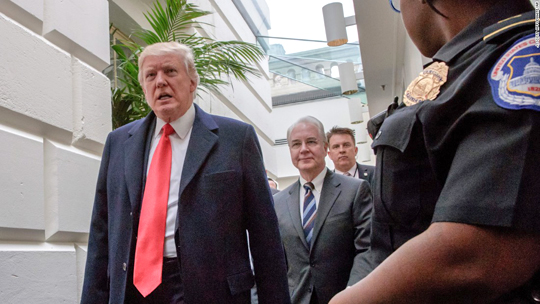
Trump1

If the high-stakes gamble works and the House manages to pass the Obamacare replacement bill, it will be an important win for President Donald Trump and House Speaker Paul Ryan who have formed an uneasy alliance to repeal the health care law.

But if the measure is blocked, it will be an embarrassing setback that casts doubt on the ability of Trump and Ryan to deliver on their ambitious agenda, including a sweeping tax overhaul and infrastructure package, both of which are being closely watched by Wall Street.

“For those who are on the fence one way or another, it's a long night of the soul for them,” Representative Tom Cole of Oklahoma said late Thursday. “It's very much an individual decision now.”

“Success breeds success; failure, you know, tends to compound itself,” he added. “So tomorrow is a very important moment for us and if you don't know that, you don't get it.”

The Trump administration made a last-minute deal with House conservatives to change the bill — by removing Obamacare's requirements that certain essential benefits be covered by insurance — in an effort to win over holdouts, who had forced GOP leaders to delay their vote, originally scheduled for Thursday.

Then Trump aides, including senior strategist Steve Bannon, went to Capitol Hill to deliver a message in person to House leaders and the Republican caucus that the president has run out of patience: Trump wanted a vote on Friday, win or lose, even if that means leaving Obamacare in place.

‘No more negotiations'

“We have to have a vote tomorrow. He expects it to pass,” Representative Chris Collins of New York said, speaking about Trump. “We are done negotiating, there are no more negotiations.”

“If it loses, we just move on to tax reform,” added Collins, a Trump ally.

House conservatives, including Freedom Caucus chairman Mark Meadows, emerged from the meeting saying they were still leaning against the bill, but were still evaluating the final package.

Meadows said late on Thursday “I'm a no” for now, but said members had been given “a binary choice” and that he will talk with other members before making a final decision.

GOP leaders didn't agree to a core demand of the Freedom Caucus to eliminate other insurance regulations, according to a senior Republican aide.

Representative Thomas Massie of Kentucky, who opposes the bill, said Republican leaders are taking a risky bet.

“If they bring this to the floor and it doesn't get to 216 quickly, the momentum could go in the other direction and they could come way short,” he said. “Because you don't want to be the person who fell on your sword and voted yes for a piece of legislation that never passes.”

‘Leaning the other way'

But other House conservatives said they were getting the sense that enough of their colleagues would end up backing it.

“I'm still a no, but it looks like it's leaning the other way,” Freedom Caucus member Ted Yoho said. Representative Mark Sanford of South Carolina agreed, saying he's picking up that it is the “sentiment” of most of the conference now to pass the bill.

The bill has struggled to win over far-right members who have demanded a more complete repeal of Obamacare, but it's also unnerved moderates concerned about projections that millions will lose coverage. A number of moderates came out against the bill this week, giving Republican leaders little room to negotiate changes.

Ryan put a brave face on the upcoming test of whether he and Trump can deliver the votes.

“For seven-and-a-half years, we have been promising the American people that we will repeal and replace this broken law because it is collapsing and hurting families,” he said. “Tomorrow we will see that.”

The GOP bill, H.R. 1628, would reverse massive gains in health coverage under the Affordable Care Act, which brought the uninsured rate to a record low. The proposal would pull hundreds of billions of dollars out of the health system by winding down Obamacare's expansion of Medicaid and limiting its subsidies, threatening revenues for hospitals, doctors and insurance companies.

Signs that the bill was in trouble on Thursday unnerved US markets, helping to erase gains, while sending hospital stocks higher.

Some changes

Meadows and other conservative Freedom Caucus members demanded a provision in the bill — agreed to by Trump and GOP leaders that would scrap the essential benefits portion of the Affordable Care Act, which requires insurers to cover 10 categories of services, for the individual market. Those services include hospitalization, ambulance services, maternitycare, pediatric services, mental health and substance abuse treatment, prescription drugs, rehabilitative care and laboratory services.

Other new provisions described by lawmakers Thursday night include a $15 billion boost to a new state flexibility fund and six more years of a 0.9% Medicare tax on high earners.

That last bit is needed to pay for what is expected to be a surge of people buying lower-cost insurance products, triggering tax credits that run from $2,000 to $4,000 per person for eligible people.

If the bill makes it to the Senate, it is expected to undergo significant changes there as well, including boosts to tax credits for people ages 50 to 64 who are hit with massive premium spikes under the bill.

Outdated CBO score

But the last-minute changes mean that Republicans will be voting on the measure without a final estimate from the Congressional Budget Office about how many millions of Americans will lose coverage or how much the measure will cost.

In another development that could unease conservatives, the CBO issued a new estimate Thursday to account for changes made to the bill earlier in the week. The nonpartisan agency cut its estimate of how much the bill would shrink the federal budget deficit, saying the updated measure would reduce the deficit by $150 billion over the next decade, $186 billion less than the initial forecast of $337 billion.

Of course, if the measure manages to pass the House, it still faces significant hurdles in the Senate.

Representative Kevin Cramer of North Dakota said he fears that even if the Freedom Caucus succeeds at getting its wish and delivers the votes for the bill to pass to the House, the provisions they demand won't pass muster under Senate rules.

“It seems that they want more inclusion on the essential benefits and some of those things that the speaker and others believe” will violate Senate rules, Cramer said. “And for some, I think they're spoiling for a fight. They want to challenge the Senate.”

Comments

Add new comment

  • Coastaldigest.com reserves the right to delete or block any comments.
  • Coastaldigset.com is not responsible for its readers’ comments.
  • Comments that are abusive, incendiary or irrelevant are strictly prohibited.
  • Please use a genuine email ID and provide your name to avoid reject.
News Network
January 2,2020

Washington, Jan 2: The number of people killed in large commercial airplane crashes fell by more than 50% in 2019 despite a high-profile Boeing 737 MAX crash in Ethiopia in March, a Dutch consulting firm said on Wednesday. Aviation consulting firm To70 said there were 86 accidents involving large commercial planes - including eight fatal incidents - resulting in 257 fatalities last year. In 2018, there were 160 accidents, including 13 fatal ones, resulting in 534 deaths, the firm said.

To70 said the fatal accident rate for large airplanes in commercial passenger air transport was just 0.18 fatal accident per million flights in 2019, or an average one fatal accident every 5.58 million flights, a significant improvement over 2018. The fatality numbers include passengers, air crew such as flight attendants and any people on the ground killed in a plane accident

Large passenger airplanes in the study are aircraft used by nearly all travelers on airlines worldwide but excludes small commuter airplanes in service, including the Cessna Caravan and some smaller turboprop airplanes, according to To70.

On Dec. 23, Boeing's board said it had fired Chief Executive Dennis Muilenburg after a pair of fatal crashes involving the 737 MAX forced it to announce it was halting output of its best-selling jetliner. The 737 MAX has been grounded since March after an October 2018 crash in Indonesia and the crash of a MAX in Ethiopia in March killed a total of 346 people.

To70 said the aviation industry spent significant effort in 2019 "focusing on so-called 'future threats' such as drones." But the MAX crashes "are a reminder that we need to retain our focus on the basics that make civil aviation so safe: well-designed and well-built aircraft flown by fully informed and well-trained crews."

The Aviation Safety Network said on Wednesday that, despite the MAX crash, 2019 "was one of the safest years ever for commercial aviation." The 157 people killed in March on Ethiopian Airlines Flight 302 accounted for more than half of all deaths last year worldwide in passenger airline crashes.

Over the last two decades, aviation deaths around the world have been falling dramatically even as travel has increased. As recently as 2005, there were 1,015 deaths aboard commercial passenger flights worldwide, the Aviation Safety Network said.

Last week, 12 people were killed when a Fokker 100 operated by Kazakh carrier Bek Air crashed near Almaty after takeoff. In May, a Russian Sukhoi Superjet 100 aircraft caught fire as it made an emergency landing at Moscow’s Sheremetyevo airport, killing 41 people.

The figures do not include accidents involving military flights, training flights, private flights, cargo operations and helicopters.

Comments

Add new comment

  • Coastaldigest.com reserves the right to delete or block any comments.
  • Coastaldigset.com is not responsible for its readers’ comments.
  • Comments that are abusive, incendiary or irrelevant are strictly prohibited.
  • Please use a genuine email ID and provide your name to avoid reject.
News Network
June 17,2020

Washington, Jun 17: The United States is closely monitoring the situation following a fierce clash between Indian and Chinese forces in eastern Ladakh and hopes that the differences will be resolved peacefully, officials said here.

Twenty Indian Army personnel including a colonel were killed in the clash with Chinese troops in the Galwan Valley in eastern Ladakh on Monday night, the biggest military confrontation in over five decades that has significantly escalated the already volatile border standoff in the region.

"We are closely monitoring the situation between Indian and Chinese forces along the Line of Actual Control," a State Department spokesperson said.

"We note the Indian military has announced that 20 soldiers have died, and we offer our condolences to their families," the official said.

Both India and China have expressed their desires to de-escalate and the US supports a peaceful resolution of the current situation, the spokesperson said.

"During their phone call on June 2, 2020, President Donald Trump and Prime Minister Narendra Modi had discussed the situation along the India-China border," the official added.

Comments

Add new comment

  • Coastaldigest.com reserves the right to delete or block any comments.
  • Coastaldigset.com is not responsible for its readers’ comments.
  • Comments that are abusive, incendiary or irrelevant are strictly prohibited.
  • Please use a genuine email ID and provide your name to avoid reject.
News Network
April 12,2020

Washington, Apr 12: The US has overtaken Italy as the country with the highest number of deaths due to COVID-19 pandemic with the fatalities crossing 20,000, according to Johns Hopkins University data, as the novel coronavirus continues to wreak havoc across the globe.

The deadly coronavirus, that originated in China in December last year, has so far killed more than one lakh people across the globe. The United States on Saturday became the country with the highest number of deaths at 20,597, surpassing Italy's 19,468 fatalities.

More than 5.3 lakh Americans have tested positive for coronavirus, which is about the same for the next four countries put together: Spain (163,027), Italy (152,271), Germany (125,452) and France (93,790). In terms of fatalities, the US and Italy are followed by Spain (16,606), France (13832) and United Kingdom (9,875), the varsity data showed.

New York City, the financial capital of the world, has emerged as the epicenter of coronavirus in the world. A city of 8.3 million, which is one of the most densely populated cities in the US, by Saturday night had as many as 8,627 deaths and more than 180,000 people had tested positive for COVID-19.

President Donald Trump has declared a national emergency and all the 50 States have been notified with major disaster declaration. More than 95 per cent of the country's 330 million population are under stay-at-home order. Trump has deployed more than 50,000 personnel from the armed forces in fight against COVID-19.

After an initial two-week social mitigation measures, that includes social distancing, the measures have been extended till April 30. Initially, members of the White House Task Force on Coronavirus had projected between one and two lakhs deaths. Now, they have dropped the projection to 60,000 deaths, mainly due to the successful implementation of these measures.

"The people of our country have gone through a lot. But we did it the right way. And we look like we'll be coming in on the very, very low side, really below the lowest, the lowest side of the curve of death," Trump told Fox News on Saturday night.

Trump asserted that situation was improving in places like New York, where there is a drop in new patients. Responding to a question, he said he wanted the country to open up as soon as possible.

However, he has not taken a decision so far, even as some media reports said that he the President was looking for early May.

"I think it's going to be the toughest decision that I've ever made. I really, hopefully that I ever will have to make. But it's certainly the toughest decision that I've ever made. I hope that I'm going to make the right decision," Trump said, adding that he will be making a decision reasonably soon.

"We're setting up a council now of some of the most distinguished leaders in virtually every field including politics and business and medical. We'll be making that decision fairly soon," Trump said.

Meanwhile, The New York Times reported that its investigations have revealed that the president was warned about a potential pandemic but that internal divisions, lack of planning and his faith in his own instincts led to a halting response.

According to The Washington Post, coronavirus is killing about one in 10 hospitalised middle-aged patients and four in 10 older than 85 in the United States. It is particularly lethal to men even when taking into account common chronic diseases that exacerbate risk.

Globally, the novel coronavirus has killed 108,862 people and infected over 1.7 million people globally. The US has the highest number of infections at 529,887, according to Johns Hopkins University data.

Comments

Add new comment

  • Coastaldigest.com reserves the right to delete or block any comments.
  • Coastaldigset.com is not responsible for its readers’ comments.
  • Comments that are abusive, incendiary or irrelevant are strictly prohibited.
  • Please use a genuine email ID and provide your name to avoid reject.