



Trump equates US with Russia, says America isnt so innocent

February 6, 2017

Washington, Feb 6: President Donald Trump has drawn a parallel between the US and Russian President Vladimir Putins regime by saying many people have been killed around the world due to Americas "mistakes", receiving flak from his opponents.
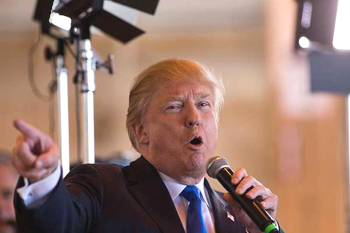
Trumpin"Well, take a look at what weve done too. Weve made a lot of mistakes. Ive been against the war in Iraq from the beginning," Trump said during an interview with Fox News.

"A lot of mistakes, OK, but a lot of people were killed. So a lot of killers around, believe me," said the US President when told that the Russian President Putin is a "killer".

"There are a lot of killers. Weve got a lot of killers. What, you think our countrys so innocent? " Trump asked.

Trump said he would like to co-operate with the Russians in the fight against ISIS.

He also said that he respects Putin, but this does not mean that the two would get along.

"Well, I respect a lot of people but that doesnt mean Im going to get along with them. Hes a leader of his country. I say its better to get along with Russia than not. And if Russia helps us in the fight against ISIS, which is a major fight, and Islamic terrorism all over the world...," Trump said.

"Will I get along with him? I have no idea," he said in response to a question.

The comment drew criticism from his political opponents.

"Equating our country with an authoritarian, murderous regime is outrageous and reprehensible, even for Mr Trump. All elected officials in the United States have a responsibility to speak up against the President?s dangerous rhetoric," said Senator Ben Cardin, Ranking member of the Senate Foreign Relations Committee.

Cardin said Trump made clear he does not believe in Americas exceptionalism when he equated the United States to Putin and his murderous regime.

"Such a ridiculous statement sends a signal that this White House does not in fact prioritise the United States but increasingly champions a Russia First Policy. It is offensive to the American people, veterans, and brave servicemen and women who put their lives on the line every day to protect our principles, liberties, and way of life," Cardin said.

Political opponents and independent journalists in Russia have been attacked, jailed, and killed under Putins regime, he said.

Democratic Leader in the House Nancy Pelosi also accused Trump for being soft on Russia.

"I want to know what the Russians have on Donald Trump," Pelosi told NBC News in an interview.

"I think we have to have that investigation by the FBI into his financial, personal and political connections to Russia, and we want to see his tax returns so we can have a truth in the relationship between Putin whom he admires..., she said.

Trumps respect for Putin was a familiar trope during presidential election which the major US intelligence agencies believe Russian intelligence sought to influence on Trump?s behalf.

Comments

Add new comment

  • Coastaldigest.com reserves the right to delete or block any comments.
  • Coastaldigset.com is not responsible for its readers’ comments.
  • Comments that are abusive, incendiary or irrelevant are strictly prohibited.
  • Please use a genuine email ID and provide your name to avoid reject.
News Network
April 26,2020

Apr 26: The remarkable story of an airman who overcame prejudice to become one of only a handful of Indian fighter pilots in the First World War has emerged in newly-released archive files by the UK's Commonwealth War Graves Commission (CWGC).

Lieutenant Shri Krishna Chanda Welinkar is one of the thousands of moving stories from the war preserved in family correspondence and being brought alive as part of a digitisation project.

The never-before-published files contain thousands of letters, pictures and other papers sent between the Commission and the next of the kin of First World War dead.

Among them is the story of Welinkar, who hailed from Bombay in colonial India. After much hardship and discrimination, he eventually became a pilot and went missing while on patrol over the skies above the Western Front in June 1918.

His family had to wait nearly three years before they finally knew for certain that he had died, and his grave was located.

“For everyone who died in the First World War, there was inevitably a partner, parent or child back home who had questions. The heartbreaking letters in CWGC's archive give us an insight into what it was like for those families trying to come to terms with their loss,” said Andrew Fetherston, chief archivist for CWGC.

“They are stories that show desperate searches for closure, former enemies uniting and, on many occasions, the sad realisation that a missing loved one would always remain so. We are pleased to be able to make this invaluable piece of World War history accessible to a new generation and help deepen our understanding of how the First World War impacted those who were left behind,” he said.

Welinkar was one of the 1.3 million Indians who answered the call to fight for the British Empire. Nearly 74,000 never saw their homeland again and are remembered today in cemeteries and memorials throughout the world, including France, Belgium, the Middle East and Africa.

Welinkar was a well-educated man studying at Cambridge University. He trained to become an aviator in Middlesex and wished to join the Royal Flying Corps, later known as the Royal Air Force.

Upon attempting to enlist, Welinkar encountered the same prejudices as his other fellow Indian airmen and was encouraged to become an air mechanic instead.

He was eventually given a commission in the Royal Flying Corps as an Officer. In 1918, he was posted to France and patrolled the skies above the Western Front.

In June 1918, Lieutenant Welinkar embarked on what would be his final patrol; he did not return and was reported missing. His fate remained unknown for many months afterwards.

The newly-released e-files chronicle the remarkable discovery of Welinkar and his final resting place long after the war had ended. Colonel Barton, who knew Welinkar, acted on behalf of his mother and helped find her missing son. They spoke to former enemies and honed their search to the grave of an unidentified man, buried by the Germans as “Oberleutnant S.C. Wumkar” in a grave in Rouvroy, Belgium.

The body was later moved and reinterred in Hangard Communal Cemetery Extension but it wasn't until the vital clue, found in the original German burial records in February 1921, that it was confirmed beyond doubt this grave was of Welinkar's.

In May 1921, Colonel Barton, on behalf of Welinkar's mother, requested that a Commission headstone be placed on the grave with the following personal inscription: “To the Honoured Memory of One of the Empire's Bravest Sons”.

This records – known as Enquiry Files – are part of a collection of nearly 3,000 files which have never been made available to the public before. Nearly half have been digitised so far, alongside a previously unreleased collection of more than 16,000 photographs held in negatives in the Commission's archive.

The files, internally referred to simply as E-Files, contain correspondence between the CWGC and the next of kin of the war dead. They often contain letters, typed memos between Commission staff and on occasion photos, maps and diagrams.

CWGC only holds an enquiry file for a small proportion of the 1.7 million people it commemorates from the Commonwealth. Today it is only possible to release those surviving records from the First World War because correspondence with families of Second World War casualties often involves people still alive today and cannot be made public for many years, due to the UK's data protection rules.

To date, more than 1,300 of the surviving 3,000 First World War enquiry files have been digitised.

The CWGC commemorates the 1.7 million Commonwealth servicemen and women who died during the two World Wars. It also holds and updates an extensive and accessible records archive, while operating over 23,000 locations in more than 150 countries and territories.

Comments

Add new comment

  • Coastaldigest.com reserves the right to delete or block any comments.
  • Coastaldigset.com is not responsible for its readers’ comments.
  • Comments that are abusive, incendiary or irrelevant are strictly prohibited.
  • Please use a genuine email ID and provide your name to avoid reject.
News Network
May 6,2020

Washington, May 6: At a time when the coronavirus pandemic has squeezed them, multi-national companies in America are laying off workers while paying cash dividends to their shareholders. Thus making the workers bear the brunt of the sacrifices while the shareholders continue to collect.

The Washington Post said in one of its reports that five big American companies have paid a combined USD 700 million to shareholders while cutting jobs, closing plants and leaving thousands of their workers filing for unemployment benefits.

Since the pandemic was declared an emergency, Caterpillar has suspended operations at two plants and a foundry, Levi Strauss has closed stores, and toolmaker Stanley Black & Decker has been planning layoffs and furloughs.

Steelcase, an office furniture manufacturer, and World Wrestling Entertainment have also shed employees.

Executives of those companies told the Post that the layoffs support the long-term health of their companies, and often the executives are giving up a piece of their salaries. Furloughed workers can apply for unemployment benefits.

But distributing millions of dollars to shareholders while leaving many workers without a paycheck is unfair, critics argue, and belies the repeated statements from executives about their concern for employees' welfare during the coronavirus crisis.

Caterpillar, for example, announced a USD 500 million distribution to shareholders April 8, about two weeks after indicating that operations at some plants would stop. The company however declined to divulge how many workers are affected.

"We are taking a variety of actions globally, but we aren't going to discuss the number of impacted people," spokeswoman of the company, Kate Kenny, said in a reply to an email by the Post.

This spate of dividends is also likely to revive long-standing debates about economic rewards.

"There are no hard-and-fast rules about this," said Amy Borrus, deputy director of the Council of Institutional Investors, a group that argues for shareholder rights and represents pension funds and other long-term investors.

Many large US companies choose to issue a regular, quarterly dividend to shareholders, often increasing it, and they boast about these payments because they help keep the share price higher than it might otherwise be. Those companies might be reluctant to announce that they are cutting or suspending their dividend during a crisis, Borrus was further quoted as saying.

But "companies have to be mindful of the optics of paying dividends if they're laying off thousands of workers," she added.

On March 26, Caterpillar had announced that because of the pandemic, it was "temporarily suspending operations at certain facilities." Two plants, in East Peoria, Ill., and Lafayette, Ind., were coming to a halt, as well as a foundry in Mapleton, Ill., according to news reports.

"We are taking a variety of actions at our global facilities to reduce production due to weaker customer demand, potential supply constraints and the spread of the covid-19 pandemic and related government actions," Kenny said via email.

"These actions include temporary facility shutdowns, indefinite or temporary layoffs," she added.

Similarly, Levi Strauss announced April 7 that the company would stop paying store workers, and about 4,000 are now on furlough. On the same day, the company announced that it was returning USD 32 million to shareholders.

"As this human and economic tragedy unfolds globally over the coming months, we are taking swift and decisive action that will ensure we remain a winner in our industry," Chip Bergh, president and chief executive of the company, also told the Post.

Stanley Black & Decker announced on April 2 that it was planning furloughs and layoffs because of the pandemic. Two weeks later, it issued a dividend to shareholders of about USD 106 million.

The notion that a company's primary purpose is to serve shareholders gained prominence in the 1980s but has come under attack in recent years, even from business executives, the newspaper reported.

Corporate decisions to suspend dividends and buybacks are complex, however, and it is difficult to know whether these suspensions of dividend and buyback programs were motivated by a desire to conserve cash in anticipation of bad times, and how much they are prompted by a sense of obligation to employees.

Over recent decades, the mandate to "maximize shareholder value" has become orthodoxy, for many, and it is often unclear what motivates companies to pare dividends or buybacks for shareholders, said William Lazonick, an emeritus economics professor at the University of Massachusetts at Lowell, who has been one of the leading critics of companies that distribute cash to shareholders through stock buybacks and dividends rather than reinvesting the profits into employees, innovation and production.

Comments

Add new comment

  • Coastaldigest.com reserves the right to delete or block any comments.
  • Coastaldigset.com is not responsible for its readers’ comments.
  • Comments that are abusive, incendiary or irrelevant are strictly prohibited.
  • Please use a genuine email ID and provide your name to avoid reject.
News Network
March 16,2020

Manila, Mar 16: The Philippines has detected an outbreak of avian flu in a northern province after tests showed presence of the highly infectious H5N6 subtype of the influenza A virus in a quail farm, the country's farm minister said on Monday.

Agriculture Secretary William Dar said the bird flu virus, the same strain that hit some local poultry farms in 2017, was detected in Jaen municipality in Nueva Ecija province, where about 1,500 quails had died on one farm alone.

A total of 12,000 quails have been destroyed and buried to prevent further infections, Dar said, citing field reports.

"We are on top of the situation," he said. "Surveillance around the 1-km and 7-km radius will be carried out immediately to ensure that the disease has not progressed around the said perimeter."

Animal quarantine checkpoints have also been set up to restrict the movement of all live domestic birds to and from the quarantine area, he said.

"We would like to emphasise that this is a single case affecting one quail farm only," Dar said.

Dr. Arlene Vytiaco, technical spokeswoman for avian flu at the agriculture department, said that while there is a possibility of transmission to humans through excretion and secretion, "the chances are very slim".

"There is also zero mortality rate," she said.

Dar said his department and the local government were jointly conducting an investigation and contact-tracing to determine the source of infection.

To ensure steady domestic supply of poultry, he said the transport of day-old chicks, hatching eggs and chicken meat will be allowed provided the source farms have tested negative for bird flu.

Comments

Add new comment

  • Coastaldigest.com reserves the right to delete or block any comments.
  • Coastaldigset.com is not responsible for its readers’ comments.
  • Comments that are abusive, incendiary or irrelevant are strictly prohibited.
  • Please use a genuine email ID and provide your name to avoid reject.