


Trump nominates 2nd Indian woman to top administration post

November 29, 2016

Washington, Nov 29: US President-elect Donald Trump today nominated a second Indian-American woman to a top administration position, putting her in charge of a federal agency within the health department as part of a "dream team" which he said would transform America's healthcare system.
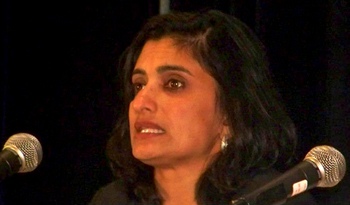
seema"I am pleased to nominate (Dr) Seema Verma to serve as Administrator of the Centers for Medicare and Medicaid Services," Trump said in a statement.

The announcement came along with Trump's nomination of Congressman Tom Price as his Health and Human Services Secretary.

A leading expert in the country on Medicare and Medicaid, Verma would serve as Administrator of Centers for Medicare and Medicaid Services.

"She has decades of experience advising on Medicare and Medicaid policy and helping states navigate our complicated systems. Together, Chairman Price and Seema Verma are the dream team that will transform our healthcare system for the benefit of all Americans," Trump said.

"I am honoured to be nominated by President-elect Trump today," said Verma, who met Trump in New York last week.

"I look forward to helping him tackle our nation's daunting healthcare problems in a responsible and sustainable way," she said.

Her nomination comes days after Indian-American Nikki Haley was named as US envoy to the United Nations by Trump.

Haley had scripted history by becoming the first-ever Indian-American to be appointed to a cabinet-level post in any US administration.

Verma currently is the President, CEO and founder of SVC, Inc, a national health policy consulting company.

Based in Indianapolis, Verma has supported Indiana through development of the historic programme since its inception in 2007, from development of the enabling legislation, negotiating the financing plan with the state's hospital association, developing the federal waiver, supporting federal negotiations and leading the implementation of the programme, including the operational design.

For more than 20 years, she has worked extensively on a variety of policy and strategic projects involving Medicaid, insurance, and public health, working with Governors' offices, state medicaid agencies, state health departments, state departments of insurance, as well as the federal government, private companies and foundations.

"Verma has extensive experience redesigning Medicaid programmes in several states. Verma is the architect of the Healthy Indiana Plan (HIP), the nation's first consumer directed Medicaid programme under Governor Mitch Daniels of Indiana and then-Governor Pence's HIP 2.0 waiver proposal," said the presidential transition team.

Verma received her Master's degree in Public Health, with a concentration in health policy and management from Johns Hopkins University, and her Bachelor's degree in Life Sciences from the University of Maryland.

She served as the state of Indiana's health reform lead following the passage of Obamacare in 2010.

Comments

Add new comment

  • Coastaldigest.com reserves the right to delete or block any comments.
  • Coastaldigset.com is not responsible for its readers’ comments.
  • Comments that are abusive, incendiary or irrelevant are strictly prohibited.
  • Please use a genuine email ID and provide your name to avoid reject.
News Network
June 20,2020

Sao Paulo, June 20: Brazil’s government confirmed on Friday that the country has risen above 1 million confirmed coronavirus cases, second only to the United States.

The country’s health ministry said that the total now stood at 10,32,913, up more than 50,000 from Thursday. The ministry said the sharp increase was due to corrections of previous days’ underreported numbers.

Brazilian President Jair Bolsonaro still downplays the risks of the virus after nearly 50,000 deaths from COVID-19 in three months, saying the impact of social isolation measures on the economy could be worse than the disease itself.

Specialists believe the actual number of cases in Brazil could be up to seven times higher than the official statistic. Johns Hopkins University says Brazil is performing an average of 14 tests per 1,00,000 people each day, and health experts say that number is up to 20 times less than needed to track the virus.

Official data show a downward trend of the virus in Brazil’s north, including the hard-hit region of the Amazon, a plateau in cases and deaths in the countries’ biggest cities near the Atlantic coast, but a rising curve in the south.

In the Brazilian countryside, which is much less prepared to handle a crisis, the pandemic is clearly growing. Many smaller cities have weaker health care systems and basic sanitation that’s insufficient to prevent contagion.

“There is a lot of regional inequality in our public health system and a shortage of professionals in the interior,” said Miguel Lago, executive director of Brazil’s Institute for Health Policy Studies, which advises public health officials.

That creates many health care deserts, with people going long distances to get attention. When they leave the hospital, the virus can go with them.

The cattle-producing state of Mato Grosso was barely touched by the virus when it hit the nation’s biggest cities in March. Sitting far from the coast, between the Bolivian border and Brazil’s capital of Brasilia, its 33 lakh residents led a mostly normal life until May. But now its people live under lockdown and meat producers have dozens of infected workers.

In Tangará da Serra, a city of 1,03,000 people in Mato Grosso, the mayor decided Friday to forbid the sale of alcoholic drinks for two weeks as an incentive for people to stay home.

Fᢩo Junqueira said the measure was needed after a spike in COVID-19 cases that filled 80% of the city’s 54 intensive care beds. The city has had nearly 300 cases of the disease, plus three fatalities.

In Rondonópolis, only 300 miles away from Tangará da Serra and home to a thriving economy, health authorities closed the local meatpacking industry after 92 cases were confirmed there. The city of 1,44,000 inhabitants counted 21 deaths from the virus and more than 600 cases. The mayor has also decided to limit sales of alcoholic beverages.

Even regions once considered examples of successful efforts against the virus are now struggling.

Porto Alegre, home to about 14 lakh people, had success in slowing the virus’ spread over the last three months. But now its mayor is considering increasing social isolation measures after ICU occupancy in the city jumped to 80% this month.

We were already making projections for schools to come back, Mayor Nelson Marchezan Jr. told The Associated Press. Now the trend is to impose more restrictions. Outside Sao Paulo city, five regions of the state’s countryside will have to close shops starting Monday due to a rise in coronavirus cases. Governor João Doria announced the decision Friday.

Dr. Mike Ryan, the World Health Organization’s executive director, said at a news conference that Brazil needs to increase its efforts to stop the spread of infections.

“The epidemic is still quite severe in Brazil. I believe health workers are working extremely hard and under pressure to be able to deal with the number of cases that they see on a daily basis,” Dr. Ryan said.

“Certainly the rise is not as exponential as it was previously, so there are some signs that the situation is stabilising. But we’ve seen this before in other epidemics in other countries.”

Margareth Dalcolmo, a clinical researcher and professor of respiratory medicine at the state-funded Oswaldo Cruz Foundation in Rio de Janeiro, believes the reopening in major cities and the virus traveling by road into Brazil’s heartland will keep the pressure on the country’s health system.

“The risk in the interior now is very big,” she said. “Our health system just can’t solve the most serious cases of COVID in many places of the countryside.”

Comments

Add new comment

  • Coastaldigest.com reserves the right to delete or block any comments.
  • Coastaldigset.com is not responsible for its readers’ comments.
  • Comments that are abusive, incendiary or irrelevant are strictly prohibited.
  • Please use a genuine email ID and provide your name to avoid reject.
Agencies
April 17,2020

Beijing/Wuhan, Apr 17: China's coronavirus death toll mounted to 4,632 on Friday as the country revised figures in its epicentre Wuhan with 1,290 additional fatalities amid international criticism of under-reporting of COVID-19 data.

The Wuhan municipal headquarters on Friday revised the number of confirmed COVID-19 cases and deaths due to the disease, state-run Xinhua news agency reported.

As of April 16, the total number of confirmed coronavirus cases in Wuhan was increased by 325 to 50,333 and the number of fatalities up by 1,290 to 3,869.

The revised figure raised China's overall COVID-19 death toll to 4,632. The total number of cases also increased to 82,692.

The Wuhan municipal headquarters in a notification said the revisions were made in accordance with related laws and regulations as well as the principle of being responsible for history, the people and the deceased.

The revision of figures came amid sharp criticism of China by the US and other nations for its alleged under-reporting of the coronavirus cases and cover-up of the origin of the viral strain, which emerged in Wuhan in December last, reportedly from the local Hunan sea food market.

Explaining the reason for the figure revision, the Wuhan municipality said it was done to ensure that the information on the city's COVID-19 epidemic is open and transparent, and that the data are accurate.

Listing the reasons for the data discrepancies, it said the surging number of patients at the early stage of the epidemic overwhelmed medical resources and the admission capacity of medical institutions. Some patients died at home without having been treated in hospitals.

Besides, during the height of their treating efforts, hospitals were operating beyond their capacities and medical staff were preoccupied with saving and treating patients, resulting in belated, missed and mistaken reporting.

Also, due to a rapid increase of designated hospitals for treating COVID-19 patients -- including those administered by ministries, Hubei Province, Wuhan city and its districts, those affiliated to companies, as well as private hospitals and makeshift hospitals -- a few medical institutions were not linked to the epidemic information network and failed to report their data in time.

The registered information of some of the deceased patients was incomplete, and there were repetitions and mistakes in the reporting, the Wuhan authorities noted.

Citing an official of the Wuhan municipal headquarters, Xinhua reported that a group for epidemic-related big data and epidemiological investigations was established in late March.

The group used information from online systems and collected full information from all epidemic-related locations to ensure that facts about every case are accurate and every figure is objective and correct.

"What lie behind the epidemic data are the lives and health of the general public, as well as the credibility of the government," the official was quoted by the report.

The timely revision of the figures, among other things, shows respect for every single life, the official said.

Meanwhile, the revised cases were not included in the overall national figures released by China's National Commission (NHC) in its daily report on Friday as it reports previous day's cases.

As per NHC data, as of Thursday the overall confirmed cases of coronavirus was 82,367, including 3,342 deaths.

As many as 1,081 patients are being treated and 77,944 people discharged after recovery, it said.

NHC said it received reports of 26 new confirmed COVID-19 cases from the mainland on Thursday, of which 15 were imported.

The other 11 new cases were domestically transmitted, it said, noting that five cases were reported in Guangdong Province, three in Heilongjiang Province, two in Shandong Province and one in Liaoning Province.

No death was reported on Thursday on the mainland.

As of Thursday, China has a total of 1,549 imported cases, NHC said, adding that 879 were undergoing treatment with 45 in severe condition. Besides, there were 66 new asymptomatic cases, taking the tally to 1,038.

Comments

Add new comment

  • Coastaldigest.com reserves the right to delete or block any comments.
  • Coastaldigset.com is not responsible for its readers’ comments.
  • Comments that are abusive, incendiary or irrelevant are strictly prohibited.
  • Please use a genuine email ID and provide your name to avoid reject.
Agencies
January 7,2020

Tehran, Jan 7: The Iranian Parliament on Tuesday ratified a motion dubbed as "harsh revenge", that considers all members of the US Pentagon and those responsible for the death of Major General Qasem Soleimani as "terrorist forces".

The triple-urgency motion is a modification of a previously ratified bill on April 23, 2019, that designated the US Central Command (CENTCOM) as a terrorist organization in retaliation to the same designation imposed on Iran's Islamic Revolutionary Guard Corps (IRGC) by Washington, the Tehran-based Mehr News Agency said in a report.

Parliament Speaker Ali Larijani said in Tuesday's open session that in the previous anti-US law, CENTCOM was designated as a terrorist entity.

"Today, following the cruel US measure in assassinating General Soleimani, the responsibility of which was accepted by the US President, we modify the previous law and announce that all members of Pentagon, commanders, agents and those responsible for the martyrdom of Gen Soleimani will be considered as terrorist forces," Larijani was quoted as saying in the report.

All of Iran nation supports the resistance, he added.

The modified law also allows withdrawal of $223 million to the IRGC's Quds Force from the National Development Fund of Iran for the next two months, added Larijani.

He said that the Supreme Leader Ayatollah Ali Khamenei's permission to withdraw the fund has been obtained, the Mehr report added.

Following its ratification, MPs chanted anti-US slogans at the Parliament.

Soleimani and his son-in-law and Abu Mahdi al-Muhandis, the second-in-command of Iraq's Popular Mobilization Front (PMF), along with eight other people were killed in the January 3 drone attack ordered by US President Donald Trump.

Soleimani, 63, was the elite Quds Force chief in charge of IRGC operations outside Iran, and has been on the ground in Syria and Iraq supervising militias backed by Tehran.

The Quds Force holds sway over a large number of militias across the region ranging from Lebanon to Syria and Iraq.

The attack has led to widespread condemnation in Iran. Supreme Leader Khamenei and President Hassan Rouhani has vowed revenge on the US.

On Sunday, Iranian MP Abolfazl Aboutorabi threatened to attack the heart of American politics.

During an open session of the Iranian Parliament on Sunday afternoon, President Trump was called a "terrorist in a suit" after he threatened to hit 52 Iranian sites hard if Tehran attacks Americans or US assets.

Comments

Add new comment

  • Coastaldigest.com reserves the right to delete or block any comments.
  • Coastaldigset.com is not responsible for its readers’ comments.
  • Comments that are abusive, incendiary or irrelevant are strictly prohibited.
  • Please use a genuine email ID and provide your name to avoid reject.