


Trump nominates 2nd Indian woman to top administration post

November 29, 2016

Washington, Nov 29: US President-elect Donald Trump today nominated a second Indian-American woman to a top administration position, putting her in charge of a federal agency within the health department as part of a "dream team" which he said would transform America's healthcare system.
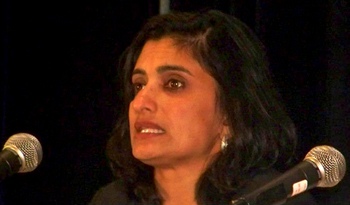
seema"I am pleased to nominate (Dr) Seema Verma to serve as Administrator of the Centers for Medicare and Medicaid Services," Trump said in a statement.

The announcement came along with Trump's nomination of Congressman Tom Price as his Health and Human Services Secretary.

A leading expert in the country on Medicare and Medicaid, Verma would serve as Administrator of Centers for Medicare and Medicaid Services.

"She has decades of experience advising on Medicare and Medicaid policy and helping states navigate our complicated systems. Together, Chairman Price and Seema Verma are the dream team that will transform our healthcare system for the benefit of all Americans," Trump said.

"I am honoured to be nominated by President-elect Trump today," said Verma, who met Trump in New York last week.

"I look forward to helping him tackle our nation's daunting healthcare problems in a responsible and sustainable way," she said.

Her nomination comes days after Indian-American Nikki Haley was named as US envoy to the United Nations by Trump.

Haley had scripted history by becoming the first-ever Indian-American to be appointed to a cabinet-level post in any US administration.

Verma currently is the President, CEO and founder of SVC, Inc, a national health policy consulting company.

Based in Indianapolis, Verma has supported Indiana through development of the historic programme since its inception in 2007, from development of the enabling legislation, negotiating the financing plan with the state's hospital association, developing the federal waiver, supporting federal negotiations and leading the implementation of the programme, including the operational design.

For more than 20 years, she has worked extensively on a variety of policy and strategic projects involving Medicaid, insurance, and public health, working with Governors' offices, state medicaid agencies, state health departments, state departments of insurance, as well as the federal government, private companies and foundations.

"Verma has extensive experience redesigning Medicaid programmes in several states. Verma is the architect of the Healthy Indiana Plan (HIP), the nation's first consumer directed Medicaid programme under Governor Mitch Daniels of Indiana and then-Governor Pence's HIP 2.0 waiver proposal," said the presidential transition team.

Verma received her Master's degree in Public Health, with a concentration in health policy and management from Johns Hopkins University, and her Bachelor's degree in Life Sciences from the University of Maryland.

She served as the state of Indiana's health reform lead following the passage of Obamacare in 2010.

Comments

Add new comment

  • Coastaldigest.com reserves the right to delete or block any comments.
  • Coastaldigset.com is not responsible for its readers’ comments.
  • Comments that are abusive, incendiary or irrelevant are strictly prohibited.
  • Please use a genuine email ID and provide your name to avoid reject.
Agencies
February 17,2020

Islamabad, Feb 17: Prime Minister Imran Khan on Monday warned that Pakistan may face another refugee crisis if the international community failed to take notice of the current situation in India.

Speaking at the two-day refugee summit in Islamabad on 40 years of hosting Afghan refugees in Pakistan, he said India’s "ultranationalist ideology going unchecked could lead to destruction and the region could become a flashpoint", The Express Tribune quoted him as saying.

Khan said if the international community does not take notice of this situation, it will create another refugee crisis for Pakistan as Muslims of India will move to Pakistan.

"This is not the India of Jawaharlal Nehru and Mahatma Gandhi. The United Nations (UN) must play its role otherwise it will become a very big problem in the future," Duniya News quoted Khan as saying.

He said said that Prime Minister Narendra Modi’s statement that India can destroy Pakistan in 11 days is not a responsible statement by a premier of a nuclear state with a huge population, the paper reported.

Khan made the statement in the presence of visiting UN Secretary General Antonio Guterres, who was also attending the summit.

He said because of the "Hindutva" ideology, Kashmiris have been lockdown for over 200 days. He alleged under the same ideology, the BJP-led government passed two discriminatory nationalistic legislations, targeting 200 million Muslims in India.

Khan was referring to India's Citizenship (Amendment) Act and the revocation of the special status to Jammu and Kashmir.

The new citizenship law passed by the Indian Parliament in December 2019 offers citizenship to non-Muslim persecuted religious minorities from Pakistan, Bangladesh and Afghanistan.

The Indian government has maintained that the CAA is an internal matter of the country and stressed that the goal is to protect the oppressed minorities of neighbouring countries.

India revoked Jammu and Kashmir's special status on August 5. Reacting to India's move, Pakistan downgraded diplomatic ties with New Delhi and expelled the Indian High Commissioner.

India has always maintained that Jammu and Kashmir is its integral part and ruled out any third party mediation, including either from the UN or the US, saying it is a bilateral issue with Pakistan.

Comments

Add new comment

  • Coastaldigest.com reserves the right to delete or block any comments.
  • Coastaldigset.com is not responsible for its readers’ comments.
  • Comments that are abusive, incendiary or irrelevant are strictly prohibited.
  • Please use a genuine email ID and provide your name to avoid reject.
Agencies
May 26,2020

Sheikhupura, May 26: Younus, the brother-in-law of Asia Bibi, a Christian woman convicted of blasphemy by a Pakistani court, was killed in Sheikhupura city of Punjab province in Pakistan on Monday.

According to the FIR, Younus had gone to his farms on May 24 and did not return home at night. His body with throat slit was traced in the farm the following morning.

It is believed that, hailing from minority Christian community, Younus was killed in a rivalry.

This is not the first time that somebody associated with Asia Bibi has been murdered in cold blood.

In 2011, Salman Taseer, the influential governor of Punjab was assassinated after he made headlines by appealing for the pardon of Asia Bibi, who had been sentenced to death for allegedly insulting Prophet Muhammad.

A month after Taseer was killed, Religious Minorities Minister Shahbaz Bhatti, a Christian who spoke out against the laws, was shot dead in Islamabad, underlining the threat faced by critics of the law.

Asia Bibi is now living in exile after the Supreme Court of Pakistan acquitted her based on insufficient evidence in October 2018.

Recounting the hellish conditions of eight years spent on death row on blasphemy charges but also the pain of exile, Asia Bibi recently broke her silence to give her first personal insight into an ordeal that caused international outrage.

French journalist Anne-Isabelle Tollet, who has co-written a book about her, was once based in the country where she led a support campaign for her."You already know my story through the media," she said in the book.

"But you are far from understanding my daily life in prison or my new life," she said. "I became a prisoner of fanaticism," she said. In prison, "tears were the only companions in the cell".

She described the horrendous conditions in squalid jails in Pakistan where she was kept chained and jeered at by other detainees.

Pakistan's blasphemy laws carry a potential death sentence for anyone who insults Islam. Critics say they have been used to persecute minority faiths and unfairly target minorities.

Pakistan's Prime Minister Imran Khan defended the country's strict blasphemy laws during his election campaigns. The status quo is still in place.

No government in Pakistan was ready to make changed to the blasphemy law due to fears of a backlash.

Comments

Add new comment

  • Coastaldigest.com reserves the right to delete or block any comments.
  • Coastaldigset.com is not responsible for its readers’ comments.
  • Comments that are abusive, incendiary or irrelevant are strictly prohibited.
  • Please use a genuine email ID and provide your name to avoid reject.
News Network
April 26,2020

Apr 26: The remarkable story of an airman who overcame prejudice to become one of only a handful of Indian fighter pilots in the First World War has emerged in newly-released archive files by the UK's Commonwealth War Graves Commission (CWGC).

Lieutenant Shri Krishna Chanda Welinkar is one of the thousands of moving stories from the war preserved in family correspondence and being brought alive as part of a digitisation project.

The never-before-published files contain thousands of letters, pictures and other papers sent between the Commission and the next of the kin of First World War dead.

Among them is the story of Welinkar, who hailed from Bombay in colonial India. After much hardship and discrimination, he eventually became a pilot and went missing while on patrol over the skies above the Western Front in June 1918.

His family had to wait nearly three years before they finally knew for certain that he had died, and his grave was located.

“For everyone who died in the First World War, there was inevitably a partner, parent or child back home who had questions. The heartbreaking letters in CWGC's archive give us an insight into what it was like for those families trying to come to terms with their loss,” said Andrew Fetherston, chief archivist for CWGC.

“They are stories that show desperate searches for closure, former enemies uniting and, on many occasions, the sad realisation that a missing loved one would always remain so. We are pleased to be able to make this invaluable piece of World War history accessible to a new generation and help deepen our understanding of how the First World War impacted those who were left behind,” he said.

Welinkar was one of the 1.3 million Indians who answered the call to fight for the British Empire. Nearly 74,000 never saw their homeland again and are remembered today in cemeteries and memorials throughout the world, including France, Belgium, the Middle East and Africa.

Welinkar was a well-educated man studying at Cambridge University. He trained to become an aviator in Middlesex and wished to join the Royal Flying Corps, later known as the Royal Air Force.

Upon attempting to enlist, Welinkar encountered the same prejudices as his other fellow Indian airmen and was encouraged to become an air mechanic instead.

He was eventually given a commission in the Royal Flying Corps as an Officer. In 1918, he was posted to France and patrolled the skies above the Western Front.

In June 1918, Lieutenant Welinkar embarked on what would be his final patrol; he did not return and was reported missing. His fate remained unknown for many months afterwards.

The newly-released e-files chronicle the remarkable discovery of Welinkar and his final resting place long after the war had ended. Colonel Barton, who knew Welinkar, acted on behalf of his mother and helped find her missing son. They spoke to former enemies and honed their search to the grave of an unidentified man, buried by the Germans as “Oberleutnant S.C. Wumkar” in a grave in Rouvroy, Belgium.

The body was later moved and reinterred in Hangard Communal Cemetery Extension but it wasn't until the vital clue, found in the original German burial records in February 1921, that it was confirmed beyond doubt this grave was of Welinkar's.

In May 1921, Colonel Barton, on behalf of Welinkar's mother, requested that a Commission headstone be placed on the grave with the following personal inscription: “To the Honoured Memory of One of the Empire's Bravest Sons”.

This records – known as Enquiry Files – are part of a collection of nearly 3,000 files which have never been made available to the public before. Nearly half have been digitised so far, alongside a previously unreleased collection of more than 16,000 photographs held in negatives in the Commission's archive.

The files, internally referred to simply as E-Files, contain correspondence between the CWGC and the next of kin of the war dead. They often contain letters, typed memos between Commission staff and on occasion photos, maps and diagrams.

CWGC only holds an enquiry file for a small proportion of the 1.7 million people it commemorates from the Commonwealth. Today it is only possible to release those surviving records from the First World War because correspondence with families of Second World War casualties often involves people still alive today and cannot be made public for many years, due to the UK's data protection rules.

To date, more than 1,300 of the surviving 3,000 First World War enquiry files have been digitised.

The CWGC commemorates the 1.7 million Commonwealth servicemen and women who died during the two World Wars. It also holds and updates an extensive and accessible records archive, while operating over 23,000 locations in more than 150 countries and territories.

Comments

Add new comment

  • Coastaldigest.com reserves the right to delete or block any comments.
  • Coastaldigset.com is not responsible for its readers’ comments.
  • Comments that are abusive, incendiary or irrelevant are strictly prohibited.
  • Please use a genuine email ID and provide your name to avoid reject.