


Trump nominates 2nd Indian woman to top administration post

November 29, 2016

Washington, Nov 29: US President-elect Donald Trump today nominated a second Indian-American woman to a top administration position, putting her in charge of a federal agency within the health department as part of a "dream team" which he said would transform America's healthcare system.
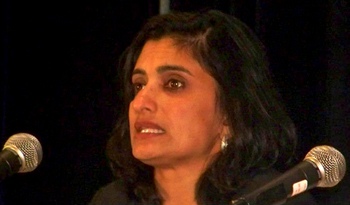
seema"I am pleased to nominate (Dr) Seema Verma to serve as Administrator of the Centers for Medicare and Medicaid Services," Trump said in a statement.

The announcement came along with Trump's nomination of Congressman Tom Price as his Health and Human Services Secretary.

A leading expert in the country on Medicare and Medicaid, Verma would serve as Administrator of Centers for Medicare and Medicaid Services.

"She has decades of experience advising on Medicare and Medicaid policy and helping states navigate our complicated systems. Together, Chairman Price and Seema Verma are the dream team that will transform our healthcare system for the benefit of all Americans," Trump said.

"I am honoured to be nominated by President-elect Trump today," said Verma, who met Trump in New York last week.

"I look forward to helping him tackle our nation's daunting healthcare problems in a responsible and sustainable way," she said.

Her nomination comes days after Indian-American Nikki Haley was named as US envoy to the United Nations by Trump.

Haley had scripted history by becoming the first-ever Indian-American to be appointed to a cabinet-level post in any US administration.

Verma currently is the President, CEO and founder of SVC, Inc, a national health policy consulting company.

Based in Indianapolis, Verma has supported Indiana through development of the historic programme since its inception in 2007, from development of the enabling legislation, negotiating the financing plan with the state's hospital association, developing the federal waiver, supporting federal negotiations and leading the implementation of the programme, including the operational design.

For more than 20 years, she has worked extensively on a variety of policy and strategic projects involving Medicaid, insurance, and public health, working with Governors' offices, state medicaid agencies, state health departments, state departments of insurance, as well as the federal government, private companies and foundations.

"Verma has extensive experience redesigning Medicaid programmes in several states. Verma is the architect of the Healthy Indiana Plan (HIP), the nation's first consumer directed Medicaid programme under Governor Mitch Daniels of Indiana and then-Governor Pence's HIP 2.0 waiver proposal," said the presidential transition team.

Verma received her Master's degree in Public Health, with a concentration in health policy and management from Johns Hopkins University, and her Bachelor's degree in Life Sciences from the University of Maryland.

She served as the state of Indiana's health reform lead following the passage of Obamacare in 2010.

Comments

Add new comment

  • Coastaldigest.com reserves the right to delete or block any comments.
  • Coastaldigset.com is not responsible for its readers’ comments.
  • Comments that are abusive, incendiary or irrelevant are strictly prohibited.
  • Please use a genuine email ID and provide your name to avoid reject.
News Network
February 19,2020

Washington, Feb 19: US President Donald Trump has said he is "saving the big deal" with India for later and he "does not know" if it will be done before the presidential election in November, clearly indicating that a major bilateral trade deal during his visit to Delhi next week might not be on the cards.

"We can have a trade deal with India. But I'm really saving the big deal for later," he told reporters at Joint Base Andrews Tuesday afternoon (local time).

The US and India could sign a "trade package" during the visit, according to media reports.

Asked whether he expects a trade deal with India before the visit, Trump said, "We're doing a very big trade deal with India. We'll have it. I don't know if it'll be done before the election, but we'll have a very big deal with India."

US Trade Representative Robert Lighthizer, the point-person for trade negotiations with India, is likely to not accompany Trump to India, sources said. However, officials have not ruled it out altogether.

In an apparent dissatisfaction over US-India trade ties, Trump said, "We're not treated very well by India." But he praised Prime Minister Narendra Modi and said he is looking forward to his visit to India.

"I happen to like Prime Minister Modi a lot," Trump said.

"He told me we'll have seven million people between the airport and the event. And the stadium, I understand, is sort of semi under construction, but it's going to be the largest stadium in the world. So it's going to be very exciting... I hope you all enjoy it," he told reporters.

Meanwhile, the US-India Strategic and Partnership Forum (USISPF) in a report said the latest quarterly data depict continuation of overall positive bilateral trade trends. The third quarter data reflects some downslide in growth rates.

"It may be due to several reasons, including the unexpected economic slowdown in India's economic growth, impact of US-China trade war, GSP withdrawal from the US side and retaliatory tariffs on specific US goods from the Indian side," USISPF said.

According to the report, the data available for the first three quarters of 2019 (January-September) pulled the overall growth rate in cumulative bilateral trade down to 4.5 percent from 8.4 percent registered for the first two quarters.

Goods and services trade performance in third quarter was dismal at -2.3 percent, in contrast with the impressive 9.6 percent growth witnessed for the first two quarters of the year; while trade in services was up two percent goods trade dropped five percent, the report said.

The cumulative US-India trade in goods and services (USD 110.9 billion) for the first three quarters of 2019 increased 4.5 percent with US exports and imports growing at four percent and five percent respectively.

The US exported USD 45.3 billion worth of goods and services to India in the first three quarters 2019, up 4 percent from the corresponding period in the previous year; and the US imported USD 65.6 billion worth of goods and services from India, up five percent from the previous year's USD 62.5 billion level for the same period, it said.

The USISPF has projected that the total bilateral trade can touch USD 238 billion by 2025 if the current 7.5 percent average annual rate of growth sustains; however, higher growth rates can result in bilateral trade in the range of USD 283 billion and USD 327 billion.

The US remains the top trading partner for India in terms of trade in goods and services, followed by China. While the bilateral trade between US and India is approximately 62 percent in goods and 38 percent in services, the bilateral trade between India and China is dominated by goods.

China had a huge trade surplus of USD 58 billion with India, indicating Beijing's strength in the Indian market, especially in sectors, such as electronics, machinery, organic chemicals, plastics and medical devices.

The US goods exports to India, in comparison, were mainly concentrated in mineral fuels, precious stones, and aircraft. The US faces tough competition with China in the Indian market in areas such as electronics, machinery, organic chemicals and medical devices.

Comments

Add new comment

  • Coastaldigest.com reserves the right to delete or block any comments.
  • Coastaldigset.com is not responsible for its readers’ comments.
  • Comments that are abusive, incendiary or irrelevant are strictly prohibited.
  • Please use a genuine email ID and provide your name to avoid reject.
Agencies
July 1,2020

The ILO has warned that if another Covid-19 wave hits in the second half of 2020, there would be global working-hour loss of 11.9 percent - equivalent to the loss of 340 million full-time jobs.

According to the 5th edition of International Labour Organisation (ILO) Monitor: Covid-19 and the world of work, the recovery in the global labour market for the rest of the year will be uncertain and incomplete.

The report said that there was a 14 percent drop in global working hours during the second quarter of 2020, equivalent to the loss of 400 million full-time jobs.

The number of working hours lost across the world in the first half of 2020 was significantly worse than previously estimated. The highly uncertain recovery in the second half of the year will not be enough to go back to pre-pandemic levels even in the best scenario, the agency warned.

The baseline model – which assumes a rebound in economic activity in line with existing forecasts, the lifting of workplace restrictions and a recovery in consumption and investment – projects a decrease in working hours of 4.9 percent (equivalent to 140 million full-time jobs) compared to last quarter of 2019.

It says that in the pessimistic scenario, the situation in the second half of 2020 would remain almost as challenging as in the second quarter.

“Even if one assumes better-tailored policy responses – thanks to the lessons learned throughout the first half of the year – there would still be a global working-hour loss of 11.9 per cent at the end of 2020, or 340 million full-time jobs, relative to the fourth quarter of 2019,” it said.

The pessimistic scenario assumes a second pandemic wave and the return of restrictions that would significantly slow recovery. The optimistic scenario assumes that workers’ activities resume quickly, significantly boosting aggregate demand and job creation. With this exceptionally fast recovery, the global loss of working hours would fall to 1.2 per cent (34 million full-time jobs).

The agency said that under the three possible scenarios for recovery in the next six months, “none” sees the global job situation in better shape than it was before lockdown measures began.

“This is why we talk of an uncertain but incomplete recovery even in the best of scenarios for the second half of this year. So there is not going to be a simple or quick recovery,” ILO Director-General Guy Ryder said.

The new figures reflect the worsening situation in many regions over the past weeks, especially in developing economies. Regionally, working time losses for the second quarter were: Americas (18.3 percent), Europe and Central Asia (13.9 percent), Asia and the Pacific (13.5 percent), Arab States (13.2 percent), and Africa (12.1 percent).

The vast majority of the world’s workers (93 per cent) continue to live in countries with some sort of workplace closures, with the Americas experiencing the greatest restrictions.

During the first quarter of the year, an estimated 5.4 percent of global working hours (equivalent to 155 million full-time jobs) were lost relative to the fourth quarter of 2019. Working- hour losses for the second quarter of 2020 relative to the last quarter of 2019 are estimated to reach 14 per cent worldwide (equivalent to 400 million full-time jobs), with the largest reduction (18.3 per cent) occurring in the Americas.

The ILO Monitor also found that women workers have been disproportionately affected by the pandemic, creating a risk that some of the modest progress on gender equality made in recent decades will be lost, and that work-related gender inequality will be exacerbated.

The severe impact of Covid-19 on women workers relates to their over-representation in some of the economic sectors worst affected by the crisis, such as accommodation, food, sales and manufacturing.

Globally, almost 510 million or 40 percent of all employed women work in the four most affected sectors, compared to 36.6 percent of men, it said.

The report said that women also dominate in the domestic work and health and social care work sectors, where they are at greater risk of losing their income and of infection and transmission and are also less likely to have social protection.

The pre-pandemic unequal distribution of unpaid care work has also worsened during the crisis, exacerbated by the closure of schools and care services.

Even as countries have adopted policy measures with unprecedented speed and scope, the ILO Monitor highlights some key challenges ahead, including finding the right balance and sequencing of health, economic and social and policy interventions to produce optimal sustainable labour market outcomes; implementing and sustaining policy interventions at the necessary scale when resources are likely to be increasingly constrained and protecting and promoting the conditions of vulnerable, disadvantaged and hard-hit groups to make labour markets fairer and more equitable.

“The decisions we adopt now will echo in the years to come and beyond 2030. Although countries are at different stages of the pandemic and a lot has been done, we need to redouble our efforts if we want to come out of this crisis in a better shape than when it started,” Ryder said. 

Comments

Add new comment

  • Coastaldigest.com reserves the right to delete or block any comments.
  • Coastaldigset.com is not responsible for its readers’ comments.
  • Comments that are abusive, incendiary or irrelevant are strictly prohibited.
  • Please use a genuine email ID and provide your name to avoid reject.
Agencies
February 17,2020

Islamabad, Feb 17: Prime Minister Imran Khan on Monday warned that Pakistan may face another refugee crisis if the international community failed to take notice of the current situation in India.

Speaking at the two-day refugee summit in Islamabad on 40 years of hosting Afghan refugees in Pakistan, he said India’s "ultranationalist ideology going unchecked could lead to destruction and the region could become a flashpoint", The Express Tribune quoted him as saying.

Khan said if the international community does not take notice of this situation, it will create another refugee crisis for Pakistan as Muslims of India will move to Pakistan.

"This is not the India of Jawaharlal Nehru and Mahatma Gandhi. The United Nations (UN) must play its role otherwise it will become a very big problem in the future," Duniya News quoted Khan as saying.

He said said that Prime Minister Narendra Modi’s statement that India can destroy Pakistan in 11 days is not a responsible statement by a premier of a nuclear state with a huge population, the paper reported.

Khan made the statement in the presence of visiting UN Secretary General Antonio Guterres, who was also attending the summit.

He said because of the "Hindutva" ideology, Kashmiris have been lockdown for over 200 days. He alleged under the same ideology, the BJP-led government passed two discriminatory nationalistic legislations, targeting 200 million Muslims in India.

Khan was referring to India's Citizenship (Amendment) Act and the revocation of the special status to Jammu and Kashmir.

The new citizenship law passed by the Indian Parliament in December 2019 offers citizenship to non-Muslim persecuted religious minorities from Pakistan, Bangladesh and Afghanistan.

The Indian government has maintained that the CAA is an internal matter of the country and stressed that the goal is to protect the oppressed minorities of neighbouring countries.

India revoked Jammu and Kashmir's special status on August 5. Reacting to India's move, Pakistan downgraded diplomatic ties with New Delhi and expelled the Indian High Commissioner.

India has always maintained that Jammu and Kashmir is its integral part and ruled out any third party mediation, including either from the UN or the US, saying it is a bilateral issue with Pakistan.

Comments

Add new comment

  • Coastaldigest.com reserves the right to delete or block any comments.
  • Coastaldigset.com is not responsible for its readers’ comments.
  • Comments that are abusive, incendiary or irrelevant are strictly prohibited.
  • Please use a genuine email ID and provide your name to avoid reject.