


Trump nominates 2nd Indian woman to top administration post

November 29, 2016

Washington, Nov 29: US President-elect Donald Trump today nominated a second Indian-American woman to a top administration position, putting her in charge of a federal agency within the health department as part of a "dream team" which he said would transform America's healthcare system.
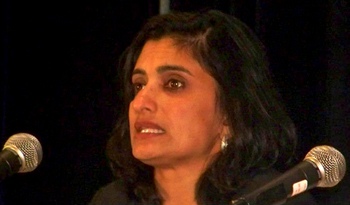
seema"I am pleased to nominate (Dr) Seema Verma to serve as Administrator of the Centers for Medicare and Medicaid Services," Trump said in a statement.

The announcement came along with Trump's nomination of Congressman Tom Price as his Health and Human Services Secretary.

A leading expert in the country on Medicare and Medicaid, Verma would serve as Administrator of Centers for Medicare and Medicaid Services.

"She has decades of experience advising on Medicare and Medicaid policy and helping states navigate our complicated systems. Together, Chairman Price and Seema Verma are the dream team that will transform our healthcare system for the benefit of all Americans," Trump said.

"I am honoured to be nominated by President-elect Trump today," said Verma, who met Trump in New York last week.

"I look forward to helping him tackle our nation's daunting healthcare problems in a responsible and sustainable way," she said.

Her nomination comes days after Indian-American Nikki Haley was named as US envoy to the United Nations by Trump.

Haley had scripted history by becoming the first-ever Indian-American to be appointed to a cabinet-level post in any US administration.

Verma currently is the President, CEO and founder of SVC, Inc, a national health policy consulting company.

Based in Indianapolis, Verma has supported Indiana through development of the historic programme since its inception in 2007, from development of the enabling legislation, negotiating the financing plan with the state's hospital association, developing the federal waiver, supporting federal negotiations and leading the implementation of the programme, including the operational design.

For more than 20 years, she has worked extensively on a variety of policy and strategic projects involving Medicaid, insurance, and public health, working with Governors' offices, state medicaid agencies, state health departments, state departments of insurance, as well as the federal government, private companies and foundations.

"Verma has extensive experience redesigning Medicaid programmes in several states. Verma is the architect of the Healthy Indiana Plan (HIP), the nation's first consumer directed Medicaid programme under Governor Mitch Daniels of Indiana and then-Governor Pence's HIP 2.0 waiver proposal," said the presidential transition team.

Verma received her Master's degree in Public Health, with a concentration in health policy and management from Johns Hopkins University, and her Bachelor's degree in Life Sciences from the University of Maryland.

She served as the state of Indiana's health reform lead following the passage of Obamacare in 2010.

Comments

Add new comment

  • Coastaldigest.com reserves the right to delete or block any comments.
  • Coastaldigset.com is not responsible for its readers’ comments.
  • Comments that are abusive, incendiary or irrelevant are strictly prohibited.
  • Please use a genuine email ID and provide your name to avoid reject.
News Network
February 26,2020

Feb 26: Looking out over the world’s largest cricket stadium, the seats jammed with more than 100,000 people, India’s prime minister heaped praise on his American visitor.

“The leadership of President Trump has served humanity,” Prime Minister Narendra Modi said Monday, highlighting Trump’s fight against terrorism and calling his 36-hour visit to India a watershed in India-U.S. relations.

The crowds cheered. Trump beamed.

“The ties between India and the U.S. are no longer just any other partnership,” Modi said. “It is a far greater and closer relationship.”

India, it seems, loves Donald Trump. It seemed obvious from the thousands who turned out to wave as his motorcade snaked through the city of Ahmedabad, and from the tens of thousands who filled the city’s new stadium. It seemed obvious from the hug that Modi gave Trump after he descended from Air Force One, and from the hundreds of billboards proclaiming Trump’s visit.

But it’s not so simple.

Because while Trump is genuinely popular in India, his clamorous and carefully choreographed welcome was also about Asian geopolitics, China’s growing power and a masterful Indian politician who gave his American visitor exactly what he wanted.

Modi “is doing this not necessarily because he loves Trump,” said Tanvi Madan, the director of the India Project at the Brookings Institution in Washington, D.C. “It’s very much about Trump as the leader of the U.S. and recognizing what it is that Trump himself likes.”

Trump likes crowds — big crowds — and the foot soldiers of India’s political parties have long known how to corral enough people to make any politician look popular. In a city like Ahmedabad, the capital of Modi’s home state of Gujarat and the center of his power base, it wouldn’t take much effort to fill a cavernous sports stadium. It was more surprising that a handful of seats remained empty, and that some in the stands had left even before Trump had finished his speech.

For India, good relations with the U.S. are deeply important: They signal that India is a serious global player, an issue that has long been important to New Delhi, and help cement an alliance that both nations see as a counterweight to China’s rise.

“For both countries, their biggest rival is China,” said John Echeverri-Gent, a professor at the University of Virginia whose research often focuses on India. “China is rapidly expanding its presence in the Indian Ocean, which India has long considered its backyard and its exclusive realm for security concerns.”

“It’s very clearly a major concern for both India and the United States,” he said.

Trump isn’t the first U.S. president that Modi has courted. In 2015, then-President Barack Obama was the first American chief guest at India’s Republic Day parade, a powerful symbolic gesture. Obama also got a Modi hug, and the media in both countries were soon writing about the two leaders’ “bromance.”

Trump is popular in India, even if some of that is simply because he’s the U.S. president. A 2019 Pew Research Center poll showed that 56% of Indians had confidence in Trump’s abilities in world affairs, one of only a handful of countries where he has that level of approval. But Obama was also popular: Before he left office, he had 58% approval in world affairs among Indians.

The Pew poll also indicated that Trump’s support was higher among supporters of Modi’s Hindu nationalist party.

That’s not surprising. Both men have fired up their nationalist bases with anti-Muslim rhetoric and government policies, from Trump’s travel bans to Modi’s crackdown in Kashmir, India’s only Muslim-majority state.

And Trump’s Indian support is far from universal. Protests against his trip roiled cities from New Delhi to Hyderabad to the far northeastern city of Gauhati, although those demonstrations were mostly overshadowed by protests over a new Indian citizenship law that Modi backs.

Modi, who is widely popular in India, has faced weeks of protests over the law, which provides fast track naturalization for some foreign-born religious minorities — but not Muslims. While Trump talked about ties with India on Tuesday, Hindus and Muslims fought in violent clashes that left at least 10 people dead over two days.

In some ways, Modi and Trump are powerful echoes of each other.

They have overlapping political styles. Both are populists who see themselves as brash, rule-breaking outsiders who disdain their countries’ traditional elites. Both are seen by their critics as having authoritarian leanings. Both surround themselves with officials who rarely question their decisions.

But are they friends?

Trump says yes. “Really, we feel very strongly about each other,” he said at a New Delhi press briefing.

But many observers aren’t so sure.

“The question is how much of this is real chemistry, as opposed to what I’d call planned chemistry” orchestrated for diplomatic reasons, said Madan. “It’s so hard to know if you’re not in the room.”

Certainly, Modi understands America’s importance to India. While the two countries continue to bicker about trade issues, the prime minister organized a welcome that impressed even India’s news media, which have watched countless choreographed mass political rallies.

“There is no other country for whose leader India would hold such an event, and for which an Indian prime minister would lavish such rhetoric,” the Hindustan Times said in an editorial.

“The spectacle and the sound were worth a thousand agreements.”

Comments

Add new comment

  • Coastaldigest.com reserves the right to delete or block any comments.
  • Coastaldigset.com is not responsible for its readers’ comments.
  • Comments that are abusive, incendiary or irrelevant are strictly prohibited.
  • Please use a genuine email ID and provide your name to avoid reject.
News Network
May 2,2020

Balochistan, May 1: Sajid Hussain, Editor-in-Chief of Balochistan Times, has been found dead in a Swedish town, the police have confirmed.

The Swedish police informed his family on Thursday night that they discovered his body from a river in Uppsala, The Times reported.
The Baloch journalist had been missing from the Swedish city since March 2 this year.

Sajid, 39, left Pakistan in 2012 and had been living as a refugee in Sweden since 2017. He wrote extensively on the suffering of the Balochis at the hands of the Pakistani military establishment.

His work often got him into trouble as the authorities did not like his reporting of Balochistan's forbidden stories, the reason he had to leave and live in exile.

The Baloch journalist was found dead two months after he went missing in Sweden.
Sajid left Pakistan because of security threats from Pakistan Army and its intelligence service ISI.

The spokesperson of the Baloch National Movement, Hammal Haider told news agency: "We are deeply saddened by the demise of prominent Baloch intellectual and writer Sajid Hussain."
"His death is indeed a loss of a great mind for the people of Balochistan. Due to his straightforwardness, he was loved among all journalistic, literary and political circles," added Haider.

"After this incident, we have serious concerns about our members and other Baloch refugees living in the West," he said.

Comments

Add new comment

  • Coastaldigest.com reserves the right to delete or block any comments.
  • Coastaldigset.com is not responsible for its readers’ comments.
  • Comments that are abusive, incendiary or irrelevant are strictly prohibited.
  • Please use a genuine email ID and provide your name to avoid reject.
News Network
June 6,2020

United Nations, Jun 6: US President Donald Trump’s response to protests against the killing of African-American George Floyd has included language “directly associated with racial segregationists” from America's past, a group of UN human rights experts have said.

There have been widespread protests across the United States as Floyd, 46, was killed by a white police officer in Minneapolis. People from diverse backgrounds have called for justice and have voiced their support to the protests.

In the wake of protests over the killing of Floyd, Trump had tweeted that “when the looting starts, the shooting starts.”

“The response of the President of the United States to the protests at different junctures has included threatening more state violence using language directly associated with racial segregationists from the nation’s past, who worked hard to deny black people fundamental human rights," a statement issued on Friday by over 60 independent experts of the Special Procedures of the United Nations Human Rights Council said.

"We are deeply concerned that the nation is on the brink of a militarised response that reenacts the injustices that have driven people to the streets to protest,” it said.

A report in The New York Times had said that the phrase "When the looting starts, the shooting starts” was used by Miami’s former police chief Walter Headley in 1967. Headley had been “long accused of using racist tactics in his force’s patrols of black neighbourhoods,” the NYT had said.

They said the recent killing of Floyd has shocked many in the world, “but it is the lived reality of black people across the United States. The uprising nationally is a protest against systemic racism that produces state-sponsored racial violence, and licenses impunity for this violence.”

They noted that following the recent spate of killings of African-Americans, many in the United States and abroad are finally acknowledging that “the problem is not a few bad apples” but instead the problem is the very way that economic, political and social life are structured in a country that prides itself in liberal democracy, and with the largest economy in the world.

Separately, 28 UN experts called on the US Government to take decisive action to address systemic racism and racial bias in the country's criminal justice system by launching independent investigations and ensuring accountability in all cases of excessive use of force by police.

“Exactly 99 years after the massacre in Tulsa, involving the killing of people of African descent and the massive loss of life, destruction of property and loss of wealth on ‘Black Wall Street’, African Americans continue to experience racial terror in state-sponsored and privately organised violence,” the experts said.

Strongly condemning the killings of Ahmaud Arbery, Breonna Taylor and George Floyd, the experts called for systemic reform and justice. “Given the track record of impunity for racial violence of this nature in the United States, Black people have good reason to fear for their lives.”

Taylor, a 25-year-old emergency medical technician was shot in her bed when police raided the wrong house; Arbery, 25, was fatally shot while jogging near his home by three white men who chased and cornered him; and Floyd was accused of using counterfeit currency in a store and died in the street while a white officer knelt on his neck and three others participated and observed.

“The origin story of policing in the United States of America starts with slave patrols and social control, where human property of enslavers was ‘protected’ with violence and impunity against people of African descent. In the US, this legacy of racial terror remains evident in modern-day policing,” the experts said.

The experts also raised concern about the police response to demonstrations in several US cities, termed by some the ‘Fed Up-rising’, that have been marked by violence, arbitrary arrest, militarisation and the detention of thousands of protesters. Reporters of colour have been targeted and detained, and some journalists have faced violence and harassment.

“Statements from the US Government inciting and threatening violence against protesters stand in stark contrast to calls for leniency and understanding which the Government had issued in the wake of largely white protests against COVID-19 restrictions on services like barbershops, salons, and spas,” the experts said.

Comments

Add new comment

  • Coastaldigest.com reserves the right to delete or block any comments.
  • Coastaldigset.com is not responsible for its readers’ comments.
  • Comments that are abusive, incendiary or irrelevant are strictly prohibited.
  • Please use a genuine email ID and provide your name to avoid reject.