


Trump nominates 2nd Indian woman to top administration post

November 29, 2016

Washington, Nov 29: US President-elect Donald Trump today nominated a second Indian-American woman to a top administration position, putting her in charge of a federal agency within the health department as part of a "dream team" which he said would transform America's healthcare system.
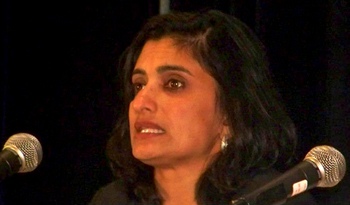
seema"I am pleased to nominate (Dr) Seema Verma to serve as Administrator of the Centers for Medicare and Medicaid Services," Trump said in a statement.

The announcement came along with Trump's nomination of Congressman Tom Price as his Health and Human Services Secretary.

A leading expert in the country on Medicare and Medicaid, Verma would serve as Administrator of Centers for Medicare and Medicaid Services.

"She has decades of experience advising on Medicare and Medicaid policy and helping states navigate our complicated systems. Together, Chairman Price and Seema Verma are the dream team that will transform our healthcare system for the benefit of all Americans," Trump said.

"I am honoured to be nominated by President-elect Trump today," said Verma, who met Trump in New York last week.

"I look forward to helping him tackle our nation's daunting healthcare problems in a responsible and sustainable way," she said.

Her nomination comes days after Indian-American Nikki Haley was named as US envoy to the United Nations by Trump.

Haley had scripted history by becoming the first-ever Indian-American to be appointed to a cabinet-level post in any US administration.

Verma currently is the President, CEO and founder of SVC, Inc, a national health policy consulting company.

Based in Indianapolis, Verma has supported Indiana through development of the historic programme since its inception in 2007, from development of the enabling legislation, negotiating the financing plan with the state's hospital association, developing the federal waiver, supporting federal negotiations and leading the implementation of the programme, including the operational design.

For more than 20 years, she has worked extensively on a variety of policy and strategic projects involving Medicaid, insurance, and public health, working with Governors' offices, state medicaid agencies, state health departments, state departments of insurance, as well as the federal government, private companies and foundations.

"Verma has extensive experience redesigning Medicaid programmes in several states. Verma is the architect of the Healthy Indiana Plan (HIP), the nation's first consumer directed Medicaid programme under Governor Mitch Daniels of Indiana and then-Governor Pence's HIP 2.0 waiver proposal," said the presidential transition team.

Verma received her Master's degree in Public Health, with a concentration in health policy and management from Johns Hopkins University, and her Bachelor's degree in Life Sciences from the University of Maryland.

She served as the state of Indiana's health reform lead following the passage of Obamacare in 2010.

Comments

Add new comment

  • Coastaldigest.com reserves the right to delete or block any comments.
  • Coastaldigset.com is not responsible for its readers’ comments.
  • Comments that are abusive, incendiary or irrelevant are strictly prohibited.
  • Please use a genuine email ID and provide your name to avoid reject.
News Network
March 24,2020

New Delhi, Mar 24: Reports of a person in China dying due to a virus called hantavirus have spread panic at a time when the world is battling the pandemic of novel coronavirus, which began in China.

The novel coronavirus has killed over 16,000 people around the world and the outbreak is yet to be brought under control.

This morning, hantavirus became one of the top trends on Twitter after the Chinese state media tweeted about one person in the country dying due the virus. However, it turns out, hantavirus is not a new virus and has been infecting humans for decades.

Global Times, a state-run English-language newspaper, wrote on Twitter on Tuesday, "A person from Yunnan Province died while on his way back to Shandong Province for work on a chartered bus on Monday. He was tested positive for hantavirus. Other 32 people on bus were tested."

Global Times's hantavirus report on Twitter has been shared over 6,000 times.

On Tuesday, hantavirus was one of the top trends on Twitter.

WHAT IS HANTAVIRUS?

Some people are calling it a new virus but so is not the case. United States's National Center for Biotechnology Information (NCBI) in a journal writes that currently, the hantavirus genus includes more than 21 species.

"Hantaviruses in the Americas are known as 'New World' hantaviruses and may cause hantavirus pulmonary syndrome [HPS]," CDC says. "Other hantaviruses, known as 'Old World' hantaviruses, are found mostly in Europe and Asia and may cause hemorrhagic fever with renal syndrome [HFRS]."

Any man, woman, or child who is around mice or rats that carry harmful hantaviruses can get HPS.

People get HPS when they breath in hantaviruses. This can happen when rodent urine and droppings that contain a hantavirus are stirred up into the air. People can also become infected when they touch mouse or rat urine, droppings, or nesting materials that contain the virus and then touch their eyes, nose, or mouth. They can also get HPS from a mouse or rat bite.

In the US, 10 confirmed cases of hantavirus infection in people who visited Yosemite National Park in California, US, in November 2012, were reported. Similarly, in 2017, CDC assisted health officials in investigating an outbreak of Seoul virus infection that infected 17 people in seven states.

WHAT ARE THE SYMPTOMS OF HANTAVIRUS?

If people get HPS, they will feel sick one to five weeks after they were around mice or rats that carried a hantavirus.

At first people with HPS will have:

Fever
Severe muscle aches
Fatigue

After a few days, they will have a hard time breathing. Sometimes people will have headaches, dizziness, chills, nausea, vomiting, diarrhoea, and stomach pain.

Usually, people do not have a runny nose, sore throat, or a rash.

Comments

Add new comment

  • Coastaldigest.com reserves the right to delete or block any comments.
  • Coastaldigset.com is not responsible for its readers’ comments.
  • Comments that are abusive, incendiary or irrelevant are strictly prohibited.
  • Please use a genuine email ID and provide your name to avoid reject.
News Network
May 2,2020

Balochistan, May 1: Sajid Hussain, Editor-in-Chief of Balochistan Times, has been found dead in a Swedish town, the police have confirmed.

The Swedish police informed his family on Thursday night that they discovered his body from a river in Uppsala, The Times reported.
The Baloch journalist had been missing from the Swedish city since March 2 this year.

Sajid, 39, left Pakistan in 2012 and had been living as a refugee in Sweden since 2017. He wrote extensively on the suffering of the Balochis at the hands of the Pakistani military establishment.

His work often got him into trouble as the authorities did not like his reporting of Balochistan's forbidden stories, the reason he had to leave and live in exile.

The Baloch journalist was found dead two months after he went missing in Sweden.
Sajid left Pakistan because of security threats from Pakistan Army and its intelligence service ISI.

The spokesperson of the Baloch National Movement, Hammal Haider told news agency: "We are deeply saddened by the demise of prominent Baloch intellectual and writer Sajid Hussain."
"His death is indeed a loss of a great mind for the people of Balochistan. Due to his straightforwardness, he was loved among all journalistic, literary and political circles," added Haider.

"After this incident, we have serious concerns about our members and other Baloch refugees living in the West," he said.

Comments

Add new comment

  • Coastaldigest.com reserves the right to delete or block any comments.
  • Coastaldigset.com is not responsible for its readers’ comments.
  • Comments that are abusive, incendiary or irrelevant are strictly prohibited.
  • Please use a genuine email ID and provide your name to avoid reject.
News Network
June 19,2020

United Nations, Jun 19: Half of the world's children -- one billion every year -- are affected by physical, sexual or psychological violence, suffering injuries and death because countries have failed to follow established strategies to protect them, the first report of its kind from the UN has said, with experts noting that the coronavirus-related lockdowns have left far too many youngsters stuck with their abusers.

While nearly all countries (88 per cent) have laws in place to protect minors, less than half (47 per cent) say they strongly enforce them, said the Global Status Report on Preventing Violence Against Children 2020 launched on Thursday.

Because countries have failed to follow established strategies to protect children, about one billion are affected each year by physical, sexual or psychological violence, it said.

"There is never any excuse for violence against children," WHO Director-General Tedros Adhanom Ghebreyesus said.

"We have evidence-based tools to prevent it, which we urge all countries to implement. Protecting the health and well-being of children is central to protecting our collective health and well-being, now and for the future," he said.

The report -- launched by the World Health Organisation, the UNICEF, the UNESCO, the Special Representative of the UN Secretary-General on Violence against Children and the End Violence Partnership -- charted progress in 155 countries against the "INSPIRE" framework, a set of seven strategies for preventing and responding to violence against children.

The report signaled a clear need in all countries to scale up efforts to implement them. It included the first ever global homicide estimates specifically for children under 18 years of age -- previous estimates were based on data that included 18 to 19-year olds.

According to the findings, in 2017, around 40,000 children were victims of homicide.

"Violence against children has always been pervasive, and now things could be getting much worse," UNICEF Executive Director Henrietta Fore said.

"Lockdowns, school closures and movement restrictions have left far too many children stuck with their abusers, without the safe space that school would normally offer. It is urgent to scale up efforts to protect children during these times and beyond, including by designating social service workers as essential and strengthening child helplines," she said.

UNESCO Director-General Audrey Azoulay said during the COVID-19 pandemic, and the related school closures, "we have seen a rise in violence and hate online – and this includes bullying".

"Now, as schools begin to re-open, children are expressing their fears about going back to school. It is our collective responsibility to ensure that schools are safe environments for all children. We need to think and act collectively to stop violence at school and in our societies at large," Azoulay said.

Stay-at-home measures including school closures have limited the usual sources of support for families and individuals such as friends, extended family or professionals.

This further erodes victims’ ability to successfully cope with crises and the new routines of daily life. Spikes in calls to helplines for child abuse and intimate partner violence have been observed, the report said.

While online communities have become central to maintain many children's learning, support and play, an increase in harmful online behaviors including cyberbullying, risky online behavior and sexual exploitation have been identified.

“Whilst this report was being finalised, confinement measures and the disrupted provision of already limited child protection services exacerbated the vulnerability of children to various forms of violence," said Najat Maalla M’jid, Special Representative of the UN Secretary-General on Violence against Children.

Of the INSPIRE strategies, only access to schools through enrolment showed the most progress with 54 per cent of the countries reporting that a sufficient number of children in need were being reached in this way.

Between 32 per cent and 37 per cent of the countries considered that victims of violence could access support services, while 26 per cent of the countries provided programmes on parent and caregiver support; 21 per cent of the countries had programmes to change harmful norms; and 15 per cent of the countries had modifications to provide safe physical environments for children, the report said.

Although a majority of countries (83 per cent) have national data on violence against children, only 21 per cent used these to set baselines and national targets to prevent and respond to violence against children, it added.

The report said about 80 per cent of countries have national plans of action and policies but only one-fifth have plans that are fully funded or have measurable targets. A lack of funding combined with inadequate professional capacity are likely contributing factors and a reason why implementation has been slow.

"Ending violence against children is the right thing to do, a smart investment to make - and it's possible. We can and must create a world where every child can thrive," Howard Taylor of the End Violence Partnership said.

Comments

Add new comment

  • Coastaldigest.com reserves the right to delete or block any comments.
  • Coastaldigset.com is not responsible for its readers’ comments.
  • Comments that are abusive, incendiary or irrelevant are strictly prohibited.
  • Please use a genuine email ID and provide your name to avoid reject.