Trump nominates 2nd Indian woman to top administration post

November 29, 2016

Washington, Nov 29: US President-elect Donald Trump today nominated a second Indian-American woman to a top administration position, putting her in charge of a federal agency within the health department as part of a "dream team" which he said would transform America's healthcare system.

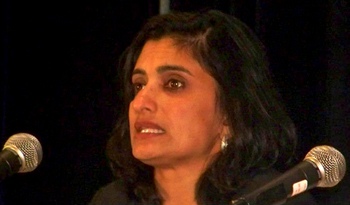
seema"I am pleased to nominate (Dr) Seema Verma to serve as Administrator of the Centers for Medicare and Medicaid Services," Trump said in a statement.

The announcement came along with Trump's nomination of Congressman Tom Price as his Health and Human Services Secretary.

A leading expert in the country on Medicare and Medicaid, Verma would serve as Administrator of Centers for Medicare and Medicaid Services.

"She has decades of experience advising on Medicare and Medicaid policy and helping states navigate our complicated systems. Together, Chairman Price and Seema Verma are the dream team that will transform our healthcare system for the benefit of all Americans," Trump said.

"I am honoured to be nominated by President-elect Trump today," said Verma, who met Trump in New York last week.

"I look forward to helping him tackle our nation's daunting healthcare problems in a responsible and sustainable way," she said.

Her nomination comes days after Indian-American Nikki Haley was named as US envoy to the United Nations by Trump.

Haley had scripted history by becoming the first-ever Indian-American to be appointed to a cabinet-level post in any US administration.

Verma currently is the President, CEO and founder of SVC, Inc, a national health policy consulting company.

Based in Indianapolis, Verma has supported Indiana through development of the historic programme since its inception in 2007, from development of the enabling legislation, negotiating the financing plan with the state's hospital association, developing the federal waiver, supporting federal negotiations and leading the implementation of the programme, including the operational design.

For more than 20 years, she has worked extensively on a variety of policy and strategic projects involving Medicaid, insurance, and public health, working with Governors' offices, state medicaid agencies, state health departments, state departments of insurance, as well as the federal government, private companies and foundations.

"Verma has extensive experience redesigning Medicaid programmes in several states. Verma is the architect of the Healthy Indiana Plan (HIP), the nation's first consumer directed Medicaid programme under Governor Mitch Daniels of Indiana and then-Governor Pence's HIP 2.0 waiver proposal," said the presidential transition team.

Verma received her Master's degree in Public Health, with a concentration in health policy and management from Johns Hopkins University, and her Bachelor's degree in Life Sciences from the University of Maryland.

She served as the state of Indiana's health reform lead following the passage of Obamacare in 2010.

Comments

Add new comment

  • Coastaldigest.com reserves the right to delete or block any comments.
  • Coastaldigset.com is not responsible for its readers’ comments.
  • Comments that are abusive, incendiary or irrelevant are strictly prohibited.
  • Please use a genuine email ID and provide your name to avoid reject.
News Network
June 4,2020

New York, Jun 4: The Minneapolis police officer who used his knee to pin down George Floyd's neck before his death was the most experienced of the four officers involved in the arrest, with a record that included medals for bravery and 17 complaints against him, including one for pulling a woman out of her car during a speeding stop.

New details about Derek Chauvin and the other now-fired officers emerged Wednesday after prosecutors upgraded Chauvin's charge to second-degree murder and charged the others with aiding and abetting in a case that has convulsed the nation with protests over race and police brutality.

Heavily redacted personnel files show that Chauvin, a 19-year veteran of the force, was initially trained as a cook and served in the Army as a military police officer.

Eleven-year veteran and native Hmong speaker Tou Thao began as a community service officer and was the subject of six complaints.

The other two officers were relative newcomers to the department, including Thomas Lane, a former juvenile detention guard who did volunteer work with Somali refugees, and J. Alexander Kueng, who got his start in law enforcement by patrolling his college campus and a department store.

The files were notable for what they didn't include. Only one of the 17 complaints against Chauvin was detailed, none of the six against Thao were mentioned and there was no further detail about a 2017 excessive force lawsuit against Thao.

Records show that the 44-year-old Chauvin initially studied cooking before taking courses in law enforcement and doing two stints in the Army as a military police officer in the late 1990s, serving at Fort Benning, Georgia, and in Germany.

Chauvin became a Minneapolis police officer in 2001 and the lone reprimand in his file involved a 2007 incident when he was accused of pulling a woman out of her car after stopping her for going 10 mph (16 kph) over the speed limit.

Investigators found it was not necessary for Chauvin to remove the woman from the car and noted that his squad car video was turned off during the stop.

But Chauvin was also singled out for bravery. Files show he won two medals of valor, one in 2006 for being part of a group of officers who opened fire on a stabbing suspect who pointed a shotgun at them, and another in 2008 for a domestic violence incident in which Chauvin broke down a bathroom door and shot a suspect in the stomach.

He also won medals of commendation in 2008 after he and his partner tackled a fleeing suspect who had a pistol in his hand, and in 2009 for single-handedly apprehending a group of gang members while working as an off-duty security guard at the El Nuevo Rodeo, a Minneapolis nightclub.

Since his arrest, the former owner of the club, Maya Santamaria, said Chauvin and Floyd both worked as security guards there at various times but that she wasn't sure if they had known one another.

She said Chauvin was unnecessarily aggressive on nights when the club had a black clientele, quelling fights by dousing the crowd with pepper spray and calling in several police squad cars as backup, a tactic she called “overkill.”

Chauvin's wife, Kellie, a Laotian immigrant who became the first Hmong winner of the Mrs. Minnesota pageant, said shortly after his arrest last week that she intends to divorce him.

Before news of the upgraded charges, an attorney for Chauvin said he was not making any statements at this time. Lawyers for the others did not return messages seeking comment.

In cellphone video of the May 25 arrest of Floyd, Chauvin is shown pressing his knee onto Floyd's neck for more than eight minutes while Floyd cries out “I can't breathe” and eventually stops moving.

During much of the arrest, Kueng and Lane were helping Chauvin restrain Floyd. Thao was standing nearby keeping onlookers back.

According the complaint, at one point during the arrest, as Chauvin held Floyd down with his knee, Lane asked Chauvin twice whether they should roll Floyd over.

“No, staying put where we got him,” Chauvin replied, “I am worried about excited delirium or whatever,” Lane said. And Chauvin replied again, “That's why we have him on his stomach.” None of the three officers moved from their positions.

Lane joined the police early last year as a 35-year-old cadet — much older than most rookies — and became a full-fledged officer last December. He had no complaints in his file during his short time on the force.

On employment forms, the University of Minnesota graduate said he done volunteer work tutoring Somali youth and as a mentor helping at-risk elementary school students with reading and homework.”

Kueng, at 26 the youngest of the four officers, was also a recent recruit to the police force. He completed his year's probation just three months before the Floyd arrest.

His personnel file, which notes that he speaks, reads and writes Russian, did not include any commendations or disciplinary actions during his short time on force.

Kueng was a 2018 graduate of the University of Minnesota, where he worked part-time as part of the campus security force. He also worked nearly three years as a theft-prevention officer at Macy's.

Thao joined the police force part-time in 2008 while attending a community college. Before that, he worked as a security guard, a supermarket stocker and trainer at McDonald's.

City records show six complaints were filed against Thao, but there was no mention of that in the records released Wednesday. There also was no mention of a 2017 federal lawsuit accusing him and another officer of excessive force.

According to the lawsuit, Lamar Ferguson claimed that in 2014, Thao and his partner stopped him and beat him up while he was on his way to his girlfriend's house. The lawsuit was settled for $25,000 ___

Richmond reported from Madison, Wisconsin. Associated Press writer Scott Bauer in Madison and researcher Rhonda Shafner in New York contributed to this report.


Comments

Add new comment

  • Coastaldigest.com reserves the right to delete or block any comments.
  • Coastaldigset.com is not responsible for its readers’ comments.
  • Comments that are abusive, incendiary or irrelevant are strictly prohibited.
  • Please use a genuine email ID and provide your name to avoid reject.
Agencies
March 25,2020

Beijing:  Around 5,000 people have signed up for the phase I clinical trial of recombinant novel coronavirus vaccine in Chinese city Wuhan where the virus first emerged late last year.

The recruitment for participants ended this week with nearly 5,000 volunteers signing up for the trial, state-run Beijing News reported on Wednesday.

A single-centre, open and dose-escalation phase I clinical trial for recombinant novel coronavirus vaccine (adenoviral vector) will be tested in healthy adults aged between 18 and 60 years, according to the ChiCTR (China Clinical Trial Register).

The trial, led by experts from the Academy of Military Medical Sciences, gained its approval on March 16 and the research is expected to last half a year.

Requiring at least 108 participants, the trial will be conducted in Wuhan, capital of Hubei province, the region worst-affected by the virus in the country, state-run China Daily reported.

Participants will experience 14-day quarantine restrictions after being vaccinated and their health condition will be recorded every day.

Chinese scientists are hastening the development of COVID-19 vaccines through five approaches --- inactivated vaccines, genetic engineering subunit vaccines, adenovirus vector vaccines, nucleic acid vaccines and vaccines using attenuated influenza virus as vectors.

So far, most teams are expected to complete preclinical research in April and some are moving forward faster, Wang Junzhi, an academician with the Chinese Academy of Engineering said.

Wang noted that research and development of COVID-19 vaccines in China is not slower than foreign counterparts and has been carried out in a scientific, standardised and orderly way.

China has stepped up the process to finalise vaccines to counter COVID-19 after Kaiser Permanente research facility in Seattle and Washington stole the march and began human trials.

China lifted tough restrictions on the Hubei province on Wednesday after a months-long lockdown as the country reported no new domestic cases.

But there were another 47 imported infections from overseas, the National Health Commission said. In total, 474 imported infections have been diagnosed in China -- mostly Chinese nationals returning home.

Comments

Add new comment

  • Coastaldigest.com reserves the right to delete or block any comments.
  • Coastaldigset.com is not responsible for its readers’ comments.
  • Comments that are abusive, incendiary or irrelevant are strictly prohibited.
  • Please use a genuine email ID and provide your name to avoid reject.
News Network
May 8,2020

May 8: Thousands of migrants have been stranded “all over the world” where they face a heightened risk of COVID-19 infection, the head of the UN migration agency International Organization for Migration (IOM) has said.

IOM Director-General António Vitorino said that more onerous health-related travel restrictions might discriminate disproportionately against migrant workers in future.

“Health is the new wealth,” Vitorino said, citing proposals by some countries to introduce the so-called immunity passports and use mobile phone apps designed to prevent the spread of the new coronavirus.

“In lots of countries in the world, we already have a system of screening checks to identify the health of migrants, above all malaria, tuberculosis… HIV-AIDS, and now I believe that there will be increased demands in health controls for regular migrants,” he said on Thursday.

Travel restrictions to try to limit the spread of the pandemic has left people on the move more vulnerable than ever and unable to work to support themselves, Vitorino told journalists via videoconference.

“There are thousands of stranded migrants all over the world.

 “In South-East Asia, in East Africa, in Latin America, because of the closing of the borders and with the travel restrictions, lots of migrants who were on the move; some of them wanted to return precisely because of the pandemic,” he said.

They are blocked, some in large groups, some in small, in the border areas, in very difficult conditions without access to minimal care, especially health screening, Vitorino said.

“We have been asking the governments to allow the humanitarian workers and the health workers to have access to (them),” he said.

Turning to Venezuelan migrants, who are believed to number around five million amidst a worsening economic crisis in the country, the IOM chief said “thousands… have lost their jobs in countries like Ecuador and Colombia and are returning back to Venezuela in large crowds without any health screening and being quarantined when they go back”.

In a statement, the IOM highlighted the plight of migrants left stranded in the desert in west, central and eastern Africa, either after having been deported without the due process, or abandoned by the smugglers.

The IOM’s immediate priorities for migrants include ensuring that they have access to healthcare and other basic social welfare assistance in their host country.

Among the UN agency’s other immediate concerns is preventing the spread of new coronavirus infection in more than 1,100 camps that it manages across the world.

They include the Cox’s Bazar complex in Bangladesh, home to around one million mainly ethnic Rohingya from Myanmar, the majority having fled persecution.

So far, no cases of infection have been reported there, the IOM chief said, adding that preventative measures have been communicated to the hundreds of thousands of camp residents, while medical capacity has been boosted.

Beyond the immediate health threat of COVID-19 infection, migrants also face growing stigmatization from which they need protection, Vitorino said.

Allowing hate speech and xenophobic narratives to thrive unchallenged also threatens to undermine the public health response to COVID-19, he said, before noting that migrant workers make up a significant percentage of the health sector in many developed countries including the UK, the US and Switzerland.

Populist narratives targeting migrants as carriers of disease could also destabilise national security through social upheaval and countries’ post-COVID economic recovery by removing critical workers in agriculture and service industries, he said.

Remittances have already seen a 30 per cent drop during the pandemic, Vitorino said, citing the World Bank data, meaning that some USD 20 billion has not been sent home to families in countries where up to 15 per cent of their gross domestic product comes from pay packets earned abroad.

Vitorino, in a plea, urged to give the health of migrants as much attention as that of the host populations in all countries.

“It is quite clear that health is the new wealth and that health concerns will be introduced in the mobility systems - not just for migration - but as a whole; where travelling for business or professional reasons, health will be the new gamechanger in town.

“If the current pandemic leads to a two or even three-tier mobility system, then we will have to try to solve the problem – the problem of the pandemic - but at the same time we have created a new problem of deepening the inequalities,” he said.

Comments

Add new comment

  • Coastaldigest.com reserves the right to delete or block any comments.
  • Coastaldigset.com is not responsible for its readers’ comments.
  • Comments that are abusive, incendiary or irrelevant are strictly prohibited.
  • Please use a genuine email ID and provide your name to avoid reject.