


Trump nominates 2nd Indian woman to top administration post

November 29, 2016

Washington, Nov 29: US President-elect Donald Trump today nominated a second Indian-American woman to a top administration position, putting her in charge of a federal agency within the health department as part of a "dream team" which he said would transform America's healthcare system.
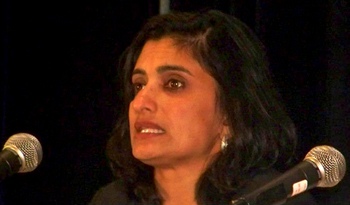
seema"I am pleased to nominate (Dr) Seema Verma to serve as Administrator of the Centers for Medicare and Medicaid Services," Trump said in a statement.

The announcement came along with Trump's nomination of Congressman Tom Price as his Health and Human Services Secretary.

A leading expert in the country on Medicare and Medicaid, Verma would serve as Administrator of Centers for Medicare and Medicaid Services.

"She has decades of experience advising on Medicare and Medicaid policy and helping states navigate our complicated systems. Together, Chairman Price and Seema Verma are the dream team that will transform our healthcare system for the benefit of all Americans," Trump said.

"I am honoured to be nominated by President-elect Trump today," said Verma, who met Trump in New York last week.

"I look forward to helping him tackle our nation's daunting healthcare problems in a responsible and sustainable way," she said.

Her nomination comes days after Indian-American Nikki Haley was named as US envoy to the United Nations by Trump.

Haley had scripted history by becoming the first-ever Indian-American to be appointed to a cabinet-level post in any US administration.

Verma currently is the President, CEO and founder of SVC, Inc, a national health policy consulting company.

Based in Indianapolis, Verma has supported Indiana through development of the historic programme since its inception in 2007, from development of the enabling legislation, negotiating the financing plan with the state's hospital association, developing the federal waiver, supporting federal negotiations and leading the implementation of the programme, including the operational design.

For more than 20 years, she has worked extensively on a variety of policy and strategic projects involving Medicaid, insurance, and public health, working with Governors' offices, state medicaid agencies, state health departments, state departments of insurance, as well as the federal government, private companies and foundations.

"Verma has extensive experience redesigning Medicaid programmes in several states. Verma is the architect of the Healthy Indiana Plan (HIP), the nation's first consumer directed Medicaid programme under Governor Mitch Daniels of Indiana and then-Governor Pence's HIP 2.0 waiver proposal," said the presidential transition team.

Verma received her Master's degree in Public Health, with a concentration in health policy and management from Johns Hopkins University, and her Bachelor's degree in Life Sciences from the University of Maryland.

She served as the state of Indiana's health reform lead following the passage of Obamacare in 2010.

Comments

Add new comment

  • Coastaldigest.com reserves the right to delete or block any comments.
  • Coastaldigset.com is not responsible for its readers’ comments.
  • Comments that are abusive, incendiary or irrelevant are strictly prohibited.
  • Please use a genuine email ID and provide your name to avoid reject.
Agencies
March 26,2020

Madrid, Mar 26: More than three billion people around the world were living under lockdown on Wednesday as governments stepped up their efforts against the coronavirus pandemic which has left more than 20,000 people dead.

As the number of confirmed cases worldwide soared past 450,000, UN Secretary General Antonio Guterres warned that only a concerted global effort could stop the spread of the virus.

In Spain, the number of fatalities surpassed those of China, where the novel coronavirus first emerged three months ago, making it the hardest-hit nation after Italy.

A total of more than 20,800 deaths have now been reported in 182 countries and territories, according to an AFP tally.

Stock markets rebounded after the US Congress moved closer to passing a $2.2 trillion relief package to prop up a teetering US economy.

In Washington, President Donald Trump said New York, the epicenter of the US outbreak with over 30,000 cases, likely has a few "tough weeks" ahead but he would decide soon whether unaffected parts of the country can get back to work.

"We want to get our country going again," Trump said. "I'm not going to do anything rash or hastily.

"By Easter we'll have a recommendation and maybe before Easter," said Trump, who had been touting a strong US economy as he faces an election in November.

UN chief Guterres said the world needs to ban together to stem the pandemic.

"COVID-19 is threatening the whole of humanity -- and the whole of humanity must fight back," Guterres said, launching an appeal for $2 billion to help the world's poor.

"Global action and solidarity are crucial," he said. "Individual country responses are not going to be enough."

India's stay-at-home order for its 1.3 billion people is now the biggest, taking the total number of individuals facing restrictions on their daily lives to more than three billion.

Anxious Indians raced for supplies after the world's second-biggest population was ordered not to leave their houses for three weeks.

Russia, which announced the death of two patients who tested positive for coronavirus on Wednesday, is expected to follow suit.

President Vladimir Putin declared next week a public holiday and postponed a public vote on controversial constitutional reforms, urging people to follow instructions given by authorities.

In Britain, heir to the throne Prince Charles became the latest high-profile figure to be infected, though he has suffered only mild symptoms.

The G20 major economies will hold an emergency videoconference on Thursday to discuss a global response to the crisis, as will the 27 leaders of the European Union, the outbreak's new epicenter.

China has begun to relax its own draconian restrictions on free movement in the province of Hubei -- where the outbreak began in December -- after the country reported no new cases.

Crowds jammed trains and buses in the province as people took their first opportunity to travel.

But Spain saw the number of deaths surge to more than 3,400 after 738 people died in the past 24 hours and the government announced a 432-million-euro ($467 million) deal to buy medical supplies from Beijing.

The death toll in Italy jumped in 24 hours by 683 to 7,503 -- by far the highest of any country.

The number of French deaths was up by 231 on Wednesday to more than 1,330, and metro and rail services in Paris were cut to a minimum.

Spain and Italy were joined by France and six more EU countries in urging Germany and the Netherlands to allow the issue of joint European bonds to cut borrowing costs and stabilise the eurozone economy.

The call is likely to fall on deaf ears when EU leaders talk on Thursday -- with northern members wary of pooling debt with big spenders -- but they will sign off on an "unprecedented" recovery plan.

At La Paz University Hospital in Madrid, nurse Guillen del Barrio sounded bereft as he related what happened overnight.

"It is really hard, we had feverish people for many hours in the waiting room," the 30-year-old told AFP.

"Many of my colleagues were crying because there were people who are dying alone, without seeing their family for the last time."

Coronavirus cases are also spreading in the Middle East, where Iran's death toll topped 2,000, and in Africa, where Mali declared its first case and several nations announced states of emergency.

In Japan, which has postponed this year's Olympic Games, Tokyo's governor urged residents to stay home this weekend, warning of a possible "explosion" of the coronavirus.

Jerusalem's Church of the Holy Sepulchre, believed by Christians to house Christ's tomb, was shut as Israel tightened movement restrictions.

The impact of the pandemic is also hitting European football, with leagues and tournaments cancelled, while the fate of the Wimbledon tennis tournament could be decided next week.

The economic damage of the virus -- and the lockdowns -- could also be devastating, with fears of a worldwide recession worse than the financial meltdown more than a decade ago.

But financial markets rose after US leaders reached agreement on a stimulus package worth roughly 10 percent of the US economy, an injection Senate Majority Leader Mitch McConnell said represented a "wartime level of investment."

Meanwhile, more than half of all Americans have been told to stay at home, including residents of the largest state, California.

The United States has at least 65,700 cases and 942 people have died.

Comments

Add new comment

  • Coastaldigest.com reserves the right to delete or block any comments.
  • Coastaldigset.com is not responsible for its readers’ comments.
  • Comments that are abusive, incendiary or irrelevant are strictly prohibited.
  • Please use a genuine email ID and provide your name to avoid reject.
Agecnies
July 13,2020

Moscow, Jul 13: Russia has become the first nation to complete clinical trials of a COVID-19 vaccine on humans. Chief researcher Elena Smolyarchuk, who heads the Center for Clinical Research on Medications at Sechenov University, told Russian news agency TASS on Sunday that the human trials for the vaccine have been completed at the university and the volunteers will be discharged soon.

"The research has been completed and it proved that the vaccine is safe. The volunteers will be discharged on July 15 and July 20," Smolyarchuk was quoted as saying in the report.

Though the results have been favourable with respect to the medication’s effectiveness, no further information was provided on when this vaccine would enter commercial production stage.

Russia had allowed clinical trials of two forms of a potential COVID-19 vaccine developed by the Gamaleya National Research Center for Epidemiology and Microbiology on June 18.

The first vaccine, in the form of a solution for intramuscular administration, was carried out at the Burdenko Military Hospital.

Another vaccine, in the form of a powder for the preparation of a solution for intramuscular administration, was carried out at Sechenov First Moscow State Medical University.

The first stage of research on the vaccine at Sechenov University involved a group of 18 volunteers and the second group involved 20 volunteers.

After vaccination, all volunteers were expected to remain in isolation in a hospital for 28 days.

Earlier, results of the COVID-19 vaccine tests performed on a group of volunteers in Russia showed that they were developing immunity to the coronavirus.

"The data obtained by the Gamalei National Research Center for Epidemiology and Microbiology, proves that volunteers of the first and second groups are forming an immune response after injections of the vaccine against the coronavirus," according to an earlier statement from the Russian Defense Ministry.

Russia has reported 719,449 cases and 11,188 deaths to date.

There are at least 21 vaccines currently under key trials, according to the World Health Organisation (WHO).

The overall number of global COVID-19 cases crossed 12.9 million, while the deaths have increased to more than 5,69,000, according to Johns Hopkins University in the US.

As of Monday morning, the total number of cases stood at 1,29,10,357, while the fatalities rose to 5,69,128.

The US accounted for the world's highest number of infections at over 33 lakh. Brazil came in the second place with over 18 lakh infections. India is third worst affected with over 8.7 lakh people reported to have COVID-19.

Comments

Add new comment

  • Coastaldigest.com reserves the right to delete or block any comments.
  • Coastaldigset.com is not responsible for its readers’ comments.
  • Comments that are abusive, incendiary or irrelevant are strictly prohibited.
  • Please use a genuine email ID and provide your name to avoid reject.
News Network
June 19,2020

United Nations, Jun 19: Half of the world's children -- one billion every year -- are affected by physical, sexual or psychological violence, suffering injuries and death because countries have failed to follow established strategies to protect them, the first report of its kind from the UN has said, with experts noting that the coronavirus-related lockdowns have left far too many youngsters stuck with their abusers.

While nearly all countries (88 per cent) have laws in place to protect minors, less than half (47 per cent) say they strongly enforce them, said the Global Status Report on Preventing Violence Against Children 2020 launched on Thursday.

Because countries have failed to follow established strategies to protect children, about one billion are affected each year by physical, sexual or psychological violence, it said.

"There is never any excuse for violence against children," WHO Director-General Tedros Adhanom Ghebreyesus said.

"We have evidence-based tools to prevent it, which we urge all countries to implement. Protecting the health and well-being of children is central to protecting our collective health and well-being, now and for the future," he said.

The report -- launched by the World Health Organisation, the UNICEF, the UNESCO, the Special Representative of the UN Secretary-General on Violence against Children and the End Violence Partnership -- charted progress in 155 countries against the "INSPIRE" framework, a set of seven strategies for preventing and responding to violence against children.

The report signaled a clear need in all countries to scale up efforts to implement them. It included the first ever global homicide estimates specifically for children under 18 years of age -- previous estimates were based on data that included 18 to 19-year olds.

According to the findings, in 2017, around 40,000 children were victims of homicide.

"Violence against children has always been pervasive, and now things could be getting much worse," UNICEF Executive Director Henrietta Fore said.

"Lockdowns, school closures and movement restrictions have left far too many children stuck with their abusers, without the safe space that school would normally offer. It is urgent to scale up efforts to protect children during these times and beyond, including by designating social service workers as essential and strengthening child helplines," she said.

UNESCO Director-General Audrey Azoulay said during the COVID-19 pandemic, and the related school closures, "we have seen a rise in violence and hate online – and this includes bullying".

"Now, as schools begin to re-open, children are expressing their fears about going back to school. It is our collective responsibility to ensure that schools are safe environments for all children. We need to think and act collectively to stop violence at school and in our societies at large," Azoulay said.

Stay-at-home measures including school closures have limited the usual sources of support for families and individuals such as friends, extended family or professionals.

This further erodes victims’ ability to successfully cope with crises and the new routines of daily life. Spikes in calls to helplines for child abuse and intimate partner violence have been observed, the report said.

While online communities have become central to maintain many children's learning, support and play, an increase in harmful online behaviors including cyberbullying, risky online behavior and sexual exploitation have been identified.

“Whilst this report was being finalised, confinement measures and the disrupted provision of already limited child protection services exacerbated the vulnerability of children to various forms of violence," said Najat Maalla M’jid, Special Representative of the UN Secretary-General on Violence against Children.

Of the INSPIRE strategies, only access to schools through enrolment showed the most progress with 54 per cent of the countries reporting that a sufficient number of children in need were being reached in this way.

Between 32 per cent and 37 per cent of the countries considered that victims of violence could access support services, while 26 per cent of the countries provided programmes on parent and caregiver support; 21 per cent of the countries had programmes to change harmful norms; and 15 per cent of the countries had modifications to provide safe physical environments for children, the report said.

Although a majority of countries (83 per cent) have national data on violence against children, only 21 per cent used these to set baselines and national targets to prevent and respond to violence against children, it added.

The report said about 80 per cent of countries have national plans of action and policies but only one-fifth have plans that are fully funded or have measurable targets. A lack of funding combined with inadequate professional capacity are likely contributing factors and a reason why implementation has been slow.

"Ending violence against children is the right thing to do, a smart investment to make - and it's possible. We can and must create a world where every child can thrive," Howard Taylor of the End Violence Partnership said.

Comments

Add new comment

  • Coastaldigest.com reserves the right to delete or block any comments.
  • Coastaldigset.com is not responsible for its readers’ comments.
  • Comments that are abusive, incendiary or irrelevant are strictly prohibited.
  • Please use a genuine email ID and provide your name to avoid reject.