


Trump nominates 2nd Indian woman to top administration post

November 29, 2016

Washington, Nov 29: US President-elect Donald Trump today nominated a second Indian-American woman to a top administration position, putting her in charge of a federal agency within the health department as part of a "dream team" which he said would transform America's healthcare system.
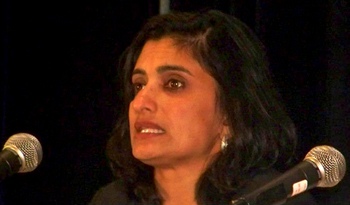
seema"I am pleased to nominate (Dr) Seema Verma to serve as Administrator of the Centers for Medicare and Medicaid Services," Trump said in a statement.

The announcement came along with Trump's nomination of Congressman Tom Price as his Health and Human Services Secretary.

A leading expert in the country on Medicare and Medicaid, Verma would serve as Administrator of Centers for Medicare and Medicaid Services.

"She has decades of experience advising on Medicare and Medicaid policy and helping states navigate our complicated systems. Together, Chairman Price and Seema Verma are the dream team that will transform our healthcare system for the benefit of all Americans," Trump said.

"I am honoured to be nominated by President-elect Trump today," said Verma, who met Trump in New York last week.

"I look forward to helping him tackle our nation's daunting healthcare problems in a responsible and sustainable way," she said.

Her nomination comes days after Indian-American Nikki Haley was named as US envoy to the United Nations by Trump.

Haley had scripted history by becoming the first-ever Indian-American to be appointed to a cabinet-level post in any US administration.

Verma currently is the President, CEO and founder of SVC, Inc, a national health policy consulting company.

Based in Indianapolis, Verma has supported Indiana through development of the historic programme since its inception in 2007, from development of the enabling legislation, negotiating the financing plan with the state's hospital association, developing the federal waiver, supporting federal negotiations and leading the implementation of the programme, including the operational design.

For more than 20 years, she has worked extensively on a variety of policy and strategic projects involving Medicaid, insurance, and public health, working with Governors' offices, state medicaid agencies, state health departments, state departments of insurance, as well as the federal government, private companies and foundations.

"Verma has extensive experience redesigning Medicaid programmes in several states. Verma is the architect of the Healthy Indiana Plan (HIP), the nation's first consumer directed Medicaid programme under Governor Mitch Daniels of Indiana and then-Governor Pence's HIP 2.0 waiver proposal," said the presidential transition team.

Verma received her Master's degree in Public Health, with a concentration in health policy and management from Johns Hopkins University, and her Bachelor's degree in Life Sciences from the University of Maryland.

She served as the state of Indiana's health reform lead following the passage of Obamacare in 2010.

Comments

Add new comment

  • Coastaldigest.com reserves the right to delete or block any comments.
  • Coastaldigset.com is not responsible for its readers’ comments.
  • Comments that are abusive, incendiary or irrelevant are strictly prohibited.
  • Please use a genuine email ID and provide your name to avoid reject.
Agencies
August 7,2020

Russia boasts that it's about to become the first country to approve a Covid-19 vaccine, with mass vaccinations planned as early as October using shots that are yet to complete clinical trials -- and scientists worldwide are sounding the alarm that the headlong rush could backfire.

Moscow sees a Sputnik-like propaganda victory, recalling the Soviet Union's launch of the world's first satellite in 1957.

But the experimental Covid-19 shots began first-in-human testing on a few dozen people less than two months ago, and there's no published scientific evidence yet backing Russia's late entry to the global vaccine race, much less explaining why it should be considered a front-runner.

“I'm worried that Russia is cutting corners so that the vaccine that will come out may be not just ineffective, but also unsafe,” said Lawrence Gostin, a global public health law expert at Georgetown University. “It doesn't work that way... Trials come first. That's really important.”

According to Kirill Dmitriev, head of Russia's Direct Investment Fund that bankrolled the effort, a vaccine developed by the Gamaleya research institute in Moscow may be approved in days, before scientists complete what's called a Phase 3 study.

That final-stage study, usually involving tens of thousands of people, is the only way to prove if an experimental vaccine is safe and really works.

Health Minister Mikhail Murashko said members of “risk groups,” such as medical workers, may be offered the vaccine this month.

He didn't clarify whether they would be part of the Phase 3 study that is said to be completed after the vaccine receives “conditional approval.”

Deputy Prime Minister Tatyana Golikova promised to start “industrial production” in September, and Murashko said mass vaccination may begin as early as October.

Dr Anthony Fauci, the top US infectious disease specialist, questioned the fast-track approach last week.

“I do hope that the Chinese and the Russians are actually testing a vaccine before they are administering the vaccine to anyone, because claims of having a vaccine ready to distribute before you do testing I think is problematic at best," he said.

Questions about this vaccine candidate come after the US, Britain and Canada last month accused Russia of using hackers to steal vaccine research from Western labs.

Delivering a vaccine first is a matter of national prestige for the Kremlin as it tries to assert the image of Russia as a global power capable of competing with the US and China.

The notion of being “the first in the world” dominated state news coverage of the effort, with government officials praising reports of the first-step testing.

In April, President Vladimir Putin ordered state officials to shorten the time of clinical trials for a variety of drugs, including potential coronavirus vaccines.

According to Russia's Association of Clinical Trials Organizations, the order set “an unattainable bar” for scientists who, as a result, "joined in on the mad race, hoping to please those at power.”

The association first raised concern in late May, when professor Alexander Gintsburg, head of the Gamaleya institute, said he and other researchers tried the vaccine on themselves.

The move was a “crude violation of the very foundations of clinical research, Russian law and universally accepted international regulations" the group said in an open letter to the government, urging scientists and health officials to adhere to clinical research standards.

But a month later, the Health Ministry authorized clinical trials of the Gamaleya product, with what appeared to be another ethical issue.

Human studies started June 17 among 76 volunteers. Half were injected with a vaccine in liquid form and the other half with a vaccine that came as soluble powder.

Some in the first half were recruited from the military, which raised concerns that servicemen may have been pressured to participate.

Some experts said their desire to perform well would affect the findings. “It's no coincidence media reports we see about the trials among the military said no one had any side effects, while the (other group) reported some," said Vasily Vlassov, a public health expert with Moscow's Higher School of Economics.

As the trials were declared completed and looming regulatory approval was announced last week, questions arose about the vaccine's safety and effectiveness.

Government assurances the drug produced the desired immune response and caused no significant side effects were hardly convincing without published scientific data describing the findings.

The World Health Organization said all vaccine candidates should go through full stages of testing before being rolled out.

“There are established practices and there are guidelines out,” WHO spokesman Christian Lindmeier said Tuesday.

“Between finding or having a clue of maybe having a vaccine that works, and having gone through all the stages, is a big difference.”

Offering an unsafe compound to medical workers on the front lines of the outbreak could make things worse, Georgetown's Gostin said, adding: “What if the vaccine started killing them or making them very ill?”

Vaccines that are not properly tested can cause harm in many ways — from a negative impact on health to creating a false sense of security or undermining trust in vaccinations, said Thomas Bollyky, director of the global health program at the Council on Foreign Relations. 

Comments

Add new comment

  • Coastaldigest.com reserves the right to delete or block any comments.
  • Coastaldigset.com is not responsible for its readers’ comments.
  • Comments that are abusive, incendiary or irrelevant are strictly prohibited.
  • Please use a genuine email ID and provide your name to avoid reject.
Agencies
March 15,2020

Houston, Mar 15: Researchers, studying the novel coronavirus, have found that the time between cases in a chain of transmission is less than a week, and over 10 per cent of patients are infected by someone who has the virus, but does not show symptoms yet, a finding that may help public health officials contain the pandemic.

The study, published in the journal Emerging Infectious Diseases, estimated what's called the serial interval of the coronavirus by measuring the time it takes for symptoms to appear in two people with the virus -- the person who infects another, and the infected second person.

According to the researchers, including those from the University of Texas at Austin, the average serial interval for the novel coronavirus in China was approximately four days.

They said the speed of an epidemic depends on two things -- how many people each case infects, and how long it takes cases to spread.

The first quantity, the scientists said, is called the reproduction number, and the second is the serial interval.

Due to the short serial interval of the disease caused by the coronavirus -- COVID-19 -- they said, emerging outbreaks will grow quickly, and could be difficult to stop.

“Ebola, with a serial interval of several weeks, is much easier to contain than influenza, with a serial interval of only a few days,” said Lauren Ancel Meyers, study co-author from UT Austin.

Meyers explained that public health responders to Ebola outbreaks have much more time to identify and isolate cases before they infect others.

“The data suggest that this coronavirus may spread like the flu. That means we need to move quickly and aggressively to curb the emerging threat,” Meyers added.

In the study, the scientists examined more than 450 infection case reports from 93 cities in China, and found the strongest evidence yet that people without symptoms must be transmitting the virus -- known as pre-symptomatic transmission.

More than one in ten infections were from people who had the virus but did not yet feel sick, the scientists said.

While researchers across the globe had some uncertainty until now about asymptomatic transmission with the coronavirus, the new evidence could provide guidance to public health officials on how to contain the spread of the disease.

“This provides evidence that extensive control measures including isolation, quarantine, school closures, travel restrictions and cancellation of mass gatherings may be warranted,” Meyers said.

The researchers cautioned that asymptomatic transmission makes containment more difficult.

With hundreds of new cases emerging around the world every day, the scientists said, the data may offer a different picture over time.

They said infection case reports are based on people's memories of where they went and whom they had contact with, and if health officials move quickly to isolate patients, that may also skew the data.

“Our findings are corroborated by instances of silent transmission and rising case counts in hundreds of cities worldwide. This tells us that COVID-19 outbreaks can be elusive and require extreme measures,” Meyers said.

Comments

Add new comment

  • Coastaldigest.com reserves the right to delete or block any comments.
  • Coastaldigset.com is not responsible for its readers’ comments.
  • Comments that are abusive, incendiary or irrelevant are strictly prohibited.
  • Please use a genuine email ID and provide your name to avoid reject.
News Network
May 30,2020

May 30: Warning of the tightrope walk ahead as governments battle the coronavirus crisis, Nobel laureate Peter Charles Doherty has expressed concern about densely populated countries such as India relaxing lockdown norms while also describing a complete shutdown as “an economic and social impossibility”.

The Australian immunologist, who cautioned that the number of COVID-19 cases will rise in the coming days, said the earliest time frame for an effective vaccine “going into large numbers of people” is nine to 12 months.

"If all goes well with testing, we could know if some of the candidate vaccines are both safe and effective as early as September/October. Then, rolling a vaccine out will depend on the type of product and how quickly it can be made, put in vials and so forth," Doherty told PTI in an email interview from Melbourne.

The novel coronavirus, he added, does not change fast like influenza and, from what is known so far, “the same vaccine should work everywhere”.

Doherty, who is with the Department of Microbiology and Immunology at the Doherty Institute, University of Melbourne, won the Nobel Prize for Medicine in 1996 for his discovery of how the body’s immune system distinguishes virus-infected cells from normal ones.

Discussing the lockdown, he said, "If it was purely a matter of hard science, everywhere should stay locked down. But that’s pretty much an economic and social impossibility.”

The expectation, he said, is the numbers will rise and limiting spread will depend on people acting responsibly and the capacity for rapid response and extensive contact testing.

“And in a densely populated country like India I think that it will be very difficult," the scientist said.

Several countries, including India, began relaxing lockdown norms in mid-May despite the WHO’s warning about a second wave. India’s lockdown began on March 25 and has since been extended. The fourth phase ends on Sunday.

Asked whether there are any alternatives to a lockdown, the 79-year-old said, "There is no other option other than closing borders. South Korea, for example, conducted massive, intensive testing and contact tracing in a wealthy country with a very disciplined population. Otherwise, not till we have effective vaccines."

He added that he personally doesn’t see the point of closing borders for people coming in if there’s already a high incidence of disease in the community, “unless it’s to avoid the need to care for them and use scarce hospital beds".

According to Doherty, the coronavirus "is a new virus which has come straight out of nature".

“It (the virus) has moved so rapidly across the world because of people travelling on international planes as well as tourist ships," he added.

The immunologist also warned against the use of hydroxychloroquine to treat COVID-19, and said current and planned trials of the anti-malaria drug should be stopped.

“My understanding is that the use of the drug in severe disease is definitely contra-indicated, but it’s not yet clear whether, if taken under medical supervision, it could have some useful effect if taken early on, or as a preventive. Those trials just haven’t been done properly," Doherty noted.

The Indian Council of Medical Research (ICMR) has backed the use of hydroxychloroquine as a preventive against COVID-19 even after the WHO suspended clinical trials of the drug citing safety concerns.

Asked whether plasma therapy can be an effective treatment for COVID-19, Doherty said, "We lack good properly controlled trials but, especially if the plasma has been tested for antibody levels and there’s evidence of good activity, it could be helpful. If I had the disease and was offered plasma therapy I would certainly accept, but I would not take hydroxychloroquine."

Doherty is also very optimistic about herd immunity developing against the SARS-CoV-2 infection.

"We think that (herd immunity) will cut in and have an obvious effect when, say, 60 per cent of people have been infected. Best hope is to boost herd immunity with a vaccine," he stated.

Herd immunity is a form of indirect protection from infectious disease that occurs when a large percentage of a population has become immune to an infection, whether through vaccination or previous infections.

The number of COVID-19 cases have crossed 5.9 million and the fatalities 3,65,000, according to the Johns Hopkins University on Saturday. 

In India, the death toll has risen to 4,971 and the number of cases to 1,73,763, according to the Union Health Ministry on Saturday.

Several states, including Bihar, Uttar Pradesh, Madhya Pradesh, Jharkhand and Chhattisgarh, have reported a rise in number since lockdown norms were relaxed in early May and migrant workers reached home.

In Uttar Pradesh, for instance, the number of infections rose from around 3,000 on May 4 to 6,532 on May 26. Similarly, Bihar’s numbers increased from around 500 to over 2,700 in the period.

Comments

Add new comment

  • Coastaldigest.com reserves the right to delete or block any comments.
  • Coastaldigset.com is not responsible for its readers’ comments.
  • Comments that are abusive, incendiary or irrelevant are strictly prohibited.
  • Please use a genuine email ID and provide your name to avoid reject.