


Trump nominates 2nd Indian woman to top administration post

November 29, 2016

Washington, Nov 29: US President-elect Donald Trump today nominated a second Indian-American woman to a top administration position, putting her in charge of a federal agency within the health department as part of a "dream team" which he said would transform America's healthcare system.
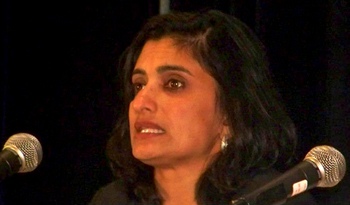
seema"I am pleased to nominate (Dr) Seema Verma to serve as Administrator of the Centers for Medicare and Medicaid Services," Trump said in a statement.

The announcement came along with Trump's nomination of Congressman Tom Price as his Health and Human Services Secretary.

A leading expert in the country on Medicare and Medicaid, Verma would serve as Administrator of Centers for Medicare and Medicaid Services.

"She has decades of experience advising on Medicare and Medicaid policy and helping states navigate our complicated systems. Together, Chairman Price and Seema Verma are the dream team that will transform our healthcare system for the benefit of all Americans," Trump said.

"I am honoured to be nominated by President-elect Trump today," said Verma, who met Trump in New York last week.

"I look forward to helping him tackle our nation's daunting healthcare problems in a responsible and sustainable way," she said.

Her nomination comes days after Indian-American Nikki Haley was named as US envoy to the United Nations by Trump.

Haley had scripted history by becoming the first-ever Indian-American to be appointed to a cabinet-level post in any US administration.

Verma currently is the President, CEO and founder of SVC, Inc, a national health policy consulting company.

Based in Indianapolis, Verma has supported Indiana through development of the historic programme since its inception in 2007, from development of the enabling legislation, negotiating the financing plan with the state's hospital association, developing the federal waiver, supporting federal negotiations and leading the implementation of the programme, including the operational design.

For more than 20 years, she has worked extensively on a variety of policy and strategic projects involving Medicaid, insurance, and public health, working with Governors' offices, state medicaid agencies, state health departments, state departments of insurance, as well as the federal government, private companies and foundations.

"Verma has extensive experience redesigning Medicaid programmes in several states. Verma is the architect of the Healthy Indiana Plan (HIP), the nation's first consumer directed Medicaid programme under Governor Mitch Daniels of Indiana and then-Governor Pence's HIP 2.0 waiver proposal," said the presidential transition team.

Verma received her Master's degree in Public Health, with a concentration in health policy and management from Johns Hopkins University, and her Bachelor's degree in Life Sciences from the University of Maryland.

She served as the state of Indiana's health reform lead following the passage of Obamacare in 2010.

Comments

Add new comment

  • Coastaldigest.com reserves the right to delete or block any comments.
  • Coastaldigset.com is not responsible for its readers’ comments.
  • Comments that are abusive, incendiary or irrelevant are strictly prohibited.
  • Please use a genuine email ID and provide your name to avoid reject.
News Network
May 30,2020

Washington, May 30: The United States will end its relationship with the World Health Organization over the body’s handling of the coronavirus pandemic, U.S. President Donald Trump said on Friday, accusing the U.N. agency of becoming a puppet of China.

The move to quit the Geneva-based body, which the United States formally joined in 1948, comes amid growing tensions between Washington and Beijing over the coronavirus outbreak. The virus first emerged in China’s Wuhan city late last year.

Speaking in the White House Rose Garden, Trump said Chinese officials “ignored their reporting obligations” to the WHO about the virus - that has killed hundreds of thousands of people globally - and pressured the agency to “mislead the world.”

“China has total control over the World Health Organization despite only paying $40 million per year compared to what the United States has been paying which is approximately $450 million a year,” he said.

Trump’s decision follows a pledge last week by Chinese President Xi Jinping to give $2 billion to the WHO over the next two years to help combat the coronavirus. The amount almost matches the WHO’s entire annual program budget for last year.

Trump last month halted funding for the 194-member organization, then in a May 18 letter gave the WHO 30 days to commit to reforms.

“Because they have failed to make the requested and greatly needed reforms, we will be today terminating our relationship with the World Health Organization and redirecting those funds to other worldwide and deserving urgent global public health needs,” Trump said on Friday.

It was not immediately clear when his decision would come into effect. A 1948 joint resolution of Congress on U.S. membership of the WHO said the country “reserves its right to withdraw from the organization on a one-year notice.”

The World Health Organization did not immediately respond to a request for comment on Trump’s announcement. It has previously denied Trump’s assertions that it promoted Chinese “disinformation” about the virus.

“It’s important to remember that the WHO is a platform for cooperation among countries,” said Donna McKay, executive director of Physicians for Human Rights. “Walking away from this critical institution in the midst of an historic pandemic will hurt people both in the United States and around the world.”

‘ABSOLUTELY CRITICAL’

The United States currently owes the WHO more than $200 million in assessed contributions, according to the WHO website. Washington also gives several hundred million dollars annually in voluntary funding tied to specific WHO programs such as polio eradication, HIV, hepatitis and tuberculosis.

Amesh A. Adalja, a senior scholar at Johns Hopkins Center for Health Security, said that in practice Trump’s decision was unlikely to change the operations of the WHO.

“From a symbolic or moral standpoint it’s the wrong type of action to be taking in the middle of a pandemic and seems to deflect responsibility for what we in the U.S. failed to do and blame the WHO,” said Adalja.

When Trump halted funding to the WHO last month, two Western diplomats said the U.S. suspension was more harmful politically to the WHO than to the agency’s current programs, which are funded for now.

The WHO is an independent international body that works with the United Nations. U.N. Secretary-General Antonio Guterres said last month that the WHO is “absolutely critical to the world’s efforts to win the war against COVID-19.”

When asked about Trump’s decision, a U.N. spokesman said: “We have consistently called for all states to support WHO.”

Trump has long scorned multilateralism as he focuses on an “America First” agenda. Since taking office, he has quit the U.N. Human Rights Council, the U.N. cultural agency, a global accord to tackle climate change and the Iran nuclear deal. He has also cut funding for the U.N. population fund and the U.N. agency that aids Palestinian refugees.

“The WHO is the world’s early warning system for infectious diseases,” said U.S. Representative Nita Lowey, a Democrat who chairs the House Committee on Appropriations. “Now, during a global pandemic that has cost over 100,000 American lives, is not the time to put the country further at risk.”

Comments

Add new comment

  • Coastaldigest.com reserves the right to delete or block any comments.
  • Coastaldigset.com is not responsible for its readers’ comments.
  • Comments that are abusive, incendiary or irrelevant are strictly prohibited.
  • Please use a genuine email ID and provide your name to avoid reject.
News Network
June 9,2020

Washington, Jun 9: When epidemiologists talked about "flattening the curve," they probably didn't mean it this way: the US hit its peak coronavirus caseload in April, but since that time the graph has been on a seemingly unending plateau.

That's unlike several other hard-hit countries which have successfully pushed down their numbers of new cases, including Spain and Italy, which now have bell-shaped curves.

Experts say the prolonged nature of the US epidemic is the result of the cumulative impact of regional outbreaks, as the virus that started out primarily on the coasts and in major cities moves inward.

Layered on top of that are the effects of lifting lockdowns in parts of the country that are experiencing rising cases, as well as a lapse in compliance with social distancing guidelines because of economic hardship, and in some cases a belief that the threat is overstated.

"The US is a large country both in geography and population, and the virus is at very different stages in different parts of the country," Tom Frieden, a former director of the Centers for Disease Control and Prevention told AFP.

The US saw more than 35,000 new cases for several days in April. While that figure has declined, it has still been exceeding 20,000 regularly in recent days.

By contrast, Italy was regularly hitting more than 5,000 cases per day in March but is currently experiencing figures in the low hundreds.

"We did not act quickly and robustly enough to stop the virus spreading initially, and data indicate that it travelled from initial hotspots along major transport routes into other urban and rural areas," added Frieden, now CEO of the non-profit Resolve to Save Lives.

To wit: the East Coast states of New York, New Jersey and Massachusetts accounted for about 50 percent of all cases until about a month or so ago -- but now the geographic footprint of the US epidemic has shifted to the Midwest and southeast, including Florida.

Another key problem, said Jennifer Nuzzo, an epidemiologist at Johns Hopkins, is that the United States is still not doing enough testing, contact tracing and isolation.

After coming late to the testing party -- for reasons ranging from technical issues to regulatory hurdles -- the US has now conducted more COVID-19 tests than any other country.

It even has one of the highest per capita rates per country of 62 per 1,000 people, according to the website ourworldindata.org -- better than Germany (52 per 1,000) and South Korea (20 per 1,000).

But according to Nuzzo, these numbers are misleading, because "the amount of testing that a country should do should be scaled to the size of its epidemic.

"The United States has the largest epidemic in the world so obviously we need to do a lot more testing than any other country."

For Johns Hopkins, the more important metric is the positivity rate -- that is, out of all tests conducted, how many came back positive for COVID-19.

As of June 7, the United States had an average daily positivity rate of 14 percent, well above the World Health Organization guideline of 5 percent over two weeks before social distancing guidelines should be relaxed.

By contrast, Germany, which has tested far fewer people in relation to its population, has a positivity rate of 5 percent.

Even if testing were scaled up, carrying out tests in of itself does very little good without the next steps -- finding out who was exposed and then asking them to isolate.

Here also, too many US states are lagging woefully behind.

Texas, which is experiencing a surge in cases after relaxing its lockdown, is a case in point. The state targeted hiring a modest 4,000 tracers by June, but according to local reports is still more than a thousand shy of even that goal.

Opt-in app based efforts have also been slow to get off the ground.

Then there is the fact that some people are growing tired of lockdowns, while others don't have the economic luxury of being able to stay home for prolonged periods.

The government sent some 160 million Americans a single stimulus check of up to $1,200 back in April but it's not clear whether more will be forthcoming.

Still others, particularly in so-called red states under Republican leadership, have chafed under restrictions and mask-wearing guidelines that they see as an affront to their personal freedom.

"The US is kind of on the extreme of the individual liberty side," Sten Vermund, dean of the Yale School of Public Health, told AFP.

Part of this has to do with mixed messaging from Republican leaders, including President Donald Trump, said Nuzzo.

"We have had at the highest political level an assertion that this is a situation that's been overblown, and that maybe certain protective behaviors are not necessary," she said.

More recently, tens of thousands of people across the country have taken to the streets to protest the killing on an unarmed black man by police, risking coronavirus infection to demonstrate against the public health threat of racialized state violence.

Comments

Add new comment

  • Coastaldigest.com reserves the right to delete or block any comments.
  • Coastaldigset.com is not responsible for its readers’ comments.
  • Comments that are abusive, incendiary or irrelevant are strictly prohibited.
  • Please use a genuine email ID and provide your name to avoid reject.
News Network
May 15,2020

May 15: Global tensions simmered over the race for a coronavirus vaccine Thursday, as the United States and China traded jabs, and France slammed pharmaceuticals giant Sanofi for suggesting the US would get any eventual vaccine first.

Scientists are working at breakneck speed to develop a vaccine for COVID-19, the disease caused by the virus, which has killed more than 300,000 people worldwide and pummelled economies.

From the US to Europe to Asia, national and local governments are easing lockdown orders to get people back to work -- while fretting over a possible second wave of infections.

Increased freedom of movement means an increased risk of contracting the virus, and so national labs and private firms are labouring to find the right formula for a vaccine.

The European Union's medicines agency offered some hope when it said one could be ready in a year, based on data from clinical trials already underway.

But Marco Cavaleri, the EMA's head of vaccines strategy, acknowledged that timeline was a "best-case scenario," and cautioned that "there may be delays."

The race for a vaccine has exposed a raw nerve in relations between the United States and China, where the virus was first detected late last year in the central city of Wuhan.

Two US agencies warned Wednesday that Chinese hackers were trying to steal COVID-19 vaccine research -- a claim Beijing rejected as "smearing" its reputation.

US President Donald Trump, who has ratcheted up the rhetoric against China, said he doesn't even want to engage with Chinese leader Xi Jinping -- potentially imperilling a trade deal between the world's top two economies.

"I'm very disappointed in China. I will tell you that right now," he said in an interview with Fox Business.

"There are many things we could do. We could do things. We could cut off the whole relationship."

On Capitol Hill, an ousted US health official told Congress that the Trump government had no strategy in place to find and distribute a vaccine to millions of Americans, warning of the "darkest winter" ahead.

"We don't have a single point of leadership right now for this response, and we don't have a master plan," said Rick Bright, who was removed last month as head of the US agency charged with developing a coronavirus vaccine.

The United States has registered nearly 86,000 deaths linked to COVID-19 -- the highest toll of any nation.

World leaders were among 140 signatories to a letter published Thursday saying any vaccine should not be patented and that the science should be shared among nations.

"Governments and international partners must unite around a global guarantee which ensures that, when a safe and effective vaccine is developed, it is produced rapidly at scale and made available for all people, in all countries, free of charge," it said.

But a row erupted in France after drugmaker Sanofi said it would reserve first shipments of any vaccine it discovered to the United States.

The comments prompted a swift rebuke from the French government -- President Emmanuel Macron's office said any vaccine should be treated as "a global public good, which is not submitted to market forces."

Sanofi chief executive Paul Hudson said the US had a risk-sharing model that allowed for manufacturing to start before a vaccine had been finally approved -- while Europe did not.

"The US government has the right to the largest pre-order because it's invested in taking the risk," Hudson told Bloomberg News.

Macron's top officials are scheduled to meet with Sanofi executives about the issue next week.

The search for a vaccine became even more urgent after the World Health Organization said the disease may never go away and the world would have to learn to live with it for good.

"This virus may become just another endemic virus in our communities and this virus may never go away," said Michael Ryan, the UN body's emergencies director.

The prospect of the disease lingering leaves governments facing a delicate balancing act between suppressing the pathogen and getting their economies up and running.

In the US, more grim economic data emerged Thursday, with nearly three million more Americans applying for unemployment benefits.

That takes the overall total to 36.5 million -- more than 10 percent of the US population.

Further signs of the damage to businesses emerged when Lloyd's of London forecast the pandemic will cost the global insurance industry about $203 billion.

European markets closed down, but Wall Street rallied despite the new jobless claims. In a sign of progress, the New York Stock Exchange trading floor was due to reopen on May 26.

The reopening of economies continued in earnest across Europe, where the EU has set out proposals for a phased restart of travel and the eventual lifting of border controls.

"Maybe it's a mistake, but we have no choice. Without tourists, we won't get by!" Enrico Facchetti, a 61-year-old former goldsmith, said of Venice's reopening.

Japan -- the world's third largest economy -- lifted a state of emergency across most of the country except for Tokyo and Osaka.

And Canadian Prime Minister Justin Trudeau said national parks would partially reopen on June 1.

But in Latin America, the virus continued to surge, with a 60 percent leap in cases in the Chilean capital of Santiago.

Authorities said 2,000 new graves were being dug at the main cemetery.

South Sudan reported its first COVID-19 death on Thursday.

And in Bangladesh, the first case was confirmed in the teeming Rohingya refugee camps in Bangladesh, which are home to nearly one million people.

Comments

Add new comment

  • Coastaldigest.com reserves the right to delete or block any comments.
  • Coastaldigset.com is not responsible for its readers’ comments.
  • Comments that are abusive, incendiary or irrelevant are strictly prohibited.
  • Please use a genuine email ID and provide your name to avoid reject.