



Trump Pushes Conspiracy Theory That 'Millions' Voted Illegally For Clinton

November 28, 2016

Washington, Nov 28: President-elect Donald Trump asserted that he would have won the US popular vote were it not for "millions of illegal" ballots, while dramatically sharpening his criticism of a recount in Wisconsin, calling it "a waste of time."
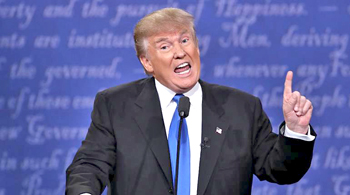
trumpaWith the recount threatening to revive debate about the legitimacy of Trump's victory -- his rival Hillary Clinton won far more popular votes, while he carried the all-important Electoral College count -- Trump and his aides pushed back hard yesterday.

Trump let fly a series of early-morning tweets in which he quoted Clinton about the need to respect the electoral process, while continuing to wage an extraordinarily public battle over the makeup of his future cabinet.

By late afternoon, Trump furthered that "In addition to winning the Electoral College in a landslide, I won the popular vote if you deduct the millions of people who voted illegally."

Trump had warned before the election that the result might be "rigged," but he had offered no such complaint after his unexpected victory November 8 -- until now.

Neither he nor any of his aides has offered any evidence of the "millions" alleged to have voted illegally, nor did Trump explain why he would oppose a recount if illegal voting was such a serious problem.

No election observers have pointed to any such widespread fraud. It was the latest bizarre twist in an increasingly rough and jolting presidential transition, with much of it fought on social media and on the nation's television screens.

Trump's top aide Kellyanne Conway, in the middle of the turbulence, appeared on Sunday to at least hint that if the Clinton team pushes too hard on the Wisconsin recount, the president-elect might rethink his vow not to seek Clinton's prosecution for using a private email server when she was secretary of state.

While the recount was requested by Green Party candidate Jill Stein, who received a minute fraction of the total vote in Wisconsin, Clinton's campaign has said it would join the process despite having seen no irregularities in the White House contest so far.

Conway said on ABC that while Trump was being "magnanimous" toward Clinton, "I guess her attitude towards that is to have her counsel go and join this ridiculous recount."

And Reince Priebus, Trump's chief of staff, said that while the president-elect is not "seeking methods and ways to persecute and prosecute Hillary Clinton," Trump would probably be "open to listening" should any new findings against her emerge from future investigations.

Comments

Add new comment

  • Coastaldigest.com reserves the right to delete or block any comments.
  • Coastaldigset.com is not responsible for its readers’ comments.
  • Comments that are abusive, incendiary or irrelevant are strictly prohibited.
  • Please use a genuine email ID and provide your name to avoid reject.
Agencies
May 28,2020

More than one in six youths were jobless since the onset of the COVID-19 pandemic while those who remain employed have seen their working hours cut by 23 per cent, according to a report by the International Labour Organisation (ILO).

According to the 'ILO Monitor: COVID-19 and the world of work: 4th edition' published on Wednesday, youths are being disproportionately affected by the pandemic, and the substantial and rapid increase in youth unemployment seen since February is affecting young women more than young men, reports Xinhua news agency.

The pandemic is inflicting a triple shock on young people.

Not only is it destroying their employment, but it is also disrupting education and training, and placing major obstacles in the way of those seeking to enter the labour market or to move between jobs, said the report.

At 13.6 per cent, the youth unemployment rate in 2019 was already higher than any other group.

There were around 267 million young people not in employment, education or training worldwide.

"If we do not take significant and immediate action to improve their situation, the legacy of the virus could be with us for decades," said ILO Director-General Guy Ryder.

"If their talent and energy is sidelined by a lack of opportunity or skills, it will damage all our futures and make it much more difficult to re-build a better, post-COVID economy."

The report called for urgent, large-scale and targeted policy responses to support youth, including broad-based employment/training guarantee programs in developed countries, and employment-intensive programs and guarantees in low- and middle-income economies.

Comments

Add new comment

  • Coastaldigest.com reserves the right to delete or block any comments.
  • Coastaldigset.com is not responsible for its readers’ comments.
  • Comments that are abusive, incendiary or irrelevant are strictly prohibited.
  • Please use a genuine email ID and provide your name to avoid reject.
Agencies
January 20,2020

For the first time in the 15 years of the Global Risks Report, the climate change and environment risk has occupied all the top five slots.

According to the 15th edition of the World Economic Forum's (WEF) Global Risks Report, the top five risks in terms of likelihood are extreme weather, climate action failure, natural disasters, biodiversity loss and human-made environmental disasters. They all fall in the one category of climate change and related environmental disasters.

WEF President Borge Brende said the world was feeling long-mounting and interconnected risks.

The report also points to how citizens are protesting across the world as discontent rises with failed systems that are creating inequality. The citizens' discontent had hardened with systems that had failed to promote advancement, it said.

"Disapproval of how governments are addressing profound economic and social issues has sparked protests throughout the world, potentially weakening the ability of governments to take decisive action should a downturn occur. Without economic and social stability, countries could lack the financial resources, fiscal margin, political capital or social support needed to confront key global risks," it said.

Listing the grim scenario, Borge said the global economy was faced with "synchronised slowdown", the past five years had been the warmest on record and cyber attacks were expected to increase this year.

The report warns that while the myriad risks were rising, time was running out on how to prevent them.

Borge said the growing palpability of shared economic, environmental and societal risks indicated that the horizon had shortened for preventing "or even mitigating" some of the direst consequences of global risks.

"It's sobering that in the face of this development, when the challenges before us demand immediate collective action, fractures within the global community appear to only be widening," he said.

The report points to grave concern about the consequences of continued environmental degradation, including the record pace of species decline.

Pointing to an unsettled geopolitical environment, the report said today's risk landscape was one in which new centres of power and influence were forming and old alliance structures and global institutions were being tested.

"While these changes can create openings for new partnership structures in the immediate term, they are putting stress on systems of coordination and challenging norms around shared responsibility. Unless stakeholders adapt multilateral mechanisms for this turbulent period, the risks that were once on the horizon will continue to arrive," it said.

Calling it a "an unsettled world", the WEF report notes that powerful economic, demographic and technological forces were shaping a new balance of power. "The result is an unsettled geopolitical landscape in which states are increasingly viewing opportunities and challenges through unilateral lenses," it said.

"What were once givens regarding alliance structures and multilateral systems no longer hold as states question the value of long-standing frameworks, adopt more nationalist postures in pursuit of individual agendas and weigh the potential geopolitical consequences of economic decoupling. Beyond the risk of conflict, if stakeholders concentrate on immediate geo-strategic advantage and fail to re-imagine or adapt mechanisms for coordination during this unsettled period, opportunities for action on key priorities may slip away," the WEF said.

In a chapter on risks to economic stability and social cohesion, it said a challenging economic climate might persist this year and members of the multi-stakeholder community saw "economic confrontations" and "domestic political polarisation" as the top risks in 2020.

The report also warned of downward pressure on the global economy from macroeconomic fragilities and financial inequality. These pressures continued to intensify in 2019, increasing the risk of economic stagnation.

Low trade barriers, fiscal prudence and strong global investment, once seen as fundamentals for economic growth, are fraying as leaders advance nationalist policies. The margins for monetary and fiscal stimuli are also narrower than before the 2008-2009 financial crisis, creating uncertainty about how well countercyclical policies will work.

The strategic partners for the WEF report included Marsh & McLennan and Zurich Insurance Group. The academic advisers were National University of Singapore, Oxford Martin School, University of Oxford and Wharton Risk Management and Decision Processes Center, University of Pennsylvania.

Comments

Add new comment

  • Coastaldigest.com reserves the right to delete or block any comments.
  • Coastaldigset.com is not responsible for its readers’ comments.
  • Comments that are abusive, incendiary or irrelevant are strictly prohibited.
  • Please use a genuine email ID and provide your name to avoid reject.
News Network
June 30,2020

Six months since the new coronavirus outbreak, the pandemic is still far from over, the World Health Organization said Monday, warning that "the worst is yet to come".

Reaching the half-year milestone just as the death toll surpassed 500,000 and the number of confirmed infections topped 10 million, the WHO said it was a moment to recommit to the fight to save lives.

"Six months ago, none of us could have imagined how our world -- and our lives -- would be thrown into turmoil by this new virus," WHO chief Tedros Adhanom Ghebreyesus told a virtual briefing.

"We all want this to be over. We all want to get on with our lives. But the hard reality is this is not even close to being over.

"Although many countries have made some progress, globally the pandemic is actually speeding up.

"We're all in this together, and we're all in this for the long haul.

"We will need even greater stores of resilience, patience, humility and generosity in the months ahead.

"We have already lost so much -- but we cannot lose hope."

Tedros also said that the pandemic had brought out the best and worst humanity, citing acts of kindness and solidarity, but also misinformation and the politicisation of the virus.

In an atmosphere of global political division and fractures on a national level, "the worst is yet to come. I'm sorry to say that," he said.

"With this kind of environment and condition, we fear the worst."

Comments

Add new comment

  • Coastaldigest.com reserves the right to delete or block any comments.
  • Coastaldigset.com is not responsible for its readers’ comments.
  • Comments that are abusive, incendiary or irrelevant are strictly prohibited.
  • Please use a genuine email ID and provide your name to avoid reject.