



‘Trump risks war if US blocks access to South China Sea'

January 13, 2017

Jan 13: The US risks a “large-scale war” with China if it attempts to blockade islands in the South China Sea, Chinese state media has said, adding that if recent statements become policy when Donald Trump takes over as president “the two sides had better prepare for a military clash”.
ChinaSea5

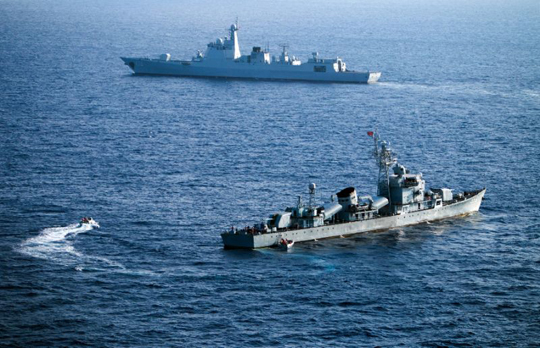
China has controversially built fortifications and artificial islands across the South China Sea. Rex Tillerson, Trump's nominee for secretary of state, said China's “access to those islands … is not going to be allowed”.

China claims nearly the entire area, with rival claims by five south-east Asian neighbours and Taiwan.

Tillerson did not specify how the US would block access but experts agreed it could only be done by a significant show of military force. Tillerson likened China's island building to “Russia's taking of Crimea”.

“Tillerson had better bone up on nuclear power strategies if he wants to force a big nuclear power to withdraw from its own territories,” said an editorial in the Global Times, a Communist-party controlled newspaper.

“China has enough determination and strength to make sure that his rabble rousing will not succeed … Unless Washington plans to wage a large-scale war in the South China Sea, any other approaches to prevent Chinese access to the islands will be foolish.”

Under Barack Obama the US remained neutral on sovereignty claims, not recognising any ownership, but often challenged China's control of the area by sailing warships past islands in what it called freedom of navigation exercises.

If that policy became more confrontational, including denying China access to islands it already controls, “it would set a course for devastating confrontation between China and the US”, declared the state-run China Daily.

China's official response was more tame. Foreign ministry spokesman Lu Kang said China-US relations were based on “non-confrontation, non-conflict, mutual benefit and win-win cooperation”.

Both newspapers also dismissed recent statements by Trump and his team – taking a similar stance to the Chinese government, which is waiting for Trump to be sworn in before equating his words with policy.

Tillerson's remarks “are not worth taking seriously because they are a mish-mash of naivety, shortsightedness, worn-out prejudices and unrealistic political fantasies”, the China Daily wrote. “Should he act on them in the real world it would be disastrous.”

There are signs, though, that Trump shares Tillerson's views and they will be carried into the White House.

In December, Trump made similar comments in an interview with Fox News, accusing Beijing of “building a massive fortress in the middle of the South China Sea, which they shouldn't be doing”.

Peter Navarro, Trump's pick to head the newly created national trade council, has been extremely hostile to China and encouraged the president-elect to pursue a “peace through strength” policy in the region.

“Beijing has created some 3,000 acres of artificial islands in the South China Sea with very limited American response,” Navarro has previously written.

Comments

Add new comment

  • Coastaldigest.com reserves the right to delete or block any comments.
  • Coastaldigset.com is not responsible for its readers’ comments.
  • Comments that are abusive, incendiary or irrelevant are strictly prohibited.
  • Please use a genuine email ID and provide your name to avoid reject.
News Network
March 28,2020

Washington, Mar 27: The United States has seen a record 18,000 new confirmed coronavirus cases and 345 deaths over the past 24 hours, according to a Johns Hopkins University tracker.

There are now 97,028 declared virus cases in the country and there have been 1,475 deaths, Johns Hopkins said.

Comments

Add new comment

  • Coastaldigest.com reserves the right to delete or block any comments.
  • Coastaldigset.com is not responsible for its readers’ comments.
  • Comments that are abusive, incendiary or irrelevant are strictly prohibited.
  • Please use a genuine email ID and provide your name to avoid reject.
Agencies
May 8,2020

United Nations, May 8: UN Secretary-General Antonio Guterres said Friday the coronavirus pandemic keeps unleashing a tsunami of hate and xenophobia, scapegoating and scare-mongering. 

The UN chief said anti-foreigner sentiment has surged online and in the streets, anti-Semitic conspiracy theories have spread, and COVID-19-related anti-Muslim attacks have occurred. 

Guterres said migrants and refugees have been vilified as a source of the virus -- and then denied access to medical treatment. 

With older persons among the most vulnerable, contemptible memes have emerged suggesting they are also the most expendable, he said. 

And journalists, whistleblowers, health professionals, aid workers and human rights defenders are being targeted simply for doing their jobs. 

Guterres appealed for an all-out effort to end hate speech globally. The secretary-general called on political leaders to show solidarity with all people, on educational institutions to focus on digital literacy at a time when extremists are seeking to prey on captive and potentially despairing audiences. 

He called on the media, especially social media, to remove racist, misogynist and other harmful content, on civil society to strengthen their outreach to vulnerable people, and on religious figures to serve as models of mutual respect. 

And I ask everyone, everywhere, to stand up against hate, treat each other with dignity and take every opportunity to spread kindness, Guterres said.

The secretary-general stressed that COVID-19 does not care who we are, where we live, what we believe or about any other distinction. His global appeal to address and counter COVID-19-related hate speech follows his April 23 message calling the coronarivus pandemic a human crisis that is fast becoming a human rights crisis. 

Guterres said then that the pandemic has seen disproportionate effects on certain communities, the rise of hate speech, the targeting of vulnerable groups, and the risks of heavy-handed security responses undermining the health response. 

With rising ethno-nationalism, populism, authoritarianism and a push back against human rights in some countries, the crisis can provide a pretext to adopt repressive measures for purposes unrelated to the pandemic, he warned.

In February, Guterres issued a call to action to countries, businesses and people to help renew and revive human rights across the globe, laying out a seven-point plan amid concerns about climate change, conflict and repression.

Comments

Add new comment

  • Coastaldigest.com reserves the right to delete or block any comments.
  • Coastaldigset.com is not responsible for its readers’ comments.
  • Comments that are abusive, incendiary or irrelevant are strictly prohibited.
  • Please use a genuine email ID and provide your name to avoid reject.
News Network
April 12,2020

Apr 12: India and other South Asian countries are likely to record their worst growth performance in four decades this year due to the coronavirus outbreak, the World Bank said on Sunday.

The South Asian region, comprising eight countries, is likely to show economic growth of 1.8 per cent to 2.8 per cent this year, the World Bank said in its South Asia Economic Focus report, well down from the 6.3 per cent it projected six months ago.

India's economy, the region's biggest, is expected to grow 1.5 per cent to 2.8 per cent in the fiscal year that started on April 1. The World Bank has estimated it will grow 4.8 per cent to 5 per cent in the fiscal year that ended on March 31.

"The green shoots of a rebound that were observable at the end of 2019 have been overtaken by the negative impacts of the global crisis," the World Bank report said.

Other than India, the World Bank forecast that Sri Lanka, Nepal, Bhutan and Bangladesh will also see sharp falls in economic growth.

Three other countries - Pakistan, Afghanistan and the Maldives - are expected to fall into recession, the World Bank said in the report, which was based on country-level data available as of April 7.

Measures taken to counter the coronavirus have disrupted supply chains across South Asia, which has recorded more than 13,000 cases so far - still lower than many parts of the world.

India's lockdown of 1.3 billion people has also left millions out of work, disrupted big and small businesses and forced an exodus of migrant workers from the cities to their homes in villages.

In the event of prolonged and broad national lockdowns, the report warned of a worst-case scenario in which the entire region would experience an economic contraction this year.

To minimize short-term economic pain, the Bank called for countries in the region to announce more fiscal and monetary steps to support unemployed migrant workers, as well as debt relief for businesses and individuals.

India has so far unveiled a $23 billion economic plan to offer direct cash transfers to millions of poor people hit by its lockdown. In neighbouring Pakistan, the government has announced a $6 billion plan to support the economy.

"The priority for all South Asian governments is to contain the virus spread and protect their people, especially the poorest who face considerable worse health and economic outcomes," said senior World Bank official Hartwig Schafer.

Comments

Add new comment

  • Coastaldigest.com reserves the right to delete or block any comments.
  • Coastaldigset.com is not responsible for its readers’ comments.
  • Comments that are abusive, incendiary or irrelevant are strictly prohibited.
  • Please use a genuine email ID and provide your name to avoid reject.