



Trump shared sensitive information with Russians: Washington Post

May 16, 2017

Washington, May 16: President Donald Trump shared highly classified information with the Russian Foreign Minister Sergei Lavrov when the latter met him at the White House last week, The Washington Post has alleged.
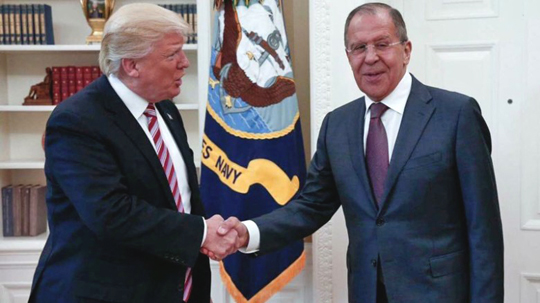
trump1

The news report was immediately refuted by both the Secretary of State Rex Tillerson and the National Security Advisor, who said that there was no discussion of specific threats with the Russians.

"This is code-word information," an unnamed US official familiar with the matter, was quoted as saying by The Washington Post.

Code-word information is a terminology that refers to one of the highest classification levels used by American spy agencies, the daily reported.

Trump "revealed more information to the Russian ambassador than we have shared with our own allies," the newspaper said, adding that following this, US officials have gone into damage control mode.

According to the daily, the sensitive classified information was given to the US by one of its allies, which had not given it permission to share this with the Russians.

However, the Trump Administration denied the allegations.

"During President Trump's meeting with Foreign Minister Lavrov, a broad range of subjects were discussed among which were common efforts and threats regarding counter-terrorism.

During that exchange, the nature of specific threats were discussed, but they did not discuss sources, methods or military operations," Tillerson said.

"The President and the (Russian) foreign minister reviewed common threats from terrorist organisations to include threats to aviation," said HR McMaster, the National Security Adviser, who participated in the meeting.

"At no time were any intelligence sources or methods discussed and no military operations were disclosed that were not already known publicly," McMaster said.

"This story is false. The President only discussed the common threats that both countries faced," said Dina Powell, Deputy National Security Advisor for Strategy, who also attended the meeting.

But The Washington Post said the information the President relayed had been provided by a US partner through an intelligence-sharing arrangement considered so sensitive that details have been withheld from allies and tightly restricted even within the US government, officials said.

Talking to reporters, McMaster described the story as false.

"The President and the Foreign Minister reviewed a range of common threats to our two countries, including threats to civil aviation.

"At no time, at no time, were intelligence sources or methods discussed and the President did not disclose any military operations that were not already publicly known," McMaster said.

"Two other senior officials who were present, including the Secretary of State, remember the meeting the same way and have said so. Their on-the-record accounts should outweigh those of anonymous sources. I was in the room. It didn't happen. Thanks, everybody," McMaster said without taking any questions.

In a statement, the Democratic Leader Nancy Pelosi said if news reports are true, Trump has "compromised a key source of intelligence collection" against ISIS and jeopardised the security of the American people.

"Even if President Trump unwittingly blew a highly classified code-word source to the Russians, that would be dangerous enough.

"If the President outed a highly classified code-word source intentionally, that would be even more dangerous," Pelosi said.

She demanded that Congress must be given a full briefing on the extent of the damage President Trump has done in compromising highly classified code-word intelligence to the Russians.

Comments

Add new comment

  • Coastaldigest.com reserves the right to delete or block any comments.
  • Coastaldigset.com is not responsible for its readers’ comments.
  • Comments that are abusive, incendiary or irrelevant are strictly prohibited.
  • Please use a genuine email ID and provide your name to avoid reject.
Agencies
June 28,2020

Paris, Jun 28: More than 10 million cases of the new coronavirus have been officially declared around the world, half of them in Europe and the United States, according to an AFP tally on Sunday based on official sources.

At least 10,003,942 infections, including 498,779 deaths, have been registered globally.

Europe remains the hardest hit continent with 2,637,546 cases including 195,975 fatalities, while the United States has 2,510,323 infections including 125,539 deaths.

The rate of infections worldwide continues to rise, with one million new cases recorded in just six days.

The tallies, using data collected by AFP from national authorities and information from the World Health Organization (WHO), probably reflect only a fraction of the actual number of infections.

Many countries are testing only symptomatic or the most serious cases and some do not have the capacity to carry out widescale testing.

Comments

Add new comment

  • Coastaldigest.com reserves the right to delete or block any comments.
  • Coastaldigset.com is not responsible for its readers’ comments.
  • Comments that are abusive, incendiary or irrelevant are strictly prohibited.
  • Please use a genuine email ID and provide your name to avoid reject.
Agencies
February 25,2020

Kuala Lumpur, Feb 25: The government party led by Interim Malaysian Prime Minister Mahathir Mohamad has rejected his resignation, urging him to continue leading it and the country, now shrouded in political uncertainty.

During an extraordinary meeting held on Monday night, the Malaysian United Indigenous Party (Bersatu) unanimously rejected the 94-year-old Prime Minister's decision, reports Efe news.

Mahathir, the world's oldest head of government, presented his resignation on Monday, later accepted by King Abdullah Pahang, on condition that he continue as Interim Prime Minister until a new government is formed.

That decision caused a domino effect that broke the Patakan Harapan (Alliance of Hope) alliance, formed in 2018 by four political parties that prevailed in that year's general elections.

Bersatu and 11 Popular Justice Party deputies announced their departure from the coalition, although they reaffirmed their confidence in Mahathir as Malaysia's political leader.

"We remain intact and prepared to build a party to face the difficulties," Marzuki Yahya, Bersatu Secretary-General, said after the meeting.

Confusion reigns in the country, with some local media claiming Bersatu and the 11 deputies Justice Party deputies intended to form a new government with opposition parties, including the historic Barisan Nasional coalition, under Mahathir's leadership.

Lim Guan Eng, Finance Minister and coalition member, said in a statement that the chief executive himself had informed him he had no intention of forming a coalition with Barisan, which suffered a historic defeat in the last elections.

A future government will need at least 112 of 222 parliament votes.

Mahathir returned to politics in 2018 heading the Patakan Harapan coalition to defeat his predecessor Najib Razak, marred by the corruption suspicions offenses.

To that end, Mahathir joined Anwar Ibrahim, a former political ally who fell out of favour in 1999 and was imprisoned five years on charges of corruption and sodomy, whom he promised to be his successor in power.

Comments

Add new comment

  • Coastaldigest.com reserves the right to delete or block any comments.
  • Coastaldigset.com is not responsible for its readers’ comments.
  • Comments that are abusive, incendiary or irrelevant are strictly prohibited.
  • Please use a genuine email ID and provide your name to avoid reject.
News Network
June 4,2020

Jun 4: A malaria drug President Donald Trump took to try to prevent COVID-19 proved ineffective for that in the first large, high-quality study to test it in people in close contact with someone with the disease.

Results published Wednesday by the New England Journal of Medicine show that hydroxychloroquine was no better than placebo pills at preventing illness from the coronavirus.

The drug did not seem to cause serious harm, though -- about 40% on it had side effects, mostly mild stomach problems.

 “We were disappointed. We would have liked for this to work,” said the study leader, Dr. David Boulware, an infectious disease specialist at the University of Minnesota.

“But our objective was to answer the question and to conduct a high-quality study,” because the evidence on the drug so far has been inconclusive, he said.

Hydroxychloroquine and a similar drug, chloroquine, have been the subject of much debate since Trump started promoting them in March.

Hydroxychloroquine has long been used for malaria, lupus, and rheumatoid arthritis, but no large studies have shown it or chloroquine to be safe or effective for much sicker patients with coronavirus, and some studies have suggested the drugs may do harm.

Trump took a two-week course of hydroxychloroquine, along with zinc and Vitamin D, after two staffers tested positive for COVID-19, and had no ill effects, according to results of his latest physical released by his doctor Wednesday.

Federal regulators have warned against hydroxychloroquine's use except in hospitals and formal studies because of the risk of side effects, especially heart rhythm problems.

Boulware's study involved 821 people in the United States and Canada living with someone diagnosed with COVID-19 or at high risk of getting it because of their job -- doctors, nurses, ambulance workers who had significant exposure to a sick patient while not wearing full protective gear.

They were randomly assigned to get either the nutrient folate as a placebo or hydroxychloroquine for five days, starting within four days of their exposure. Neither they nor others involved in the research knew who was getting which pills.

After 14 days in the study, 12 per cent on the drug developed COVID-19 symptoms versus 14 per cent in the placebo group, but the difference is so small it could have occurred by chance, Boulware said.

“There's basically no effect. It does not prevent infection,” he said of the drug. Even if it were to give some slim advantage, “we'd want a much larger effect” to justify its use and risk of side effects for preventing illness, he said.

Results were no different among a subgroup of participants who were taking zinc or vitamin C, which some people believe might help make hydroxychloroquine more effective or fight the coronavirus.

There are some big caveats: The study enrolled people through the Internet and social media, relying on them to report their own symptoms rather than having them tracked in a formal way by doctors.

Participants were not all tested for the coronavirus but were diagnosed as COVID-19 cases based on symptoms in many cases. And not all took their medicines as directed.

The results “are more provocative than definitive,” and the drug may yet have prevention benefits if tried sooner or in a different way, Dr. Myron Cohen of the University of North Carolina at Chapel Hill wrote in a commentary in the journal.

Others were glad to see a study that had a comparison group and good scientific methods after so many weaker reports on hydroxychloroquine.

“This fits with everything else we've seen so far which suggests that it's not beneficial," said Dr. Peter Bach, director of a health policy center at Memorial Sloan Kettering Cancer Center in New York.

This study was in younger relatively healthy people, but the results “would make me very discouraged about trying to use this in older people” who are most vulnerable to serious illness from the coronavirus, Bach said.

“If it does work, it doesn't work very well.” Dr. Dan Culver, a lung specialist at the Cleveland Clinic, said there's still a chance that giving the drug sooner than four days after someone's exposure to the virus may help prevent illness.

But the study “takes 'home run' off the table” as far as hopes for the drug, he said.

The study was mostly funded by David Baszucki, founder of Roblox, a California-based game software company, and other private donors and the Minnesota university.

Boulware also is leading a study testing hydroxychloroquine for treating COVID-19. The study is finished and results are being analyzed now.

On Tuesday, the journal Lancet posted an “expression of concern” about a study it published earlier this month of nearly 15,000 COVID-19 patients on the malaria drugs that tied their use to a higher risk of dying in the hospital or developing a heartbeat problem.

Scientists have raised serious questions about the database used for that study, and its authors have launched an independent audit.

That work had a big impact: the World Health Organization suspended use of hydroxychloroquine in a study it is leading, and French officials stopped the drug's use in hospitals. On Wednesday, the WHO said experts who reviewed safety information decided that its study could resume.

Comments

Add new comment

  • Coastaldigest.com reserves the right to delete or block any comments.
  • Coastaldigset.com is not responsible for its readers’ comments.
  • Comments that are abusive, incendiary or irrelevant are strictly prohibited.
  • Please use a genuine email ID and provide your name to avoid reject.