



Trump to sign executive order on reform of H-1B visa system

April 18, 2017

Washington, Apr 18: US President Donald Trump is set to sign an executive order that would tighten the process of issuing the H-1B visas and seek a review of the system for creating an "entirely new structure" for awarding these visas, the most sought-after by Indian IT firms and professionals.
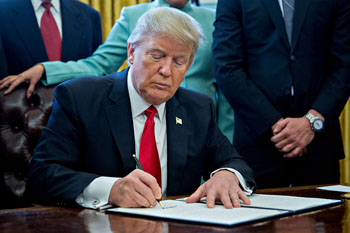
Trump1Trump is scheduled to travel to Milwaukee, Wisconsin, the home state of House of Representatives Speaker Paul Ryan, to sign the 'Buy American, Hire American' Executive Order.

This was a transitional step aimed at achieving a more skills-based and merit-based immigration system. The executive order would be signed a day after the US Citizenship and Immigration Services (USCIS) announced that it has completed the computerised draw of lots from the 199,000 petitions it received for the Congressional mandated 65,000 H-1B visas for the fiscal year 2018 beginning October 1 this year.

The lottery was held for the 20,000 H-1B visas for those applicants having higher education from US educational institutions. Opposing the traditional lottery system for H-1B visas, a senior administration official told White House reporters that these visas were being used by companies to bring in foreign workers at a low wage rate and displace local workers.

The official argued that there were enough qualified people within the country to meet the demand of technology professionals. "With respect to the H-1B visa programme in particular, which deals mostly with STEM jobs, we graduate about twice as many STEM students each year as find jobs in STEM fields.

"The issue of training workers for skilled manufacturing jobs is a different aspect of a policy then, say, the H-1B visa, which obviously is for STEM occupations," the official said. The official argued that the reality was that the US has large numbers of unemployed American workers. "Right now we're creating an environment with our guest- worker programmes where those workers are being bypassed," the official said.

"If you make it harder to abuse the guest-worker programmes, it creates more of a market for domestic workers, as well as more of a market for the kinds of job training and vocational training programmes that you're talking about," said the official, who spoke on condition of anonymity. Trump had made the alleged abuse and fraud in H-1B visa system a major election issue during his campaign.

The executive order signed by Trump today will call for the strict enforcement of all laws governing entry into the United States of labour from abroad, for the stated purpose of creating higher wages and higher employment rates for workers in America, the official said.

"It would further call on the departments of Labour, Justice, Homeland Security and State to take prompt action to crackdown on fraud and abuse, which should both be understood as separate problems, in our immigration system in order to protect workers in the United States and their economic conditions," the official asserted.

"As a practical matter, you're creating an entirely new structure for awarding these visas. I mean, it is a completely...total transformation of the H-1B programme," the official said. According to the senior administration official, these reforms were broadly supported by groups that represent American workers in the US, and that a lot of the driving action historically for these kinds of guest-worker reforms have been from groups that in fact even tilt Democratic.

"This (executive order) would apply across the board, but in particular, the executive order has an additional clause on the H-1B visa programme, and calls on those same four departments to put forward reforms to see to it that H-1B visas are awarded to the most skilled or highest-paid applicants," the official said. Noting that right now the H-1B visas were awarded by random lottery, the official said 80 per cent of H-1B workers were paid less than the median wage in their fields.

Only about five to six per cent, depending on the year, of H-1B workers command the highest wage tier recognised by the Department of Labour, there being four wage tiers, he said. "The highest wage tier, for instance in 2015, was only five per cent of H-1B workers. So 80 per cent received less than the median wage and only 10 per cent received the median wage," he noted.

"And, so only five per cent were categorised at the highest wage tier of the four wage tiers that are in place for the H-1B guest-worker visa," the official said. The result of that is that workers are often brought in well below market rates to replace American workers, sort of violating the principle of the programme, which is supposed to be a means for bringing in skilled labour, the official said.

"And instead, you're bringing in, a lot of times, workers who are actually less skilled and lower paid than the workers that they're replacing," he stated. The official said Trump has done more to bring a national spotlight onto the abuses in the H-1B guest-worker programme than anybody in the country has at any point in recent history.

"If you change that current system that awards visas randomly without regard for skill or wage to a skills-based awarding, it makes it extremely difficult to use the visa to replace or undercut American workers. These are not bringing in workers at beneath the market wage," he said. The top three recipients of the H-1B visas, the official said, were Tata (TCS), Infosys and Cognizant.

"Some companies oftentimes are called outsourcing firms. They're like the top recipients of H-1B visa. You know, are companies like Tata (TCS), Infosys, Cognizant. They will apply for a very large number of visas; more than they get. Like putting extra tickets in the lottery raffle, if you will," the official said.

"And then they'll get the lion's share of visas," the official said. As part of the executive order, the agencies have been asked to do everything they can, he said. "But you could be looking at things on the administration side like increasing fees for H-1B visas. You could be looking at things like if we could adjust the wage scale to have a more honest reflection of what the prevailing wages actually are in these fields," the official said.

Comments

Add new comment

  • Coastaldigest.com reserves the right to delete or block any comments.
  • Coastaldigset.com is not responsible for its readers’ comments.
  • Comments that are abusive, incendiary or irrelevant are strictly prohibited.
  • Please use a genuine email ID and provide your name to avoid reject.
News Network
April 15,2020

Wuhan, Apr 15: In the six days after top Chinese officials secretly determined they likely were facing a pandemic from a new coronavirus, the city of Wuhan at the epicenter of the disease hosted a mass banquet for tens of thousands of people; millions began traveling through for Lunar New Year celebrations.

President Xi Jinping warned the public on the seventh day, Janaury 20. But by that time, more than 3,000 people had been infected during almost a week of public silence, according to internal documents obtained by The Associated Press and expert estimates based on retrospective infection data.

That delay from Jan 14 to Jan. 20 was neither the first mistake made by Chinese officials at all levels in confronting the outbreak, nor the longest lag, as governments around the world have dragged their feet for weeks and even months in addressing the virus.

But the delay by the first country to face the new coronavirus came at a critical time — the beginning of the outbreak. China's attempt to walk a line between alerting the public and avoiding panic set the stage for a pandemic that has infected almost 2 million people and taken more than 126,000 lives.

A This is tremendous, a said Zuo-Feng Zhang, an epidemiologist at the University of California, Los Angeles. If they took action six days earlier, there would have been much fewer patients and medical facilities would have been sufficient. We might have avoided the collapse of Wuhan's medical system.

Other experts noted that the Chinese government may have waited on warning the public to stave off hysteria, and that it did act quickly in private during that time.

But the six-day delay by China's leaders in Beijing came on top of almost two weeks during which the national Center for Disease Control did not register any cases from local officials, internal bulletins obtained by the AP confirm. Yet during that time, from Jan 5 to Jan 17, hundreds of patients were appearing in hospitals not just in Wuhan but across the country.

It's uncertain whether it was local officials who failed to report cases or national officials who failed to record them. It's also not clear exactly what officials knew at the time in Wuhan, which only opened back up last week with restrictions after its quarantine.

But what is clear, experts say, is that China's rigid controls on information, bureaucratic hurdles and a reluctance to send bad news up the chain of command muffled early warnings. The punishment of eight doctors for rumor-mongering, broadcast on national television on Jan. 2, sent a chill through the city's hospitals.

Doctors in Wuhan were afraid, said Dali Yang, a professor of Chinese politics at the University of Chicago. It was truly intimidation of an entire profession. Without these internal reports, it took the first case outside China, in Thailand on Jan 13, to galvanize leaders in Beijing into recognising the possible pandemic before them. It was only then that they launched a nationwide plan to find cases distributing CDC-sanctioned test kits, easing the criteria for confirming cases and ordering health officials to screen patients, all without telling the public.

The Chinese government has repeatedly denied suppressing information in the early days, saying it immediately reported the outbreak to the World Health Organization.

Allegations of a cover-up or lack of transparency in China are groundless, said foreign ministry spokesman Zhao Lijian at a Thursday press conference.

The documents show that the head of China's National Health Commission, Ma Xiaowei, laid out a grim assessment of the situation on Jan. 14 in a confidential teleconference with provincial health officials.

A memo states that the teleconference was held to convey instructions on the coronavirus from President Xi Jinping, Premier Li Keqiang and Vice Premier Sun Chunlan, but does not specify what those instructions were.

The epidemic situation is still severe and complex, the most severe challenge since SARS in 2003, and is likely to develop into a major public health event, the memo cites Ma as saying.

The National Health Commission is the top medical agency in the country. In a faxed statement, the Commission said it had organised the teleconference because of the case reported in Thailand and the possibility of the virus spreading during New Year travel. It added that China had published information on the outbreak in an open, transparent, responsible and timely manner," in accordance with important instructions repeatedly issued by President Xi.

The documents come from an anonymous source in the medical field who did not want to be named for fear of retribution. The AP confirmed the contents with two other sources in public health familiar with the teleconference. Some of the memo's contents also appeared in a public notice about the teleconference, stripped of key details and published in February.

Under a section titled sober understanding of the situation, the memo said that clustered cases suggest that human-to-human transmission is possible. It singled out the case in Thailand, saying that the situation had changed significantly because of the possible spread of the virus abroad.

With the coming of the Spring Festival, many people will be traveling, and the risk of transmission and spread is high, the memo continued.

Comments

Add new comment

  • Coastaldigest.com reserves the right to delete or block any comments.
  • Coastaldigset.com is not responsible for its readers’ comments.
  • Comments that are abusive, incendiary or irrelevant are strictly prohibited.
  • Please use a genuine email ID and provide your name to avoid reject.
News Network
April 17,2020

Washington, Apr 17: The confirmed coronavirus death toll in the United States reached 32,917 on Thursday, according to a tally by Johns Hopkins University.

The toll as of 8:30 pm (0030 GMT Friday) marked an increase of 4,491 deaths in the past 24 hours, by far the highest daily toll in the pandemic so far.

But the figure likely includes "probable" deaths related to COVID-19, which were not previously included. This week, New York City announced it would add 3,778 "probable" coronavirus deaths to its toll.

As of Thursday night, the US Centers for Disease Control and Prevention had recorded 31,071 coronavirus deaths, including 4,141 "probable" virus deaths.

The US has the highest death toll in the world, followed by Italy with 22,170 dead although its population is just a fifth of that of the US.

Spain has recorded 19,130 deaths, followed by France with 17,920.

More than 667,800 coronavirus cases have been recorded in the United States, which has seen a record number of deaths over the past two days.

Meanwhile, President Donald Trump unveiled plans Thursday evening to reopen the US economy, allowing each state's governor "to take a phased deliberate approach to reopening their individual states".

Comments

Add new comment

  • Coastaldigest.com reserves the right to delete or block any comments.
  • Coastaldigset.com is not responsible for its readers’ comments.
  • Comments that are abusive, incendiary or irrelevant are strictly prohibited.
  • Please use a genuine email ID and provide your name to avoid reject.
News Network
May 2,2020

Balochistan, May 1: Sajid Hussain, Editor-in-Chief of Balochistan Times, has been found dead in a Swedish town, the police have confirmed.

The Swedish police informed his family on Thursday night that they discovered his body from a river in Uppsala, The Times reported.
The Baloch journalist had been missing from the Swedish city since March 2 this year.

Sajid, 39, left Pakistan in 2012 and had been living as a refugee in Sweden since 2017. He wrote extensively on the suffering of the Balochis at the hands of the Pakistani military establishment.

His work often got him into trouble as the authorities did not like his reporting of Balochistan's forbidden stories, the reason he had to leave and live in exile.

The Baloch journalist was found dead two months after he went missing in Sweden.
Sajid left Pakistan because of security threats from Pakistan Army and its intelligence service ISI.

The spokesperson of the Baloch National Movement, Hammal Haider told news agency: "We are deeply saddened by the demise of prominent Baloch intellectual and writer Sajid Hussain."
"His death is indeed a loss of a great mind for the people of Balochistan. Due to his straightforwardness, he was loved among all journalistic, literary and political circles," added Haider.

"After this incident, we have serious concerns about our members and other Baloch refugees living in the West," he said.

Comments

Add new comment

  • Coastaldigest.com reserves the right to delete or block any comments.
  • Coastaldigset.com is not responsible for its readers’ comments.
  • Comments that are abusive, incendiary or irrelevant are strictly prohibited.
  • Please use a genuine email ID and provide your name to avoid reject.