



Trump to sign executive order on reform of H-1B visa system

April 18, 2017

Washington, Apr 18: US President Donald Trump is set to sign an executive order that would tighten the process of issuing the H-1B visas and seek a review of the system for creating an "entirely new structure" for awarding these visas, the most sought-after by Indian IT firms and professionals.
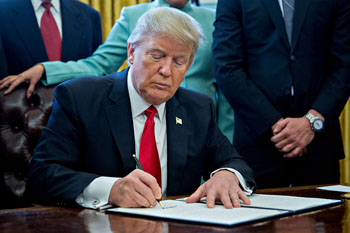
Trump1Trump is scheduled to travel to Milwaukee, Wisconsin, the home state of House of Representatives Speaker Paul Ryan, to sign the 'Buy American, Hire American' Executive Order.

This was a transitional step aimed at achieving a more skills-based and merit-based immigration system. The executive order would be signed a day after the US Citizenship and Immigration Services (USCIS) announced that it has completed the computerised draw of lots from the 199,000 petitions it received for the Congressional mandated 65,000 H-1B visas for the fiscal year 2018 beginning October 1 this year.

The lottery was held for the 20,000 H-1B visas for those applicants having higher education from US educational institutions. Opposing the traditional lottery system for H-1B visas, a senior administration official told White House reporters that these visas were being used by companies to bring in foreign workers at a low wage rate and displace local workers.

The official argued that there were enough qualified people within the country to meet the demand of technology professionals. "With respect to the H-1B visa programme in particular, which deals mostly with STEM jobs, we graduate about twice as many STEM students each year as find jobs in STEM fields.

"The issue of training workers for skilled manufacturing jobs is a different aspect of a policy then, say, the H-1B visa, which obviously is for STEM occupations," the official said. The official argued that the reality was that the US has large numbers of unemployed American workers. "Right now we're creating an environment with our guest- worker programmes where those workers are being bypassed," the official said.

"If you make it harder to abuse the guest-worker programmes, it creates more of a market for domestic workers, as well as more of a market for the kinds of job training and vocational training programmes that you're talking about," said the official, who spoke on condition of anonymity. Trump had made the alleged abuse and fraud in H-1B visa system a major election issue during his campaign.

The executive order signed by Trump today will call for the strict enforcement of all laws governing entry into the United States of labour from abroad, for the stated purpose of creating higher wages and higher employment rates for workers in America, the official said.

"It would further call on the departments of Labour, Justice, Homeland Security and State to take prompt action to crackdown on fraud and abuse, which should both be understood as separate problems, in our immigration system in order to protect workers in the United States and their economic conditions," the official asserted.

"As a practical matter, you're creating an entirely new structure for awarding these visas. I mean, it is a completely...total transformation of the H-1B programme," the official said. According to the senior administration official, these reforms were broadly supported by groups that represent American workers in the US, and that a lot of the driving action historically for these kinds of guest-worker reforms have been from groups that in fact even tilt Democratic.

"This (executive order) would apply across the board, but in particular, the executive order has an additional clause on the H-1B visa programme, and calls on those same four departments to put forward reforms to see to it that H-1B visas are awarded to the most skilled or highest-paid applicants," the official said. Noting that right now the H-1B visas were awarded by random lottery, the official said 80 per cent of H-1B workers were paid less than the median wage in their fields.

Only about five to six per cent, depending on the year, of H-1B workers command the highest wage tier recognised by the Department of Labour, there being four wage tiers, he said. "The highest wage tier, for instance in 2015, was only five per cent of H-1B workers. So 80 per cent received less than the median wage and only 10 per cent received the median wage," he noted.

"And, so only five per cent were categorised at the highest wage tier of the four wage tiers that are in place for the H-1B guest-worker visa," the official said. The result of that is that workers are often brought in well below market rates to replace American workers, sort of violating the principle of the programme, which is supposed to be a means for bringing in skilled labour, the official said.

"And instead, you're bringing in, a lot of times, workers who are actually less skilled and lower paid than the workers that they're replacing," he stated. The official said Trump has done more to bring a national spotlight onto the abuses in the H-1B guest-worker programme than anybody in the country has at any point in recent history.

"If you change that current system that awards visas randomly without regard for skill or wage to a skills-based awarding, it makes it extremely difficult to use the visa to replace or undercut American workers. These are not bringing in workers at beneath the market wage," he said. The top three recipients of the H-1B visas, the official said, were Tata (TCS), Infosys and Cognizant.

"Some companies oftentimes are called outsourcing firms. They're like the top recipients of H-1B visa. You know, are companies like Tata (TCS), Infosys, Cognizant. They will apply for a very large number of visas; more than they get. Like putting extra tickets in the lottery raffle, if you will," the official said.

"And then they'll get the lion's share of visas," the official said. As part of the executive order, the agencies have been asked to do everything they can, he said. "But you could be looking at things on the administration side like increasing fees for H-1B visas. You could be looking at things like if we could adjust the wage scale to have a more honest reflection of what the prevailing wages actually are in these fields," the official said.

Comments

Add new comment

  • Coastaldigest.com reserves the right to delete or block any comments.
  • Coastaldigset.com is not responsible for its readers’ comments.
  • Comments that are abusive, incendiary or irrelevant are strictly prohibited.
  • Please use a genuine email ID and provide your name to avoid reject.
News Network
January 30,2020

Jan 30: The death toll rose to 170 in the new virus outbreak in China on Thursday as foreign evacuees from the worst-hit region begin returning home under close observation and world health officials expressed “great concern” that the disease is starting to spread between people outside of China.

Thursday’s figures cover the previous 24 hours and represent an increase of 38 deaths and 1,737 cases for a total of 7,711. Of the new deaths, 37 were in the epicenter of the outbreak in Hubei province and one in the southwestern province of Sichuan.

The news comes as the 195 Americans evacuated from Wuhan, the Hubei province city of 11 million where the outbreak originated, are undergoing three days of testing and monitoring at a Southern California military base to make sure they do not show signs of the virus.

A group of 210 Japanese evacuees from Wuhan landed Thursday at Tokyo’s Haneda airport on a second government chartered flight, according to the foreign ministry. Reports said nine of those aboard the flight showed signs of cough and fever. Three of the 206 Japanese who returned on Wednesday tested positive for the new coronavirus, Prime Minister Shinzo Abe said during a parliamentary session. Two of them showed no symptoms of the disease.

France, New Zealand, Australia and other countries are also pulling out their citizens or making plans to do so.

The World Health Organization emergencies chief said the few cases of human-to-human spread of the virus outside China — in Japan, Germany, Canada and Vietnam — were of “great concern” and were part of the reason the U.N. health agency’s director-general was reconvening a committee of experts on Thursday to assess whether the outbreak should be declared a global emergency.

The new virus has now infected more people in China than were sickened there during the 2002-2003 SARS outbreak.

Dr. Michael Ryan spoke at a news conference in Geneva on Wednesday after returning from a trip to Beijing to meet with Chinese President Xi Jinping and other senior government leaders. He said China was taking “extraordinary measures in the face of an extraordinary challenge” posed by the outbreak.

To date, about 99% of the cases are in China. Ryan estimated the death rate of the new virus at 2%, but said the figure was very preliminary. With fluctuating numbers of cases and deaths, scientists are only able to produce a rough estimate of the fatality rate and it’s likely many milder cases of the virus are being missed.

In comparison, the SARS virus killed about 10% of people who caught it. The new virus is from the coronavirus family, which includes those that can cause the common cold as well as more serious illnesses such as SARS and MERS.

Scientists say there are many questions to be answered about the new virus, including just how easily it spreads and how severe it is.

In a report published Wednesday, Chinese researchers suggested that person-to-person spread among close contacts occurred as early as mid-December.

“Considerable efforts” will be needed to control the spread if this ratio holds up elsewhere, researchers wrote in the report, published in the New England Journal of Medicine.

More than half of the cases in which symptoms began before Jan. 1 were tied to a seafood market, but only 8% of cases after that have been, researchers found. They reported the average incubation period was five days.

Comments

Add new comment

  • Coastaldigest.com reserves the right to delete or block any comments.
  • Coastaldigset.com is not responsible for its readers’ comments.
  • Comments that are abusive, incendiary or irrelevant are strictly prohibited.
  • Please use a genuine email ID and provide your name to avoid reject.
News Network
April 18,2020

Washington, Apr 18: The United States on Friday passed 700,000 confirmed coronavirus cases, according to a tally maintained by Johns Hopkins University.

With the highest number of cases and deaths of any country in the world, the US had recorded 700,282 cases of COVID-19 and 36,773 deaths as of 8:30 pm (0030 GMT Friday), according to the Baltimore-based university.

That marked an increase of 3,856 deaths in the past 24 hours, but that figure likely includes "probable" virus-linked deaths, which had not previously been counted.

This week, New York City said it would add 3,778 "probable" virus deaths to its official count.

The US Centers for Disease Control and Prevention gave a toll Friday night of 33,049 dead, including 4,226 probable virus-linked deaths.

The United States has seen the highest death toll in the world in the coronavirus pandemic, ahead of Italy (22,745 deaths) although its population is just a fifth of that of the US.

Spain has recorded 19,478 deaths, followed by France with 18,681.

Trump announces $19 billion relief for farmers amid COVID-19 epidemic

President Donald Trump on Friday announced a $19 billion financial rescue package to help the agriculture industry weather the staggering economic downturn sparked by measures to defeat the coronavirus.

Trump told a press conference the government "will be implementing a $19 billion relief program for our great farmers and ranchers as they cope with the fallout of the global pandemic."

The program will include direct payments to farmers, ranchers and producers who Trump said have experienced "unprecedented losses during this pandemic."

Agriculture Secretary Sonny Perdue said US farmers have been hit hard by a sharp shift in demand, as schools and restaurants close and more Americans eat at home.

That has disrupted the food supply chain, forcing farmers in many places to destroy dairy output and plow under crops that no longer have buyers.

"Having to dump milk and plow under vegetables ready to market is not only financially distressing, but it's heartbreaking as well to those who produce them," Perdue said.

Perdue said some $3 billion of the money would go to buying produce and milk from such farmers, and redistribute it to community food banks.

Millions of Americans have recently turned to food pantries for meals and groceries after losing their jobs.

Comments

Add new comment

  • Coastaldigest.com reserves the right to delete or block any comments.
  • Coastaldigset.com is not responsible for its readers’ comments.
  • Comments that are abusive, incendiary or irrelevant are strictly prohibited.
  • Please use a genuine email ID and provide your name to avoid reject.
News Network
June 16,2020

Beijing, Jun 16: The coronavirus situation in China's capital is "extremely severe", a city official warned Tuesday, as 27 new infections were reported from Beijing where a new cluster has sparked a huge trace-and-test programme.

The COVID-19 resurgence -- believed to have started at the sprawling Xinfadi wholesale food market in the capital -- has sparked alarm as China had largely brought its outbreak under control through mass testing and lockdowns imposed earlier in the year.

The new cases took the number of confirmed infections in Beijing over the past five days to 106, as authorities locked down almost 30 communities in the city and tested tens of thousands of people.

"The epidemic situation in the capital is extremely severe," Beijing city spokesman Xu Hejian warned at a press conference.

The World Health Organization had already expressed concern about the cluster, pointing to Beijing's size and connectivity.

Officials in the capital have said they will test stall owners and managers at all of the city's food markets, restaurants and government canteens.

Beijing's coronavirus testing capacity has been expanded to 90,000 a day, according to China's official news agency Xinhua.

On Tuesday, the capital's transport commission banned taxi- and ride-hailing services from driving out of the city, Xinhua reported, in another move to try and contain the new outbreak.

All indoor sports and entertainment venues in Beijing were ordered to shut on Monday, and some other cities across China warned they would quarantine those arriving from the capital.

The National Health Commission also reported four new domestic infections in Hebei province, which surrounds Beijing, and a case reported in southwestern Sichuan province was linked to the Beijing cluster.

Authorities were also racing to track people from Beijing who had travelled to other parts of China, and those who visited the capital have been encouraged to get tested.

Beijing spokesman Xu said: "High-risk people who have left Beijing must inform local authorities immediately."

Market inspections

Authorities shut down another market on Tuesday -- Tiantaohonglian in the central Xicheng district -- after one employee there was diagnosed with COVID-19, state broadcaster CCTV reported.

Seven residential estates surrounding that market were also locked down.

In total, Beijing officials said Tuesday they have disinfected 276 agricultural markets, closed 11 markets, and disinfected more than 33,000 food and beverage businesses in a bid to stamp out the new cluster.

Officials had warned Sunday that since May 30, 200,000 people had visited the Xinfadi market -- the original site of the new outbreak.

More than 8,000 workers from Xinfadi have been tested and sent to centralised quarantine facilities.

Until this recent outbreak, most of China's cases in recent months were nationals returning home as the pandemic spread to other countries.

China's Center for Disease Control and Prevention said Monday that the virus strain found in the Beijing outbreak was a "major epidemic strain in the European countries".

While the virus was detected on chopping boards used to handle imported salmon at Xinfadi, "it does not clearly or definitely indicate it's from imported seafood", Wu Zunyou, the body's chief epidemiologist, said in an interview with state broadcaster CCTV.

"Ever since new cases suddenly emerged in Beijing, we have tried to figure out the reasons for the outbreak since there were no COVID-19 cases found over the past two months," Wu Zunyou said.

"We came up with several possibilities, and the most likely one is that the carrier of the novel coronavirus comes from outside China or other parts of China and brought it here."

On Tuesday, another eight imported cases were reported.

Comments

Add new comment

  • Coastaldigest.com reserves the right to delete or block any comments.
  • Coastaldigset.com is not responsible for its readers’ comments.
  • Comments that are abusive, incendiary or irrelevant are strictly prohibited.
  • Please use a genuine email ID and provide your name to avoid reject.