


Trump to sign executive order on reform of H-1B visa system

April 18, 2017

Washington, Apr 18: US President Donald Trump is set to sign an executive order that would tighten the process of issuing the H-1B visas and seek a review of the system for creating an "entirely new structure" for awarding these visas, the most sought-after by Indian IT firms and professionals.
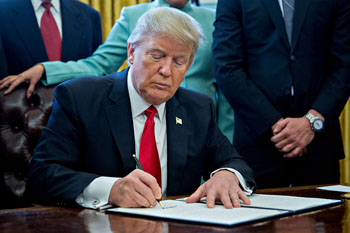
Trump1Trump is scheduled to travel to Milwaukee, Wisconsin, the home state of House of Representatives Speaker Paul Ryan, to sign the 'Buy American, Hire American' Executive Order.

This was a transitional step aimed at achieving a more skills-based and merit-based immigration system. The executive order would be signed a day after the US Citizenship and Immigration Services (USCIS) announced that it has completed the computerised draw of lots from the 199,000 petitions it received for the Congressional mandated 65,000 H-1B visas for the fiscal year 2018 beginning October 1 this year.

The lottery was held for the 20,000 H-1B visas for those applicants having higher education from US educational institutions. Opposing the traditional lottery system for H-1B visas, a senior administration official told White House reporters that these visas were being used by companies to bring in foreign workers at a low wage rate and displace local workers.

The official argued that there were enough qualified people within the country to meet the demand of technology professionals. "With respect to the H-1B visa programme in particular, which deals mostly with STEM jobs, we graduate about twice as many STEM students each year as find jobs in STEM fields.

"The issue of training workers for skilled manufacturing jobs is a different aspect of a policy then, say, the H-1B visa, which obviously is for STEM occupations," the official said. The official argued that the reality was that the US has large numbers of unemployed American workers. "Right now we're creating an environment with our guest- worker programmes where those workers are being bypassed," the official said.

"If you make it harder to abuse the guest-worker programmes, it creates more of a market for domestic workers, as well as more of a market for the kinds of job training and vocational training programmes that you're talking about," said the official, who spoke on condition of anonymity. Trump had made the alleged abuse and fraud in H-1B visa system a major election issue during his campaign.

The executive order signed by Trump today will call for the strict enforcement of all laws governing entry into the United States of labour from abroad, for the stated purpose of creating higher wages and higher employment rates for workers in America, the official said.

"It would further call on the departments of Labour, Justice, Homeland Security and State to take prompt action to crackdown on fraud and abuse, which should both be understood as separate problems, in our immigration system in order to protect workers in the United States and their economic conditions," the official asserted.

"As a practical matter, you're creating an entirely new structure for awarding these visas. I mean, it is a completely...total transformation of the H-1B programme," the official said. According to the senior administration official, these reforms were broadly supported by groups that represent American workers in the US, and that a lot of the driving action historically for these kinds of guest-worker reforms have been from groups that in fact even tilt Democratic.

"This (executive order) would apply across the board, but in particular, the executive order has an additional clause on the H-1B visa programme, and calls on those same four departments to put forward reforms to see to it that H-1B visas are awarded to the most skilled or highest-paid applicants," the official said. Noting that right now the H-1B visas were awarded by random lottery, the official said 80 per cent of H-1B workers were paid less than the median wage in their fields.

Only about five to six per cent, depending on the year, of H-1B workers command the highest wage tier recognised by the Department of Labour, there being four wage tiers, he said. "The highest wage tier, for instance in 2015, was only five per cent of H-1B workers. So 80 per cent received less than the median wage and only 10 per cent received the median wage," he noted.

"And, so only five per cent were categorised at the highest wage tier of the four wage tiers that are in place for the H-1B guest-worker visa," the official said. The result of that is that workers are often brought in well below market rates to replace American workers, sort of violating the principle of the programme, which is supposed to be a means for bringing in skilled labour, the official said.

"And instead, you're bringing in, a lot of times, workers who are actually less skilled and lower paid than the workers that they're replacing," he stated. The official said Trump has done more to bring a national spotlight onto the abuses in the H-1B guest-worker programme than anybody in the country has at any point in recent history.

"If you change that current system that awards visas randomly without regard for skill or wage to a skills-based awarding, it makes it extremely difficult to use the visa to replace or undercut American workers. These are not bringing in workers at beneath the market wage," he said. The top three recipients of the H-1B visas, the official said, were Tata (TCS), Infosys and Cognizant.

"Some companies oftentimes are called outsourcing firms. They're like the top recipients of H-1B visa. You know, are companies like Tata (TCS), Infosys, Cognizant. They will apply for a very large number of visas; more than they get. Like putting extra tickets in the lottery raffle, if you will," the official said.

"And then they'll get the lion's share of visas," the official said. As part of the executive order, the agencies have been asked to do everything they can, he said. "But you could be looking at things on the administration side like increasing fees for H-1B visas. You could be looking at things like if we could adjust the wage scale to have a more honest reflection of what the prevailing wages actually are in these fields," the official said.

Comments

Add new comment

  • Coastaldigest.com reserves the right to delete or block any comments.
  • Coastaldigset.com is not responsible for its readers’ comments.
  • Comments that are abusive, incendiary or irrelevant are strictly prohibited.
  • Please use a genuine email ID and provide your name to avoid reject.
News Network
March 12,2020

Geneva, Mar 12: For the global economy, virus repercussions were profound, with increasing concerns of wealth- and job-wrecking recessions. U.S. stocks wiped out more than all the gains from a huge rally a day earlier as Wall Street continued to reel.

The Dow Jones Industrial Average dropped 1,464 points, bringing it 20% below its record set last month and putting it in what Wall Street calls a “bear market.” The broader S&P 500 is just 1 percentage point away from falling into bear territory and bringing to an end one of the greatest runs in Wall Street’s history.

WHO officials said they thought long and hard about labeling the crisis a pandemic — defined as sustained outbreaks in multiple regions of the world.

The risk of employing the term, Ryan said, is “if people use it as an excuse to give up.” But the benefit is “potentially of galvanizing the world to fight.”

Underscoring the mounting challenge: soaring numbers in the U.S. and Europe’s status as the new epicenter of the pandemic. While Italy exceeds 12,000 cases and the United States has topped 1,300, China reported a record low of just 15 new cases Thursday and three-fourths of its infected patients have recovered.

China’s totals of 80,793 cases and 3,169 deaths are a shrinking portion of the world’s more than 126,000 infections and 4,600 deaths.

“If you want to be blunt, Europe is the new China,” said Robert Redfield, the head of the U.S. Centers for Disease Control and Prevention.

With 12,462 cases and 827 deaths, Italy said all shops and businesses except pharmacies and grocery stores would be closed beginning Thursday and designated billions in financial relief to cushion economic shocks in its latest efforts to adjust to the fast-evolving crisis that silenced the usually bustling heart of the Catholic faith, St. Peter’s Square.

Comments

Add new comment

  • Coastaldigest.com reserves the right to delete or block any comments.
  • Coastaldigset.com is not responsible for its readers’ comments.
  • Comments that are abusive, incendiary or irrelevant are strictly prohibited.
  • Please use a genuine email ID and provide your name to avoid reject.
News Network
May 14,2020

May 14: The UN’s children agency has warned that an additional 6,000 children could die daily from preventable causes over the next six months as the COVID-19 pandemic weakens the health systems and disrupts routine services, the first time that the number of children dying before their fifth birthday could increase worldwide in decades.

As the coronavirus outbreak enters its fifth month, the UN Children’s Fund (UNICEF) requested USD 1.6 billion to support its humanitarian response for children impacted by the pandemic.

The health crisis is “quickly becoming a child rights crisis. And without urgent action, a further 6,000 under-fives could die each day,” it said.

With a dramatic increase in the costs of supplies, shipment and care, the agency appeal is up from a USD 651.6 million request made in late March – reflecting the devastating socioeconomic consequences of the disease and families’ rising needs.

"Schools are closed, parents are out of work and families are under strain," UNICEF Executive Director Henrietta Fore said on Tuesday.

 “As we reimagine what a post-COVID world would look like, these funds will help us respond to the crisis, recover from its aftermath, and protect children from its knock-on effects.”

The estimate of the 6,000 additional deaths from preventable causes over the next six months is based on an analysis by researchers from the Johns Hopkins Bloomberg School of Public Health, published on Wednesday in the Lancet Global Health Journal.

UNICEF said it was based on the worst of three scenarios analysing 118 low and middle-income countries, estimating that an additional 1.2 million deaths could occur in just the next six months, due to reductions in routine health coverage, and an increase in so-called child wasting.

Around 56,700 more maternal deaths could also occur in just six months, in addition to the 144,000 likely deaths across the same group of countries. The worst case scenario, of children dying before their fifth birthdays, would represent an increase "for the first time in decades,” Fore said.

"We must not let mothers and children become collateral damage in the fight against the virus. And we must not let decades of progress on reducing preventable child and maternal deaths, be lost,” she said.

Access to essential services, like routine immunisation, has already been compromised for hundreds of millions of children and threatens a significant increase in child mortality.

According to a UNICEF analysis, some 77 per cent of children under the age of 18 worldwide are living in one of 132 countries with COVID-19 movement restrictions.

The UN agency also spotlighted that the mental health and psychosocial impact of restricted movement, school closures and subsequent isolation are likely to intensify already high levels of stress, especially for vulnerable youth.

At the same time, they maintained that children living under restricted movement and socio-economic decline are in greater jeopardy of violence and neglect. Girls and women are at increased risk of sexual and gender-based violence.

The UNICEF pointed out that in many cases, refugee, migrant and internally displaced children are experiencing reduced access to protection and services while being increasingly exposed to xenophobia and discrimination.

“We have seen what the pandemic is doing to countries with developed health systems and we are concerned about what it would do to countries with weaker systems and fewer available resources,” Fore said.

In countries suffering from humanitarian crises, UNICEF is working to prevent transmission and mitigate the collateral impacts on children, women and vulnerable populations – with a special focus on access to health, nutrition, water and sanitation, education and protection.

To date, the UN agency said it has received USD 215 million to support its pandemic response, and additional funding will help build upon already-achieved results.

Within its response, UNICEF has reached more than 1.67 billion people with COVID-19 prevention messaging around hand washing and cough and sneeze hygiene; over 12 million with critical water, sanitation and hygiene supplies; and nearly 80 million children with distance or home-based learning.

The UN agency has also shipped to 52 countries, more than 6.6 million gloves, 1.3 million surgical masks, 428,000 N95 respirators and 34,500 COVID-19 diagnostic tests, among other items.

Comments

Add new comment

  • Coastaldigest.com reserves the right to delete or block any comments.
  • Coastaldigset.com is not responsible for its readers’ comments.
  • Comments that are abusive, incendiary or irrelevant are strictly prohibited.
  • Please use a genuine email ID and provide your name to avoid reject.
News Network
June 15,2020

Stockholm, Jun 15: Nuclear powers continue to modernise their arsenals, researchers said Monday, warning that tensions were rising and the outlook for arms control was "bleak".

"The loss of key channels of communication between Russia and the USA... could potentially lead to a new nuclear arms race," said Shannon Kile, director of the nuclear arms control programme at the Stockholm International Peace Research Institute (SIPRI) and co-author of the report.

Russia and the US account for more than 90 percent of the world's nuclear weapons.

Kile was referring to the future of the New START treaty between the US and Russia, which is set to expire in February 2021.

It is the final nuclear deal still in force between the two superpowers, aimed at maintaining their nuclear arsenals below Cold War levels.

"Discussions to extend New START or to negotiate a new treaty made no progress in 2019," the SIPRI researchers noted.

At the same time, nuclear powers continue to modernise their weapons while China and India are increasing the size of their arsenals.

"China is in the middle of a significant modernisation of its nuclear arsenal. It is developing a so-called nuclear triad for the first time, made up of new land- and sea-based missiles and nuclear-capable aircraft," SIPRI said.

The country has repeatedly rejected Washington's insistence that it join any future nuclear arms reduction talks.

The number of nuclear warheads declined in the past year.

At the start of 2020, the United States, Russia, Britain, China, India, Pakistan, Israel and North Korea together had 13,400 nuclear arms, according to SIPRI's estimates, 465 fewer than at the start of 2019.

The decline was attributed mainly to the United States and Russia.

While the future of the New START treaty remains uncertain, Washington and Moscow have continued to respect their obligations under the accord.

"In 2019, the forces of both countries remained below the limits specified by the treaty," the report said. But both nations "have extensive and expensive programmes underway to replace and modernise their nuclear warheads, missile and aircraft delivery systems, and nuclear weapon production facilities," it added.

"Both countries have also given new or expanded roles to nuclear weapons in their military plans and doctrines, which marks a significant reversal of the post-Cold War trend towards the gradual marginalisation of nuclear weapons."

The Treaty on the Non-Proliferation of Nuclear Weapons (NPT), a cornerstone of the global nuclear non-proliferation regime, celebrates its 50th anniversary this year.

The number of nuclear arms worldwide has declined since hitting a peak of almost 70,000 in the mid-1980s.

The five original nuclear powers -- Washington, Beijing, Moscow, Paris and London -- in March reiterated their commitment to the treaty.

Comments

Add new comment

  • Coastaldigest.com reserves the right to delete or block any comments.
  • Coastaldigset.com is not responsible for its readers’ comments.
  • Comments that are abusive, incendiary or irrelevant are strictly prohibited.
  • Please use a genuine email ID and provide your name to avoid reject.